

a
b
Ice-Driven Sea Level Fluctuations
145
Br unhes
Matuyama
~ -1 .0
o
2 3 4
5
6
7
8
9
10
II
12 13 14 15
16
Depth in core (m)
6' 18 0
Glacial ~fI~ct
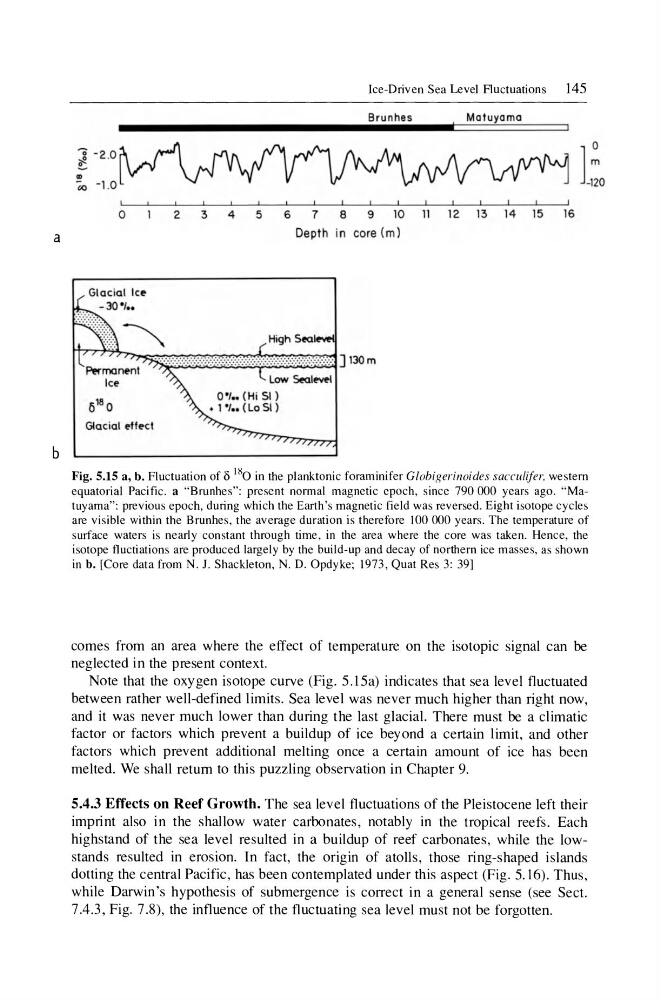
Fig. 5.15 a, b. Fluctuation of () 180 in the planktonic foraminifer Globigerinoides sacculifer. western
equatorial Pacific. a "Brunhes": present nonnal magnetic epoch, since 790000 years ago. "Matuyama": previous epoch, during which the Earth 's magnetic field was reversed. Eight isotope cycles
are visible within the Brunhes, the average duration is therefore 100000 years . The temperature of
surface waters is nearly constant through time, in the area where the core was taken. Hence, the
isotope fluctiations are produced largely by the build-up and decay of northern ice masses, as shown
in b. [Core data from N. J. Shackleton, N. D. Opdyke; 1973 , Quat Res 3: 39]
comes from an area where the effect of temperature on the isotopic signal can be
neglected in the present context.
Note that the oxygen isotope curve (Fig. 5.15a) indicates that sea level fluctuated
between rather well-defined limits. Sea level was never much higher than right now,
and it was never much lower than during the last glacial. There must be a climatic
factor or factors which prevent a buildup of ice beyond a certain limit, and other
factors which prevent additional melting once a certain amount of ice has been
melted. We shall retum to this puzzling observation in Chapter 9.
5.4.3 Effects on Reef Growth. The sea level fluctuations of the Pleistocene left their
imprint also in the shallow water carbonates, notably in the tropical reefs . Each
highstand of the sea level resulted in a buildup of reef carbonates, while the lowstands resulted in erosion. In fact, the origin of atolls, those ring-shaped islands
dotting the central Pacific, has been contemplated under this aspect (Fig. 5.16). Thus,
while Darwin's hypothesis of submergence is correct in a general sense (see Sect.
7.4.3, Fig. 7.8), the influence of the fluctuating sea level must not be forgotten.
b
Ice-Driven Sea Level Fluctuations
145
Br unhes
Matuyama
~ -1 .0
o
2 3 4
5
6
7
8
9
10
II
12 13 14 15
16
Depth in core (m)
6' 18 0
Glacial ~fI~ct
Fig. 5.15 a, b. Fluctuation of () 180 in the planktonic foraminifer Globigerinoides sacculifer. western
equatorial Pacific. a "Brunhes": present nonnal magnetic epoch, since 790000 years ago. "Matuyama": previous epoch, during which the Earth 's magnetic field was reversed. Eight isotope cycles
are visible within the Brunhes, the average duration is therefore 100000 years . The temperature of
surface waters is nearly constant through time, in the area where the core was taken. Hence, the
isotope fluctiations are produced largely by the build-up and decay of northern ice masses, as shown
in b. [Core data from N. J. Shackleton, N. D. Opdyke; 1973 , Quat Res 3: 39]
comes from an area where the effect of temperature on the isotopic signal can be
neglected in the present context.
Note that the oxygen isotope curve (Fig. 5.15a) indicates that sea level fluctuated
between rather well-defined limits. Sea level was never much higher than right now,
and it was never much lower than during the last glacial. There must be a climatic
factor or factors which prevent a buildup of ice beyond a certain limit, and other
factors which prevent additional melting once a certain amount of ice has been
melted. We shall retum to this puzzling observation in Chapter 9.
5.4.3 Effects on Reef Growth. The sea level fluctuations of the Pleistocene left their
imprint also in the shallow water carbonates, notably in the tropical reefs . Each
highstand of the sea level resulted in a buildup of reef carbonates, while the lowstands resulted in erosion. In fact, the origin of atolls, those ring-shaped islands
dotting the central Pacific, has been contemplated under this aspect (Fig. 5.16). Thus,
while Darwin's hypothesis of submergence is correct in a general sense (see Sect.
7.4.3, Fig. 7.8), the influence of the fluctuating sea level must not be forgotten.