

84
Peter Stille and Graham Shields
Er
I~$vs O
rose 4 . . . . .
,.Oiss. _J
WATER
I
LC
-A
t
Sorption Desorptior~
Sus;~..I SUSPENDED LOAD
I
t
Sec~imenlation Resuspens~on
I- SEDI MENT
a, ~*
~,._ _..,,.
!
Rad elegy Elution
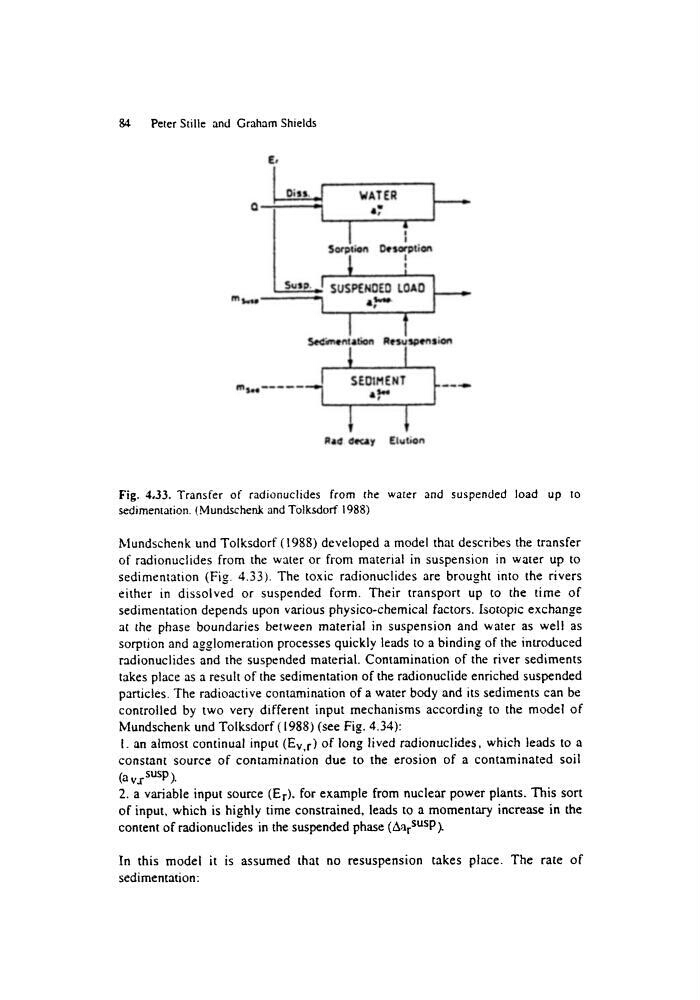
Fig. 4,33. Transfer of radionuclides from the water and suspended load up to
sedimentation. (Mundschenk and Tolksdorf 1988)
Mundschenk und Tolksdorf (1988) developed a model that describes the transfer
of radionuclides from the water or from material in suspension in water up to
sedimentation (Fig. 4.33). The toxic radionuclides are brought into the rivers
either in dissolved or suspended form. Their transport up to the time of
sedimentation depends upon various physico-chemical factors. Isotopic exchange
at the phase boundaries between material in suspension and water as well as
sorption and agglomeration processes quickly leads to a binding of the introduced
radionuclides and the suspended material. Contamination of the river sediments
takes place as a result of the sedimentation of the radionuclide enriched suspended
particles. The radioactive contamination of a water body and its sediments can be
controlled by two very different input mechanisms according to the model of
Mundschenk und Tolksdorf (1988) (see Fig. 4.34):
I. an almost continual input (Ev,r) of long lived radionuclides0 which leads to a
constant source of contamination due to the erosion of a contaminated soil
(a v.r susp ).
2. a variable input source (Er). for example from nuclear power plants. This sort
of input, which is highly time constrained, leads to a momentary increase in the
content of radionuclides in the suspended phase (AarSUSp).
In this model it is assumed that no resuspension takes place. The rate of
sedimentation:
Peter Stille and Graham Shields
Er
I~$vs O
rose 4 . . . . .
,.Oiss. _J
WATER
I
LC
-A
t
Sorption Desorptior~
Sus;~..I SUSPENDED LOAD
I
t
Sec~imenlation Resuspens~on
I- SEDI MENT
a, ~*
~,._ _..,,.
!
Rad elegy Elution
Fig. 4,33. Transfer of radionuclides from the water and suspended load up to
sedimentation. (Mundschenk and Tolksdorf 1988)
Mundschenk und Tolksdorf (1988) developed a model that describes the transfer
of radionuclides from the water or from material in suspension in water up to
sedimentation (Fig. 4.33). The toxic radionuclides are brought into the rivers
either in dissolved or suspended form. Their transport up to the time of
sedimentation depends upon various physico-chemical factors. Isotopic exchange
at the phase boundaries between material in suspension and water as well as
sorption and agglomeration processes quickly leads to a binding of the introduced
radionuclides and the suspended material. Contamination of the river sediments
takes place as a result of the sedimentation of the radionuclide enriched suspended
particles. The radioactive contamination of a water body and its sediments can be
controlled by two very different input mechanisms according to the model of
Mundschenk und Tolksdorf (1988) (see Fig. 4.34):
I. an almost continual input (Ev,r) of long lived radionuclides0 which leads to a
constant source of contamination due to the erosion of a contaminated soil
(a v.r susp ).
2. a variable input source (Er). for example from nuclear power plants. This sort
of input, which is highly time constrained, leads to a momentary increase in the
content of radionuclides in the suspended phase (AarSUSp).
In this model it is assumed that no resuspension takes place. The rate of
sedimentation: