

4 Isotope Geochemistry in the Environment
83
contamination of the groundwater by these elements must take place mainly by
way of dissolved phases.
4.5 Radionuclides as Tracers in Sedimentology
Atomic bomb trials carried out between 1945 and 1972 in the atmosphere had the
consequences that by 1955 significant quantities of radionuclides were already
reaching the floors of lakes and rivers. The largest activity peak is usually
associated with the period shortly before the first wide reaching test ban. During
this time, several countries made 'good" use of their last opportunity for
unrestricted testing. The long lived Cesium isotope (137Cs) can still be detected in
river sediments today. As we saw in the preceeding section, the reactor accident of
Chernobyl was likewise characterized by an increase in the activity of such
radionuclides, thus creating a second time marker in the sediments. This is
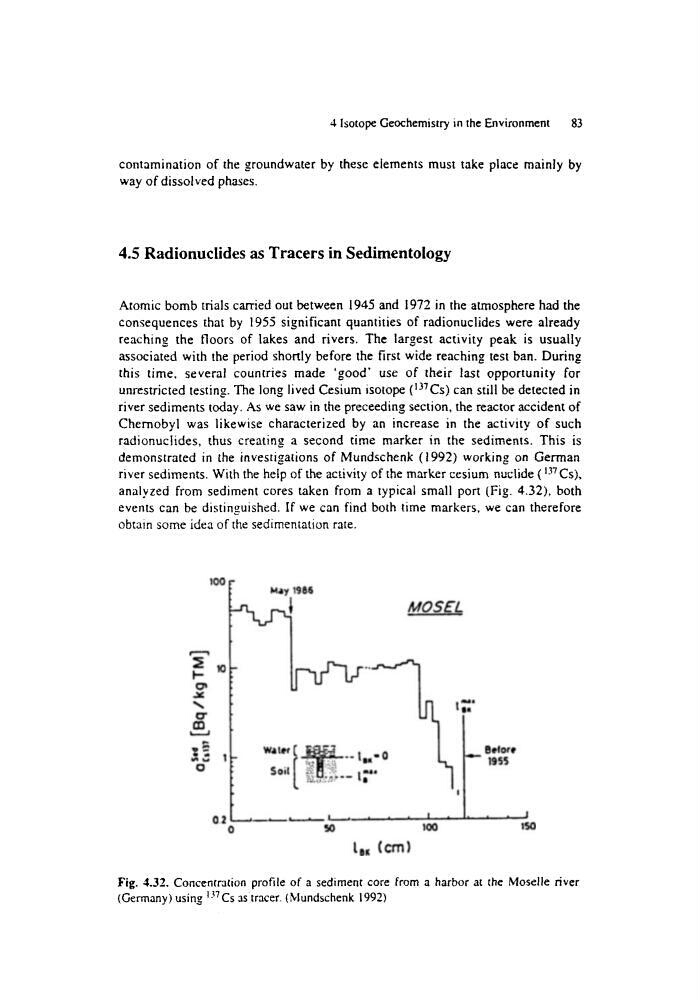
demonstrated in the investigations of Mundschenk (1992) working on German
river sediments. With the help of the activity of the marker cesium nuclide ( 137 Cs),
analyzed from sediment cores taken from a typical small port (Fig. 4.32), both
events can be distinguished. If we can find both time markers, we can therefore
obtain some idea of the sedimentation rate.
100
r
I-- 1o
cn
c3"
m
o
May 1986
M O S E L
OZ ~ L - - - . . _ - -
t
,
9 ,
I
,
!
0
50
100
150
LBK (cm)
Before
1955
]Fig. 4.32. Concemration profile o f a sediment core from a harbor at the M o s e l l e river
(Germany) using 137 Cs as tracer. (Mundschenk 1992)
83
contamination of the groundwater by these elements must take place mainly by
way of dissolved phases.
4.5 Radionuclides as Tracers in Sedimentology
Atomic bomb trials carried out between 1945 and 1972 in the atmosphere had the
consequences that by 1955 significant quantities of radionuclides were already
reaching the floors of lakes and rivers. The largest activity peak is usually
associated with the period shortly before the first wide reaching test ban. During
this time, several countries made 'good" use of their last opportunity for
unrestricted testing. The long lived Cesium isotope (137Cs) can still be detected in
river sediments today. As we saw in the preceeding section, the reactor accident of
Chernobyl was likewise characterized by an increase in the activity of such
radionuclides, thus creating a second time marker in the sediments. This is
demonstrated in the investigations of Mundschenk (1992) working on German
river sediments. With the help of the activity of the marker cesium nuclide ( 137 Cs),
analyzed from sediment cores taken from a typical small port (Fig. 4.32), both
events can be distinguished. If we can find both time markers, we can therefore
obtain some idea of the sedimentation rate.
100
r
I-- 1o
cn
c3"
m
o
May 1986
M O S E L
OZ ~ L - - - . . _ - -
t
,
9 ,
I
,
!
0
50
100
150
LBK (cm)
Before
1955
]Fig. 4.32. Concemration profile o f a sediment core from a harbor at the M o s e l l e river
(Germany) using 137 Cs as tracer. (Mundschenk 1992)