

6-1 Peter Stille and Graham Shields
91
9O
r's 118
E
:o
~" 86
.c)
E
0 84,
82
80
i i/%/IVI
/
/
a
L
a
i
*
,
,
i
1
i
i
i
i
i
,
J
,
i
,
9
,
L
*
9
124
126
128
130
G2
13t,
136
138
It, O
142
1#.4
146
NeuTron n u m b e r
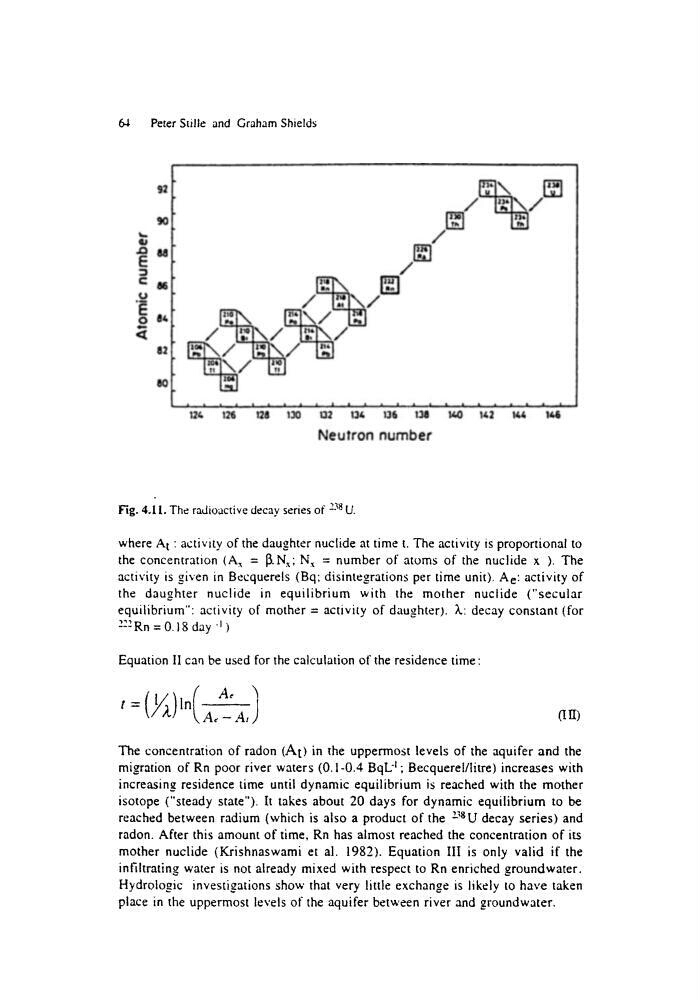
Fig. 4.11. The radioactive decay series of 238 U.
where At " activity of the daughter nuclide at time t. The activity is proportional to
the concentration (A s = ~.Nx; Nx = number of atoms of the nuclide x ). The
activity is given in Becquerels (Bq; disintegrations per time unit). Ae: activity of
the daughter nuclide in equilibrium with the mother nuclide ("secular
equilibrium": activity of mother = activity of daughter). ~.: decay constant (for
2-'-'Rn =0.18 day J)
Equation II can be used for the calculation of the residence time :
,:('A)'n( Z_,
\A< - A , ]
(In')
The concentration of radon (At) in the uppermost levels of the aquifer and the
migration of Rn poor river waters (0.1-0.4 BqL'Z ; Becquerel/litre) increases with
increasing residence time until dynamic equilibrium is reached with the mother
isotope ("steady state"). It takes about 20 days for dynamic equilibrium to be
reached between radium (which is also a product of the z~sU decay series) and
radon. After this amount of time, Rn has almost reached the concentration of its
mother nuclide (Krishnaswami et al. 1982). Equation III is only valid if the
infiltrating water is not already mixed with respect to Rn enriched groundwater.
Hydrologic investigations show that very little exchange is likely to have taken
place in the uppermost levels of the aquifer between river and groundwater.
91
9O
r's 118
E
:o
~" 86
.c)
E
0 84,
82
80
i i/%/IVI
/
/
a
L
a
i
*
,
,
i
1
i
i
i
i
i
,
J
,
i
,
9
,
L
*
9
124
126
128
130
G2
13t,
136
138
It, O
142
1#.4
146
NeuTron n u m b e r
Fig. 4.11. The radioactive decay series of 238 U.
where At " activity of the daughter nuclide at time t. The activity is proportional to
the concentration (A s = ~.Nx; Nx = number of atoms of the nuclide x ). The
activity is given in Becquerels (Bq; disintegrations per time unit). Ae: activity of
the daughter nuclide in equilibrium with the mother nuclide ("secular
equilibrium": activity of mother = activity of daughter). ~.: decay constant (for
2-'-'Rn =0.18 day J)
Equation II can be used for the calculation of the residence time :
,:('A)'n( Z_,
\A< - A , ]
(In')
The concentration of radon (At) in the uppermost levels of the aquifer and the
migration of Rn poor river waters (0.1-0.4 BqL'Z ; Becquerel/litre) increases with
increasing residence time until dynamic equilibrium is reached with the mother
isotope ("steady state"). It takes about 20 days for dynamic equilibrium to be
reached between radium (which is also a product of the z~sU decay series) and
radon. After this amount of time, Rn has almost reached the concentration of its
mother nuclide (Krishnaswami et al. 1982). Equation III is only valid if the
infiltrating water is not already mixed with respect to Rn enriched groundwater.
Hydrologic investigations show that very little exchange is likely to have taken
place in the uppermost levels of the aquifer between river and groundwater.