

58
Peter Stille and Graham Shields
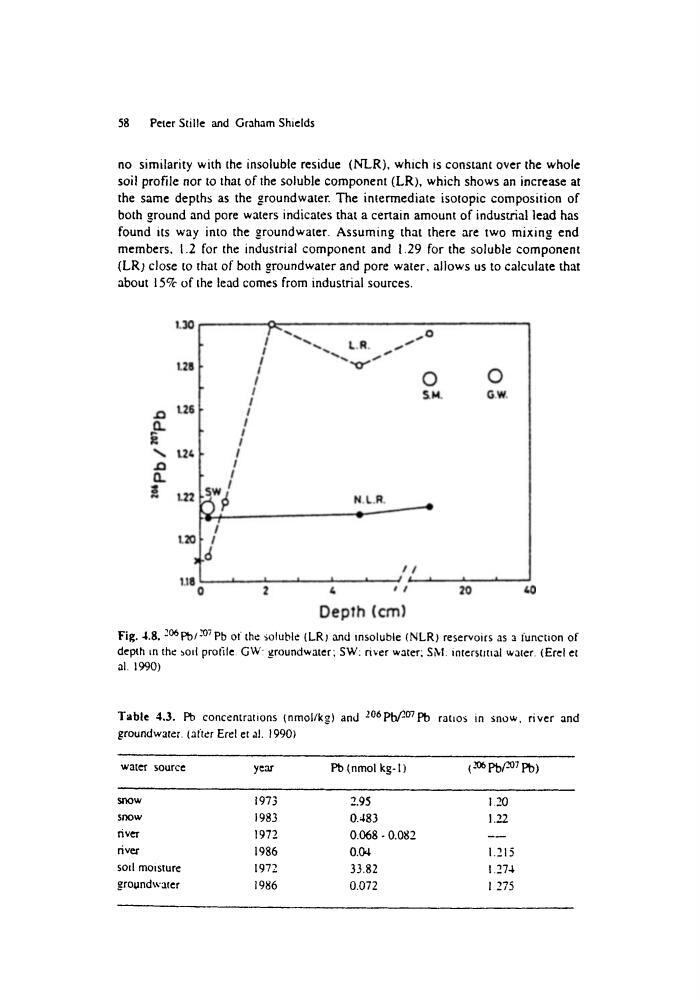
no similarity with the insoluble residue (NLR), which is constant over the whole
soil profile nor to that of the soluble component (LR), which shows an increase at
the same depths as the groundwater. The intermediate isotopic composition of
both ground and pore waters indicates that a certain amount of industrial lead has
found its way into the groundwater. Assuming that there are two mixing end
members, 1.2 for the industrial component and 1.29 for the soluble component
(LR) close to that of both groundwater and pore water, allows us to calculate that
about 15% of the lead comes from industrial sources.
1.30
!.28
c-, 1.26
%
1.24
J~
I:)_
1.22
I
~
I ~ O
I
~ .
L R
!
/
S.M.
GW
I
/
/
I
I
/
/
/
1.20- /
.d
1.1~
0
NL.R.
/ /
I
I
I
I
I
= ] I
I
I
.~
2
4
t I
20
t.O
Depth (cm)
Fig. 4.8. 2~176
Pb of the soluble (LR) and insoluble {NLR) reservoirs as a function of
depth m the ~otl profile GW: groundwater; SW: river water; SM: interstmal water. (Erel el
al. 1990)
Table 4.3. Pb concentrations (.nmol/kg) and 2~176
rauos in snow, river and
groundwater. (after Erel et al. 1990)
water source
year
Pb (nmol kg- I )
(.-' O6 pb/2O7 Pb)
snow
1973
2.95
1.20
snow
1983
0.483
1.22
river
1972
0.068 - 0.082
- -
river
1986
0.04
I. 215
sotl moisture
1972
33.82
1.274
groondwater
1986
0.072
1 275
Peter Stille and Graham Shields
no similarity with the insoluble residue (NLR), which is constant over the whole
soil profile nor to that of the soluble component (LR), which shows an increase at
the same depths as the groundwater. The intermediate isotopic composition of
both ground and pore waters indicates that a certain amount of industrial lead has
found its way into the groundwater. Assuming that there are two mixing end
members, 1.2 for the industrial component and 1.29 for the soluble component
(LR) close to that of both groundwater and pore water, allows us to calculate that
about 15% of the lead comes from industrial sources.
1.30
!.28
c-, 1.26
%
1.24
J~
I:)_
1.22
I
~
I ~ O
I
~ .
L R
!
/
S.M.
GW
I
/
/
I
I
/
/
/
1.20- /
.d
1.1~
0
NL.R.
/ /
I
I
I
I
I
= ] I
I
I
.~
2
4
t I
20
t.O
Depth (cm)
Fig. 4.8. 2~176
Pb of the soluble (LR) and insoluble {NLR) reservoirs as a function of
depth m the ~otl profile GW: groundwater; SW: river water; SM: interstmal water. (Erel el
al. 1990)
Table 4.3. Pb concentrations (.nmol/kg) and 2~176
rauos in snow, river and
groundwater. (after Erel et al. 1990)
water source
year
Pb (nmol kg- I )
(.-' O6 pb/2O7 Pb)
snow
1973
2.95
1.20
snow
1983
0.483
1.22
river
1972
0.068 - 0.082
- -
river
1986
0.04
I. 215
sotl moisture
1972
33.82
1.274
groondwater
1986
0.072
1 275