

4 Isotope Geochemistry in the Environment
57
Increasing depth sees not only a decrease in organic carbon but also of lead. At 2
cm, the Pb concentrations reach a minimum, then Pb content begins to increase
along with organic carbon. This variation can be viewed as the result of natural
weathering processes without any recognizable contribution from industrial lead.
This natural, geogenic trend relates to the strong binding behaviour associated
with lead and organic carbon, which only ceases where the amount of organic
carbon is reduced due to oxidation. Oxidation of organic carbon releases acids,
which attack accessory U-rich minerals and allow for the mobilization of
radiogenic lead in the soil.
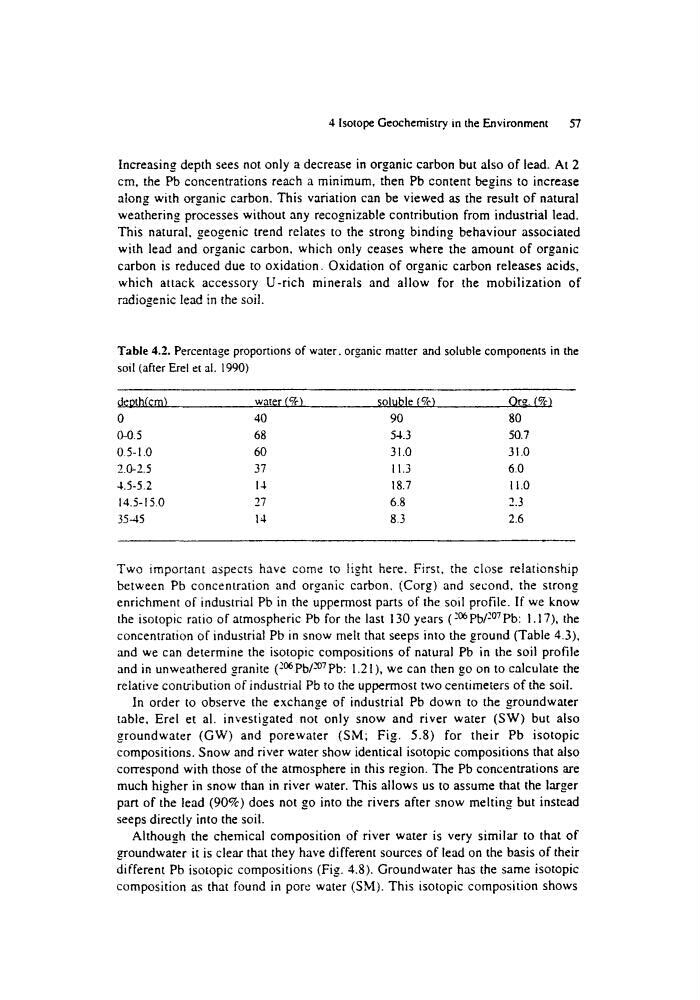
Table 4.2. Percentage proportions of water, organic matter and soluble components in the
soil (,after Erel et al. 1990)
Or
water (%)
~oluble (%)
Ore. (%)
0
40
90
80
0-0.5
68
54.3
50.7
0.5-1.0
60
31.0
31.0
2.0-2.5
37
11.3
6.0
4.5-5.2
14
18.7
I 1.0
14.5-15.0
27
6.8
2.3
35-45
14
8.3
2.6
Two important aspects have come to light here. First, the close relationship
between Pb concentration and organic carbon, (Corg) and second, the strong
enrichment of industrial Pb in the uppermost parts of the soil profile. If we know
the isotopic ratio of atmospheric Pb for the last 130 years ('~176
1.17), the
concentration of industrial Pb in snow melt that seeps into the ground (Table 4.3),
and we can determine the isotopic compositions of natural Pb in the soil profile
and in unweathered granite (2~176
1.21), we can then go on to calculate the
relative contribution of industrial Pb to the uppermost two centimeters of the soil.
In order to observe the exchange of industrial Pb down to the groundwater
table, Erel et al. investigated not only snow and river water (SW) but also
groundwater (GW) and porewater (SM; Fig. 5.8) for their Pb isotopic
compositions. Snow and river water show identical isotopic compositions that also
correspond with those of the atmosphere in this region. The Pb concentrations are
much higher in snow than in river water. This allows us to assume that the larger
part of the lead (90%) does not go into the rivers after snow melting but instead
seeps directly into the soil.
Although the chemical composition of river water is very similar to that of
m'oundwater it is clear that they have different sources of lead on the basis of their
different Pb isotopic compositions (Fig. 4.8). Groundwater has the same isotopic
composition as that found in pore water (SM). This isotopic composition shows
57
Increasing depth sees not only a decrease in organic carbon but also of lead. At 2
cm, the Pb concentrations reach a minimum, then Pb content begins to increase
along with organic carbon. This variation can be viewed as the result of natural
weathering processes without any recognizable contribution from industrial lead.
This natural, geogenic trend relates to the strong binding behaviour associated
with lead and organic carbon, which only ceases where the amount of organic
carbon is reduced due to oxidation. Oxidation of organic carbon releases acids,
which attack accessory U-rich minerals and allow for the mobilization of
radiogenic lead in the soil.
Table 4.2. Percentage proportions of water, organic matter and soluble components in the
soil (,after Erel et al. 1990)
Or
water (%)
~oluble (%)
Ore. (%)
0
40
90
80
0-0.5
68
54.3
50.7
0.5-1.0
60
31.0
31.0
2.0-2.5
37
11.3
6.0
4.5-5.2
14
18.7
I 1.0
14.5-15.0
27
6.8
2.3
35-45
14
8.3
2.6
Two important aspects have come to light here. First, the close relationship
between Pb concentration and organic carbon, (Corg) and second, the strong
enrichment of industrial Pb in the uppermost parts of the soil profile. If we know
the isotopic ratio of atmospheric Pb for the last 130 years ('~176
1.17), the
concentration of industrial Pb in snow melt that seeps into the ground (Table 4.3),
and we can determine the isotopic compositions of natural Pb in the soil profile
and in unweathered granite (2~176
1.21), we can then go on to calculate the
relative contribution of industrial Pb to the uppermost two centimeters of the soil.
In order to observe the exchange of industrial Pb down to the groundwater
table, Erel et al. investigated not only snow and river water (SW) but also
groundwater (GW) and porewater (SM; Fig. 5.8) for their Pb isotopic
compositions. Snow and river water show identical isotopic compositions that also
correspond with those of the atmosphere in this region. The Pb concentrations are
much higher in snow than in river water. This allows us to assume that the larger
part of the lead (90%) does not go into the rivers after snow melting but instead
seeps directly into the soil.
Although the chemical composition of river water is very similar to that of
m'oundwater it is clear that they have different sources of lead on the basis of their
different Pb isotopic compositions (Fig. 4.8). Groundwater has the same isotopic
composition as that found in pore water (SM). This isotopic composition shows