

4 Isotope Geochemistry in the Environment
55
If one assumes a ratio of 1.1 for anthropogenic Pb and a ratio of 1.2 for natural Pb,
it is possible to estimate, within a fair margin of error, the relative amount of
anthopogenic Pb which is transported into the rivers. This would be 45-80% for
the Seine, 40-70% for the Loire, 25-43% for the Garonne and 15-28% for the
Rhone. Thus, it can be shown that the Seine is the most contaminated river of the
four. Annually, the Seine transports 75-140 tons of anthropogenic Pb as
suspended load into the Atlantic. The Rhone transports 70-125 tons, the Garonne
40-75 tons and the Loire 35-60. These enormous amounts of Pb, which are carried
each year by these rivers into the oceans are directly related to the main industrial
agglomerations of France. For example, 30% of the French population live close
to the Seine river basin, along with 40% of the whole commercial activity.
The transport of industrial Pb in a soil down to the groundwater table is
discussed in Erel et al. (1990). This study looks at the application of the Pb
isotopic method to the investigation of transport mechanisms and the
reconstruction of the migration routes of heavy metals from the atmosphere into
groundwater. The area of investigation is located in a secluded valley in the
Yosemite national park (USA). Snow and river water samples were collected as
well as samples from a 30 cm deep soil profile, which reached down to the
groundwater table.
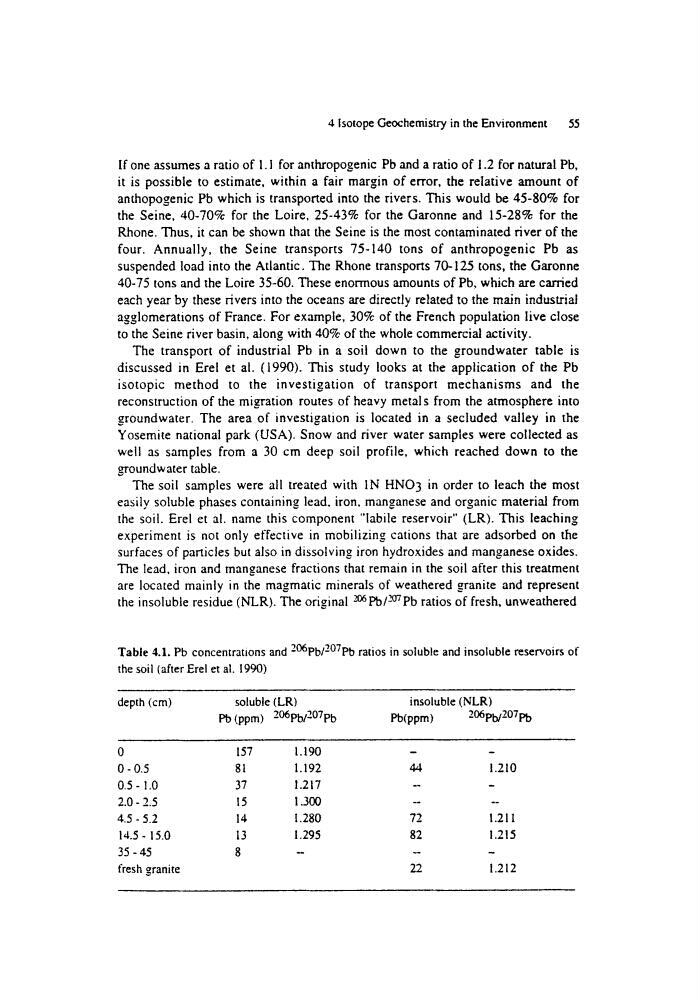
The soil samples were all treated with IN HNO3 in order to leach the most
easily soluble phases containing lead, iron. manganese and organic material from
the soil. Erel et al. name this component "labile reservoir" (LR). This leaching
experiment is not only effective in mobilizing cations that are adsorbed on the
surfaces of particles but also in dissolving iron hydroxides and manganese oxides.
The lead, iron and manganese fractions that remain in the soil after this treatment
are located mainly in the magmatic minerals of weathered granite and represent
the insoluble residue (NLR). The original z~176
ratios of fresh, unweathered
Table 4.1. Pb concentrations and 206pb/207pb ratios in soluble and insoluble reservoirs of
the soil (after Erel et al. 1990)
depth (cm)
soluble (LR)
insoluble (NLR)
Pb (ppm) 206pb/207pb
Pb(ppm)
206pb/207pb
0
157
h 190
-
-
0 - 0.5
81
1.192
44
!.210
0.5- 1.0
37
1.217
-
-
2.0 - 2.5
15
1.300
. . . .
4.5 - 5.2
14
1.280
72
1.211
14.5- 15.0
13
1.295
82
1.215
35 - 45
8
.
.
.
.
fresh granite
22
1.212
55
If one assumes a ratio of 1.1 for anthropogenic Pb and a ratio of 1.2 for natural Pb,
it is possible to estimate, within a fair margin of error, the relative amount of
anthopogenic Pb which is transported into the rivers. This would be 45-80% for
the Seine, 40-70% for the Loire, 25-43% for the Garonne and 15-28% for the
Rhone. Thus, it can be shown that the Seine is the most contaminated river of the
four. Annually, the Seine transports 75-140 tons of anthropogenic Pb as
suspended load into the Atlantic. The Rhone transports 70-125 tons, the Garonne
40-75 tons and the Loire 35-60. These enormous amounts of Pb, which are carried
each year by these rivers into the oceans are directly related to the main industrial
agglomerations of France. For example, 30% of the French population live close
to the Seine river basin, along with 40% of the whole commercial activity.
The transport of industrial Pb in a soil down to the groundwater table is
discussed in Erel et al. (1990). This study looks at the application of the Pb
isotopic method to the investigation of transport mechanisms and the
reconstruction of the migration routes of heavy metals from the atmosphere into
groundwater. The area of investigation is located in a secluded valley in the
Yosemite national park (USA). Snow and river water samples were collected as
well as samples from a 30 cm deep soil profile, which reached down to the
groundwater table.
The soil samples were all treated with IN HNO3 in order to leach the most
easily soluble phases containing lead, iron. manganese and organic material from
the soil. Erel et al. name this component "labile reservoir" (LR). This leaching
experiment is not only effective in mobilizing cations that are adsorbed on the
surfaces of particles but also in dissolving iron hydroxides and manganese oxides.
The lead, iron and manganese fractions that remain in the soil after this treatment
are located mainly in the magmatic minerals of weathered granite and represent
the insoluble residue (NLR). The original z~176
ratios of fresh, unweathered
Table 4.1. Pb concentrations and 206pb/207pb ratios in soluble and insoluble reservoirs of
the soil (after Erel et al. 1990)
depth (cm)
soluble (LR)
insoluble (NLR)
Pb (ppm) 206pb/207pb
Pb(ppm)
206pb/207pb
0
157
h 190
-
-
0 - 0.5
81
1.192
44
!.210
0.5- 1.0
37
1.217
-
-
2.0 - 2.5
15
1.300
. . . .
4.5 - 5.2
14
1.280
72
1.211
14.5- 15.0
13
1.295
82
1.215
35 - 45
8
.
.
.
.
fresh granite
22
1.212