

50, Peter Stille and Graham Shields
(Seine, Loire, Garonne-Gironde, Rhone) and also to ascertain the amount of
contamination due to industrial lead.
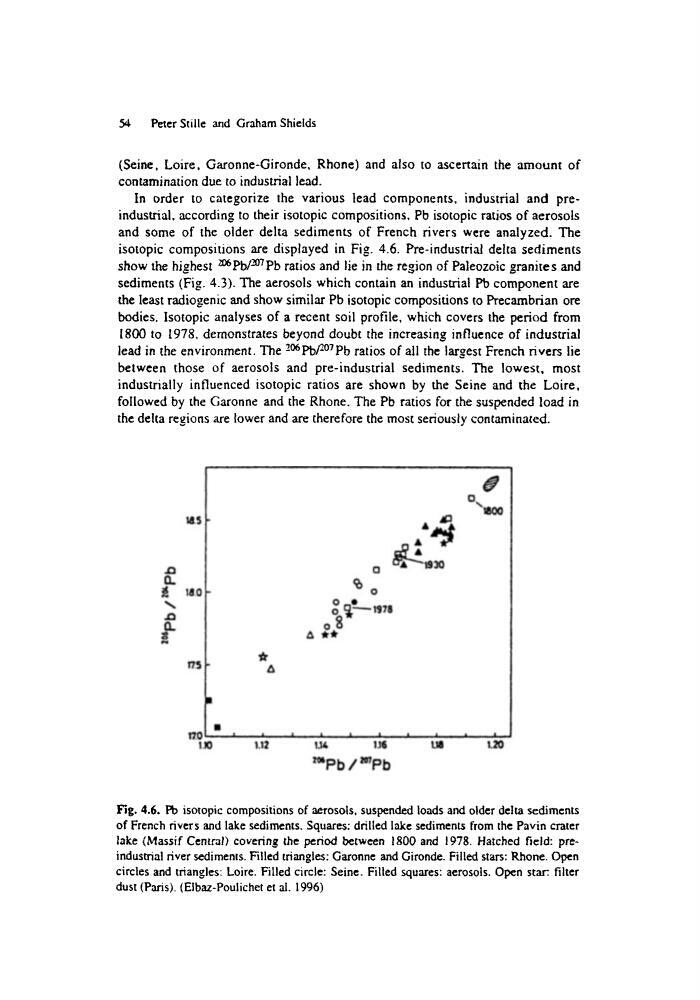
In order to categorize the various lead components, industrial and preindustrial, according to their isotopic compositions, Pb isotopic ratios of aerosols
and some of the older delta sediments of French rivers were analyzed. The
isotopic compositions are displayed in Fig. 4.6. Pre-industrial delta sediments
show the highest z~176
ratios and lie in the region of Paleozoic granites and
sediments (Fig. 4.3). The aerosols which contain an industrial Pb component are
the least radiogenic and show similar Pb isotopic compositions to Precambrian ore
bodies. Isotopic analyses of a recent soil profile, which covers the period from
1800 to 1978, demonstrates beyond doubt the increasing influence of industrial
lead in the environment. The ~-~176
ratios of all the largest French rivers lie
between those of aerosols and pre-industrial sediments. The lowest, most
industrially influenced isotopic ratios are shown by the Seine and the Loire,
followed by the Garonne and the Rhone. The Pb ratios for the suspended load in
the delta regions are lower and are therefore the most seriously contaminated.
0.
18.0
I"/5
~r
A
O
O O
A ,X, 'dr
@
D
"tB00
I
i
~
i
9
I
I
!
t
~
A
1701. 10
I, 2
1.14
1.16
t.18
1,20
~'Pb / ~Pb
Fig. 4.6. Po isotopic compositions of aerosols, suspended loads and older delta sediments
of French rivers and lake sediments. Squares: drilled lake sediments from the Pavin crater
lake (Massif Central) covering the period between 1800 and 1978. Hatched field: preindustrial river sediments. Filled triangles: Garonne and Gironde. Filled stars: Rhone. Open
circles and triangles: Loire. Filled circle: Seine. Filled squares: aerosols. Open star:, filter
dust (Paris). (Elbaz-Poulichet et al. 1996)
(Seine, Loire, Garonne-Gironde, Rhone) and also to ascertain the amount of
contamination due to industrial lead.
In order to categorize the various lead components, industrial and preindustrial, according to their isotopic compositions, Pb isotopic ratios of aerosols
and some of the older delta sediments of French rivers were analyzed. The
isotopic compositions are displayed in Fig. 4.6. Pre-industrial delta sediments
show the highest z~176
ratios and lie in the region of Paleozoic granites and
sediments (Fig. 4.3). The aerosols which contain an industrial Pb component are
the least radiogenic and show similar Pb isotopic compositions to Precambrian ore
bodies. Isotopic analyses of a recent soil profile, which covers the period from
1800 to 1978, demonstrates beyond doubt the increasing influence of industrial
lead in the environment. The ~-~176
ratios of all the largest French rivers lie
between those of aerosols and pre-industrial sediments. The lowest, most
industrially influenced isotopic ratios are shown by the Seine and the Loire,
followed by the Garonne and the Rhone. The Pb ratios for the suspended load in
the delta regions are lower and are therefore the most seriously contaminated.
0.
18.0
I"/5
~r
A
O
O O
A ,X, 'dr
@
D
"tB00
I
i
~
i
9
I
I
!
t
~
A
1701. 10
I, 2
1.14
1.16
t.18
1,20
~'Pb / ~Pb
Fig. 4.6. Po isotopic compositions of aerosols, suspended loads and older delta sediments
of French rivers and lake sediments. Squares: drilled lake sediments from the Pavin crater
lake (Massif Central) covering the period between 1800 and 1978. Hatched field: preindustrial river sediments. Filled triangles: Garonne and Gironde. Filled stars: Rhone. Open
circles and triangles: Loire. Filled circle: Seine. Filled squares: aerosols. Open star:, filter
dust (Paris). (Elbaz-Poulichet et al. 1996)