

4 Isotope Geochemistry in the Environment
51
Paleozoic sulfides from Australia display even higher ratios of 1.14 to 1.16. All
these Precambrian lead sulphide ores, whose Pb isotopic compositions have been
more or less frozen by the removal of uranium (U/Pb=0) have been used in the
manufacture of petrol. Their characteristic Pb isotopic signatures can now be
identified worldwide.
At the end of the sixties some people started to think about the application of
the Pb isotopic system to the solution of environment related problems. At that
time it was not at all clear how much the Pb isotopic composition varied in the
various environmental systems such as soil, water, air, plants as welt as in petrol
and in other industrial products and to what extent these differences could be
distinguished using a mass spectrometer. The work of Ault et al. (1970) was
pioneering in this respect. They were among the first to investigate Pb isotopic
compositions in the environment. Although the mass spectrometer precision at
that time can scarcely be compared with precision today, it is worthwhile taking a
closer look at some of the results of their investigations.
Ault et al. were able to demonstrate that the 2~176
ratios of particles in the
air over various cities in America could vary significantly both within the city and
between cities. This made it possible to identify point sources of lead for the first
time. An interesting case is that of the important traffic route between
Philadelphia and New York. It was here that the first attempt was made to
determine the influence of vehicle derived lead particles on soils and vegetation.
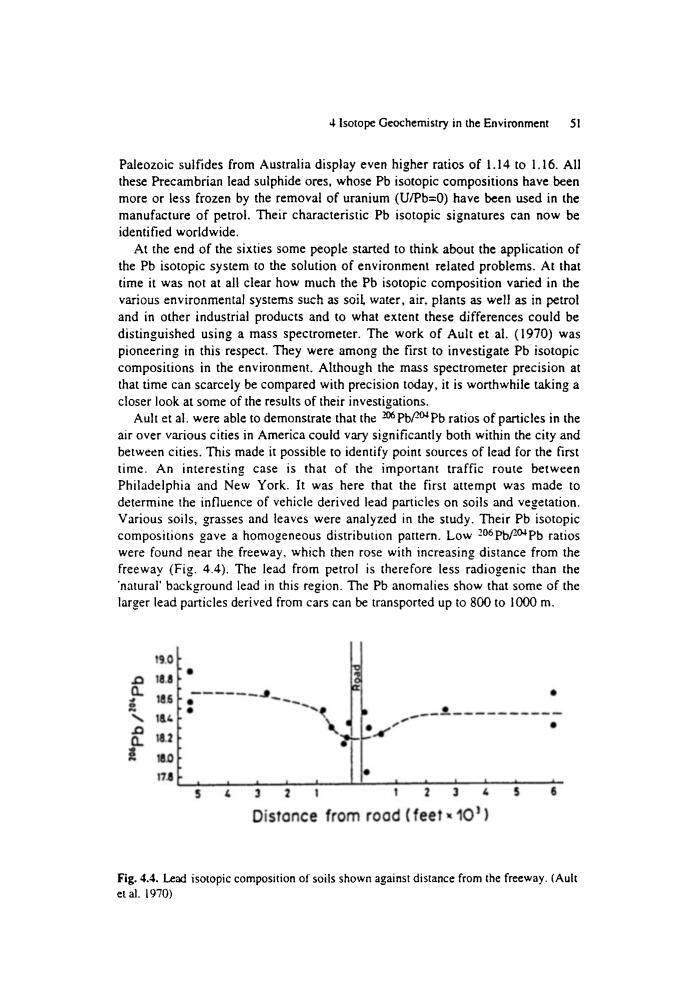
Various soils, grasses and leaves were analyzed in the study. Their Pb isotopic
compositions gave a homogeneous distribution pattern. Low 2~176
ratios
were found near the freeway, which then rose with increasing distance from the
freeway (Fig. 4.4). The lead from petrol is therefore less radiogenic than the
'natural' background lead in this region. The Pb anomalies show that some of the
larger lead particles derived from cars can be transported up to 800 to 1000 m.
19.0
r
18.8
n
18.5
18,4
.,Q
i"1 18.2
~
18.o
17.8
\ ,
"tl
9
f
. 4 r "
5
4
3
2
t
I
3
I.
Distance from road (feet ~ 10 3 )
Fig. 4.4. Lead isotopic composition of soils shown against distance from the freeway. (Auk
et al. 1970)
51
Paleozoic sulfides from Australia display even higher ratios of 1.14 to 1.16. All
these Precambrian lead sulphide ores, whose Pb isotopic compositions have been
more or less frozen by the removal of uranium (U/Pb=0) have been used in the
manufacture of petrol. Their characteristic Pb isotopic signatures can now be
identified worldwide.
At the end of the sixties some people started to think about the application of
the Pb isotopic system to the solution of environment related problems. At that
time it was not at all clear how much the Pb isotopic composition varied in the
various environmental systems such as soil, water, air, plants as welt as in petrol
and in other industrial products and to what extent these differences could be
distinguished using a mass spectrometer. The work of Ault et al. (1970) was
pioneering in this respect. They were among the first to investigate Pb isotopic
compositions in the environment. Although the mass spectrometer precision at
that time can scarcely be compared with precision today, it is worthwhile taking a
closer look at some of the results of their investigations.
Ault et al. were able to demonstrate that the 2~176
ratios of particles in the
air over various cities in America could vary significantly both within the city and
between cities. This made it possible to identify point sources of lead for the first
time. An interesting case is that of the important traffic route between
Philadelphia and New York. It was here that the first attempt was made to
determine the influence of vehicle derived lead particles on soils and vegetation.
Various soils, grasses and leaves were analyzed in the study. Their Pb isotopic
compositions gave a homogeneous distribution pattern. Low 2~176
ratios
were found near the freeway, which then rose with increasing distance from the
freeway (Fig. 4.4). The lead from petrol is therefore less radiogenic than the
'natural' background lead in this region. The Pb anomalies show that some of the
larger lead particles derived from cars can be transported up to 800 to 1000 m.
19.0
r
18.8
n
18.5
18,4
.,Q
i"1 18.2
~
18.o
17.8
\ ,
"tl
9
f
. 4 r "
5
4
3
2
t
I
3
I.
Distance from road (feet ~ 10 3 )
Fig. 4.4. Lead isotopic composition of soils shown against distance from the freeway. (Auk
et al. 1970)