

50
Peter Stifle and Graham Shields
not only to differentiate between industrial and natural lead but can help trace
contamination also. For this purpose, ~-~
2~176
and ~Pb/-n~Pb
ratios can be used.
Industrial lead comes from ore bodies, whose Pb isotopic composition differs
markedly from that of average crustal rock. During the formation of lead ore
bodies, uranium is separated from lead due to its starkly contrasting geochemical
behavior. This has the consequence that -~~ and -nYTpb, which are the decay
products of 238 U and -~' ~~ U respectively, are no longer produced after the formation
of the lead ore body (U/Pb=0). Most ore bodies that exist today have therefore
lower 206 philO7 Pb, -~ Pb/--~ Pb and 2o7 pb/z~ Pb isotopic ratios than average crustal
rocks in which lead can still be found together with uranium and where both 2~
and ~-~ are still being produced.
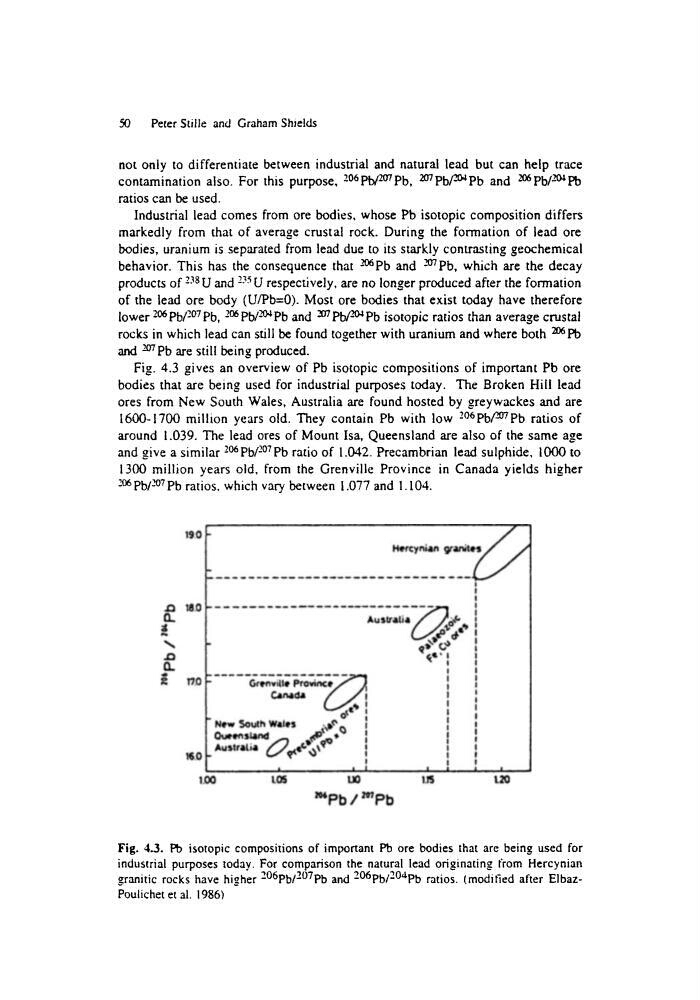
Fig. 4.3 gives an overview of Pb isotopic compositions of important Pb ore
bodies that are being used for industrial purposes today. The Broken Hill lead
ores from New South Wales, Australia are found hosted by greywackes and are
1600-1700 million years old. They contain Pb with low -~~176
ratios of
around 1.039. The lead ores of Mount Isa, Queensland are also of the same age
and give a similar 2~176
ratio of 1.042. Precambrian lead sulphide, I000 to
1300 million years old. from the Grenville Province in Canada yields higher
-'~176
ratios, which vary between 1.077 and I. I04.
190
43 18.0
n
~
17.0
Hercynian gr:i:~/
!
~ c +
~r
Grenville Pro~nce f~j
New South Wares
~.~_
Queensland __
~ ~
AustraUa ~...)?~r q
,.
I
I
1.10
1.15
Z~+pb / Z~
16,0
i
I
1.o0
I.O5
t20
Fig. 4.3. Pb isotopic compositions of important Pb ore bodies that are being used for
industrial purposes today. For comparison the natural lead originating from Hercynian
granitic rocks have higher 206pb1207pb and 206pb1204pb ratios. (modified after ElbazPoulichet et al. 1986)
Peter Stifle and Graham Shields
not only to differentiate between industrial and natural lead but can help trace
contamination also. For this purpose, ~-~
2~176
and ~Pb/-n~Pb
ratios can be used.
Industrial lead comes from ore bodies, whose Pb isotopic composition differs
markedly from that of average crustal rock. During the formation of lead ore
bodies, uranium is separated from lead due to its starkly contrasting geochemical
behavior. This has the consequence that -~~ and -nYTpb, which are the decay
products of 238 U and -~' ~~ U respectively, are no longer produced after the formation
of the lead ore body (U/Pb=0). Most ore bodies that exist today have therefore
lower 206 philO7 Pb, -~ Pb/--~ Pb and 2o7 pb/z~ Pb isotopic ratios than average crustal
rocks in which lead can still be found together with uranium and where both 2~
and ~-~ are still being produced.
Fig. 4.3 gives an overview of Pb isotopic compositions of important Pb ore
bodies that are being used for industrial purposes today. The Broken Hill lead
ores from New South Wales, Australia are found hosted by greywackes and are
1600-1700 million years old. They contain Pb with low -~~176
ratios of
around 1.039. The lead ores of Mount Isa, Queensland are also of the same age
and give a similar 2~176
ratio of 1.042. Precambrian lead sulphide, I000 to
1300 million years old. from the Grenville Province in Canada yields higher
-'~176
ratios, which vary between 1.077 and I. I04.
190
43 18.0
n
~
17.0
Hercynian gr:i:~/
!
~ c +
~r
Grenville Pro~nce f~j
New South Wares
~.~_
Queensland __
~ ~
AustraUa ~...)?~r q
,.
I
I
1.10
1.15
Z~+pb / Z~
16,0
i
I
1.o0
I.O5
t20
Fig. 4.3. Pb isotopic compositions of important Pb ore bodies that are being used for
industrial purposes today. For comparison the natural lead originating from Hercynian
granitic rocks have higher 206pb1207pb and 206pb1204pb ratios. (modified after ElbazPoulichet et al. 1986)