

48
Peter Stille and Graham Shields
Depending on the size and nature of the populous, waste water may make up
between 2 and 20% of the flowing water. More than half the precipitation that
falls on land, i.e. rain or melt water, filters away through the underlying soil
through sand, gravel and rock before making it back to the surface by way of
springs.
Trickling of contaminants through rocks and soil may lead to an increase in the
concentration of certain substances, which are the products of chemical
weathering. These sorts of weathering products make their appearance if soil or
rock forming minerals react with acid rain or with naturally occurring carbonic
acid from within the humus layer. After strong rains or rapid melting of snow, a
large amount of water may remain on the surface. In this way, depending on the
type of surface or the population density, the amount and influence of
anthropogenic substances may increase substantially.
In a pioneering study, Murozumi et al. (1969) analyzed various samples of
Greenland snow specifically for their lead concentrations. They reached the
conclusion that Pb concentrations in Arctic precipitation had increased from preindustrial time values of 1 pg Pb/g to 200 pg Pb/g at the present day. Despite some
criticism of their interpretation at the time and the inability of subsequent workers
to avoid problems of analytic precision and procedural blank Pb contamination,
their data remain unchallenged and have been further supported since (e.g. see
Wolff and Peel 1985). It is probable that the very first Pb contamination in the air
derives from Roman times. Now, 2000 years later, it seems likely that "not even
2% of Pb in the global troposphere is from natural sources" (Boutron and
Patterson 1986). This can be estimated by comparing Pb concentrations in Arctic
10 3
10 ~
E I0 ~
Z
,V
|
I
,
I
, ;
t
I0'
10 2
tO ~
iO"
I
I
,
10"1
10 s
I0 i
F (mcJ Im2 a)
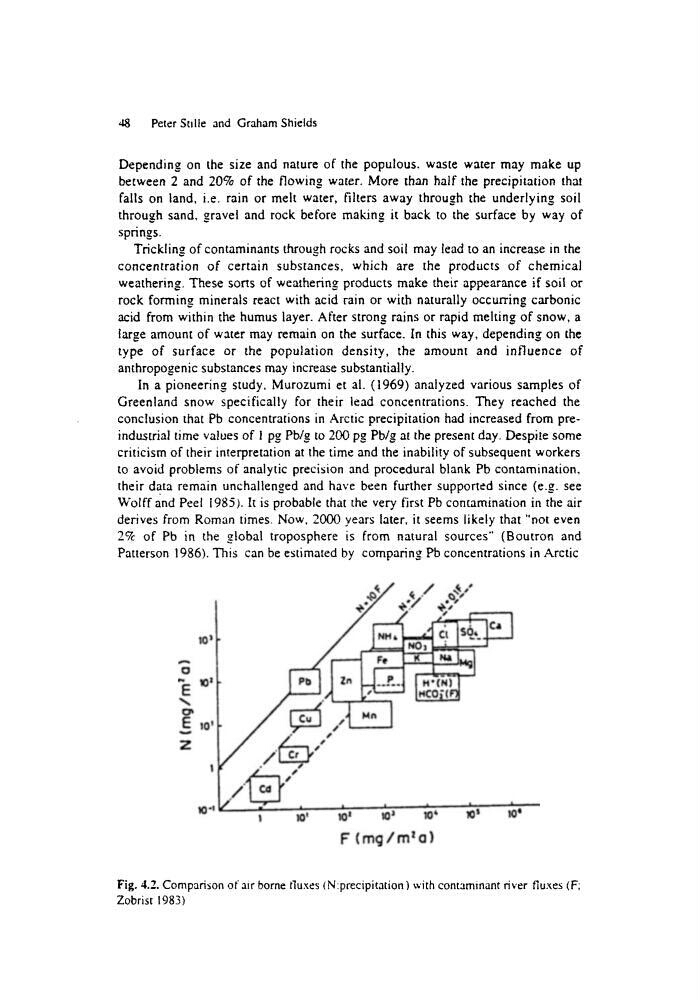
Fig. 4.2. Comparison or air borne tluxes (N:precipitation) with contaminant river fluxes (F;
Zobrist 1983)
Peter Stille and Graham Shields
Depending on the size and nature of the populous, waste water may make up
between 2 and 20% of the flowing water. More than half the precipitation that
falls on land, i.e. rain or melt water, filters away through the underlying soil
through sand, gravel and rock before making it back to the surface by way of
springs.
Trickling of contaminants through rocks and soil may lead to an increase in the
concentration of certain substances, which are the products of chemical
weathering. These sorts of weathering products make their appearance if soil or
rock forming minerals react with acid rain or with naturally occurring carbonic
acid from within the humus layer. After strong rains or rapid melting of snow, a
large amount of water may remain on the surface. In this way, depending on the
type of surface or the population density, the amount and influence of
anthropogenic substances may increase substantially.
In a pioneering study, Murozumi et al. (1969) analyzed various samples of
Greenland snow specifically for their lead concentrations. They reached the
conclusion that Pb concentrations in Arctic precipitation had increased from preindustrial time values of 1 pg Pb/g to 200 pg Pb/g at the present day. Despite some
criticism of their interpretation at the time and the inability of subsequent workers
to avoid problems of analytic precision and procedural blank Pb contamination,
their data remain unchallenged and have been further supported since (e.g. see
Wolff and Peel 1985). It is probable that the very first Pb contamination in the air
derives from Roman times. Now, 2000 years later, it seems likely that "not even
2% of Pb in the global troposphere is from natural sources" (Boutron and
Patterson 1986). This can be estimated by comparing Pb concentrations in Arctic
10 3
10 ~
E I0 ~
Z
,V
|
I
,
I
, ;
t
I0'
10 2
tO ~
iO"
I
I
,
10"1
10 s
I0 i
F (mcJ Im2 a)
Fig. 4.2. Comparison or air borne tluxes (N:precipitation) with contaminant river fluxes (F;
Zobrist 1983)