

4 Isotope Geochemistry in the Environment
The introduction of anthropogenic, geogenic and pedogenic, organic and
inorganic contaminants or poisons into our biosphere has been greatly accelerated
due to recent human activity. Substances, which do not appear in nature, are being
increasingly introduced into the natural cycles that link the continents, oceans and
atmosphere together. This increased influx of abiotic material and
anthropogenicalty induced, accelerated turn over of natural poisons places a
burden on the environment, in particular the surface environment.
In order to characterize and understand the various cycles every source,
transport route and transformation process must be determined for each and every
substance. This subject is discussed in greater detail in Kummert and Stumm
(1989) and Sigg and Stumm (1989). Surface water (rain, spring, pore and river
waters) plays a significant role in the regulation of these material cycles. A
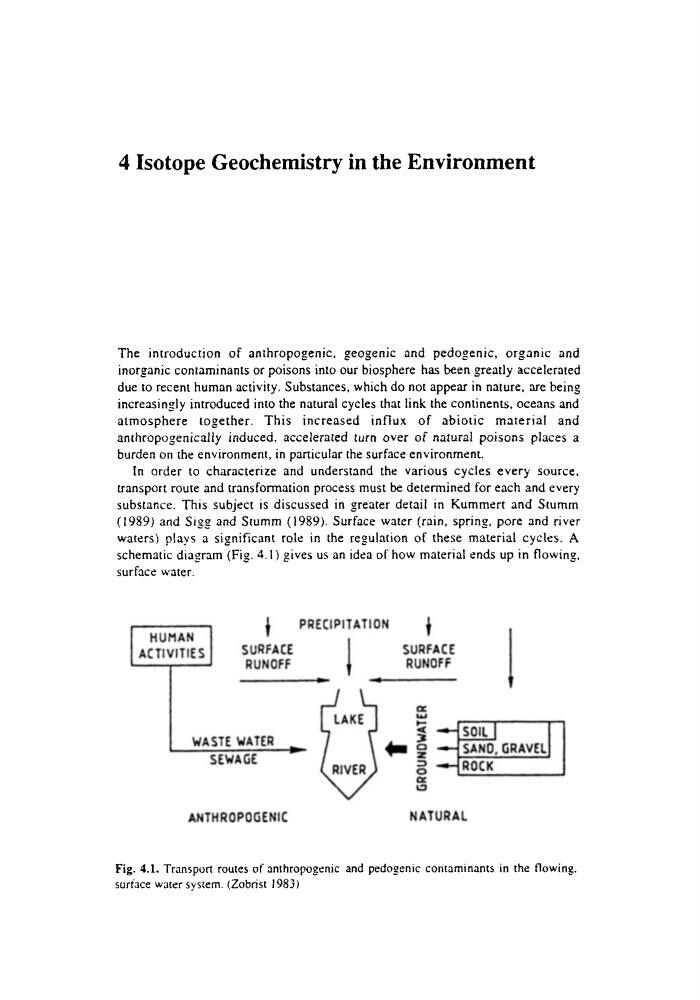
schematic diagram (Fig. 4.1) gives us an idea of how material ends up in flowing,
surface water.
[ HU.A. ]
1
.. ]
SURFACE
|ACTIVITIES,,
RUNOFF
WASTE WATER
SEWAGE
PRECIPITATION
SURFACE
RUNOFF
- ~ SAND. GRAVELi
z
" ~ R O C K
'
o
V
ANTHROPOSENIC
NATURAL
Fig. 4.1, Transport routes of anthropogenic and pedogenic contaminants in the flowing.
surface water system. (Zobrist 1983)
The introduction of anthropogenic, geogenic and pedogenic, organic and
inorganic contaminants or poisons into our biosphere has been greatly accelerated
due to recent human activity. Substances, which do not appear in nature, are being
increasingly introduced into the natural cycles that link the continents, oceans and
atmosphere together. This increased influx of abiotic material and
anthropogenicalty induced, accelerated turn over of natural poisons places a
burden on the environment, in particular the surface environment.
In order to characterize and understand the various cycles every source,
transport route and transformation process must be determined for each and every
substance. This subject is discussed in greater detail in Kummert and Stumm
(1989) and Sigg and Stumm (1989). Surface water (rain, spring, pore and river
waters) plays a significant role in the regulation of these material cycles. A
schematic diagram (Fig. 4.1) gives us an idea of how material ends up in flowing,
surface water.
[ HU.A. ]
1
.. ]
SURFACE
|ACTIVITIES,,
RUNOFF
WASTE WATER
SEWAGE
PRECIPITATION
SURFACE
RUNOFF
- ~ SAND. GRAVELi
z
" ~ R O C K
'
o
V
ANTHROPOSENIC
NATURAL
Fig. 4.1, Transport routes of anthropogenic and pedogenic contaminants in the flowing.
surface water system. (Zobrist 1983)