

-42 Peter StilM and Graham Shields
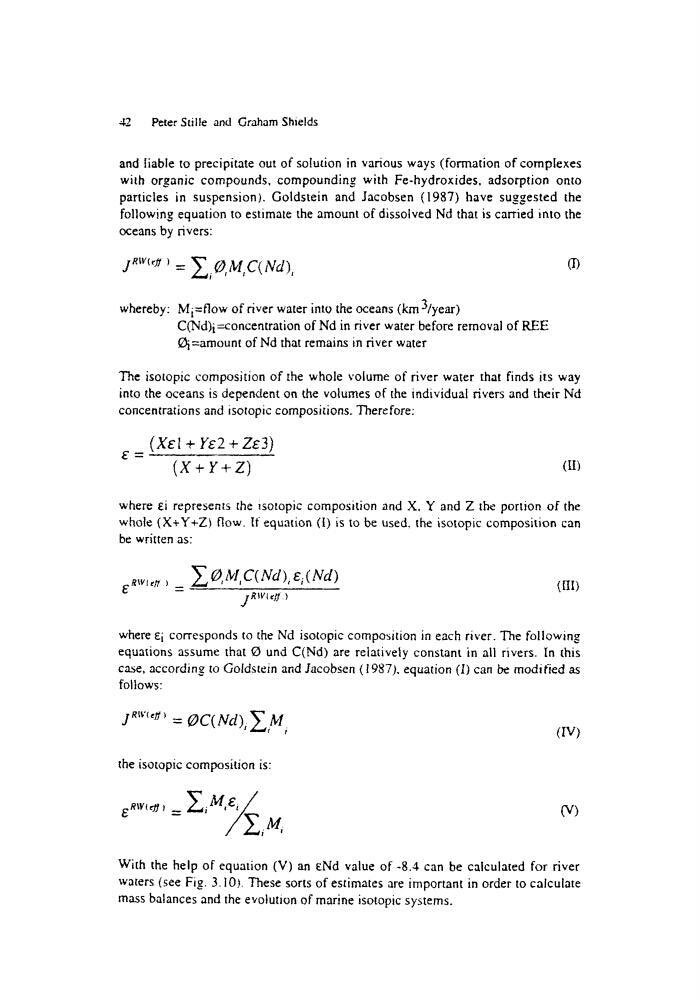
and liable to precipitate out of solution in various ways (formation of complexes
with organic compounds, compounding with Fe-hydroxides, adsorption onto
particles in suspension). Goldstein and Jacobsen (1987) have suggested the
following equation to estimate the amount of dissolved Nd that is carried into the
oceans by rivers:
jR,v,,Z , = Z , O,M,C( Nd),
03
whereby: Mi=flow of river water into the oceans (kin 3/year)
C(Nd)i=concentration of Nd in river water before removal of REE
Oi =amount of Nd that remains in river water
The isotopic composition of the whole volume of river water that finds its way
into the oceans is dependent on the volumes of the individual rivers and their Nd
concentrations and isotopic compositions. Therefore:
E' = ( X e l + Y~2 + Z g 3 )
( X + Y + Z)
(If)
where ei represents the isotopic composition and X, Y and Z the portion of the
whole (X+Y+Z) flow. If equation (1) is to be used, the isotopic composition can
be written as:
e Rw,`,~ , = ZO'M'C(Nd)'e'(Nd)
([II)
jRw~r
where ei corresponds to the Nd isotopic composition in each river. The following
equations assume that O und C(Nd) are relatively constant in all rivers. In this
case, according to Goldstein and Jacobsen (1987), equation (I) can be modified as
follows:
jRt~'(,tt~ = OC( Nd)i ZiM ~
(Iv)
the isotopic composition is:
eRw,~, Z i M , r
=
/ y . M ,
(v)
With the help of equation (V) an ~Nd value of -8.4 can be calculated for river
waters (see Fig. 3. I0) These sorts of estimates are important in order to calculate
mass balances and the evolution of marine isotopic systems.
and liable to precipitate out of solution in various ways (formation of complexes
with organic compounds, compounding with Fe-hydroxides, adsorption onto
particles in suspension). Goldstein and Jacobsen (1987) have suggested the
following equation to estimate the amount of dissolved Nd that is carried into the
oceans by rivers:
jR,v,,Z , = Z , O,M,C( Nd),
03
whereby: Mi=flow of river water into the oceans (kin 3/year)
C(Nd)i=concentration of Nd in river water before removal of REE
Oi =amount of Nd that remains in river water
The isotopic composition of the whole volume of river water that finds its way
into the oceans is dependent on the volumes of the individual rivers and their Nd
concentrations and isotopic compositions. Therefore:
E' = ( X e l + Y~2 + Z g 3 )
( X + Y + Z)
(If)
where ei represents the isotopic composition and X, Y and Z the portion of the
whole (X+Y+Z) flow. If equation (1) is to be used, the isotopic composition can
be written as:
e Rw,`,~ , = ZO'M'C(Nd)'e'(Nd)
([II)
jRw~r
where ei corresponds to the Nd isotopic composition in each river. The following
equations assume that O und C(Nd) are relatively constant in all rivers. In this
case, according to Goldstein and Jacobsen (1987), equation (I) can be modified as
follows:
jRt~'(,tt~ = OC( Nd)i ZiM ~
(Iv)
the isotopic composition is:
eRw,~, Z i M , r
=
/ y . M ,
(v)
With the help of equation (V) an ~Nd value of -8.4 can be calculated for river
waters (see Fig. 3. I0) These sorts of estimates are important in order to calculate
mass balances and the evolution of marine isotopic systems.