

40 Peter Stille and Graham Shields
conversely low Sm/Nd ratios are to be expected for the suspension. Goldstein and
Jacobsen (I 987) were able to demonstrate that (Sm/Nd) water / (Srn/Nd) SUSp 9 >1 is
the case for most of the river systems of the World. This ratio is also pH
dependent. River water with pH>7 displays far higher Sm/Nd ratios in the
dissolved fraction than in the suspended load. It is assumed that higher pH
increases the stablility of the carbonate and hydroxide complexes of the heavy
REE relative to the light REE. 1"~7Sm/l~Nd ratios determined on filtered river
water display a large degree of variation, from 0.1 to 0.18. Most ratios lie around
0.12 which corresponds to the average crustal composition. Typical patterns of
variation of the REE can be found in Goldstein and Jacobsen (1988a,b) and
Elderfield et al. (1990; Fig. 3.8).
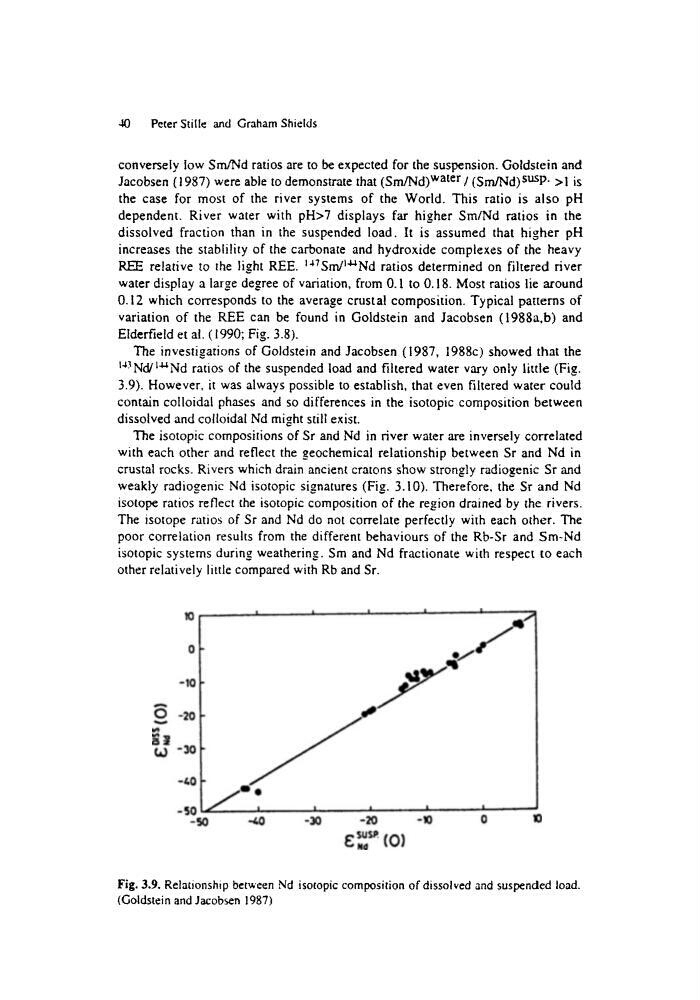
The investigations of Goldstein and Jacobsen (1987, 1988c) showed that the
t'*3NcYI'~Nd ratios of the suspended load and filtered water vary only little (Fig.
3.9). However, it was always possible to establish, that even filtered water could
contain colloidal phases and so differences in the isotopic composition between
dissolved and colloidal Nd might still exist.
The isotopic compositions of Sr and Nd in river water are inversely correlated
with each other and reflect the geochemical relationship between Sr and Nd in
crustal rocks. Rivers which drain ancient cratons show strongly radiogenic Sr and
weakly radiogenic Nd isotopic signatures (Fig. 3.10). Therefore, the Sr and Nd
isotope ratios reflect the isotopic composition of the region drained by the rivers.
The isotope ratios of Sr and Nd do not correlate perfectly with each other. The
poor correlation results from the different behaviours of the Rb-Sr and Sm-Nd
isotopic systems during weathering. Sm and Nd fractionate with respect to each
other relatively little compared with Rb and St.
Io
o
-1o
O -2o
~
-3o
-4o
- 5 o
-N
I
I
I
I
l
• '
QI
|
I
, ,,I
!
~$US~
,,~ (O)
Fig. 3.9. Relationship between Nd isotopic composition of dissolved and suspended load.
(Goldstein and Jacobsen 1987)
conversely low Sm/Nd ratios are to be expected for the suspension. Goldstein and
Jacobsen (I 987) were able to demonstrate that (Sm/Nd) water / (Srn/Nd) SUSp 9 >1 is
the case for most of the river systems of the World. This ratio is also pH
dependent. River water with pH>7 displays far higher Sm/Nd ratios in the
dissolved fraction than in the suspended load. It is assumed that higher pH
increases the stablility of the carbonate and hydroxide complexes of the heavy
REE relative to the light REE. 1"~7Sm/l~Nd ratios determined on filtered river
water display a large degree of variation, from 0.1 to 0.18. Most ratios lie around
0.12 which corresponds to the average crustal composition. Typical patterns of
variation of the REE can be found in Goldstein and Jacobsen (1988a,b) and
Elderfield et al. (1990; Fig. 3.8).
The investigations of Goldstein and Jacobsen (1987, 1988c) showed that the
t'*3NcYI'~Nd ratios of the suspended load and filtered water vary only little (Fig.
3.9). However, it was always possible to establish, that even filtered water could
contain colloidal phases and so differences in the isotopic composition between
dissolved and colloidal Nd might still exist.
The isotopic compositions of Sr and Nd in river water are inversely correlated
with each other and reflect the geochemical relationship between Sr and Nd in
crustal rocks. Rivers which drain ancient cratons show strongly radiogenic Sr and
weakly radiogenic Nd isotopic signatures (Fig. 3.10). Therefore, the Sr and Nd
isotope ratios reflect the isotopic composition of the region drained by the rivers.
The isotope ratios of Sr and Nd do not correlate perfectly with each other. The
poor correlation results from the different behaviours of the Rb-Sr and Sm-Nd
isotopic systems during weathering. Sm and Nd fractionate with respect to each
other relatively little compared with Rb and St.
Io
o
-1o
O -2o
~
-3o
-4o
- 5 o
-N
I
I
I
I
l
• '
QI
|
I
, ,,I
!
~$US~
,,~ (O)
Fig. 3.9. Relationship between Nd isotopic composition of dissolved and suspended load.
(Goldstein and Jacobsen 1987)