

22
Peter Stille and Graham Shields
and in particular isotopic equilibrium can only be achieved in the smallest microenvironment.
In order to understand chemical exchange processes during weathering better,
hydrogen and oxygen isotope investigations in particular were carried out on clay
minerals. We now know that chemical reactions that eventually lead to the
formation of clay minerals can only take place under conditions of high
water/rock ratio. This means, that a large amount of water must exchange with
rock in order for a clay mineral to be formed. Based on hydrogen and oxygen
isotope studies, it can be safely assumed that such authigenic clay minerals exist
in isotopic equilibrium with local, meteoric water.
As water is the most important medium in which the weathering of minerals
and the new formation of clay minerals takes place, we need to take a look at the
isotopic characteristics of water and its isotopic fractionation processes.
When water evaporates at the surface of the ocean, the water vapour is enriched
in ~60 and H because Hzt60 has a higher vapour pressure than HzlSO or deuterium
water molecules (Fig. 2.9). As a consequence, the 6JsO and 6D values of water
vapour above the ocean are negative with respect to "Standard Mean Ocean
Water" or "SMOW". If rain drops form as a result of condensation of the water
vapour in a cloud, these rain drops will be relatively enriched in tso and D, as is
seawater. This removal of lso and D has the consequence that the remaining
damp air masses become ever more enriched in 160 and H.
O3
r
O3
2.30
2.10
1.90
1.70
1.50
1.30
1.10
0.90
0.70
0
K6
K5
K4
I
I
I
,|,,
I
.
I
I
I
I
-I
200
400
600
800
1000
1 / S r , , l O 3
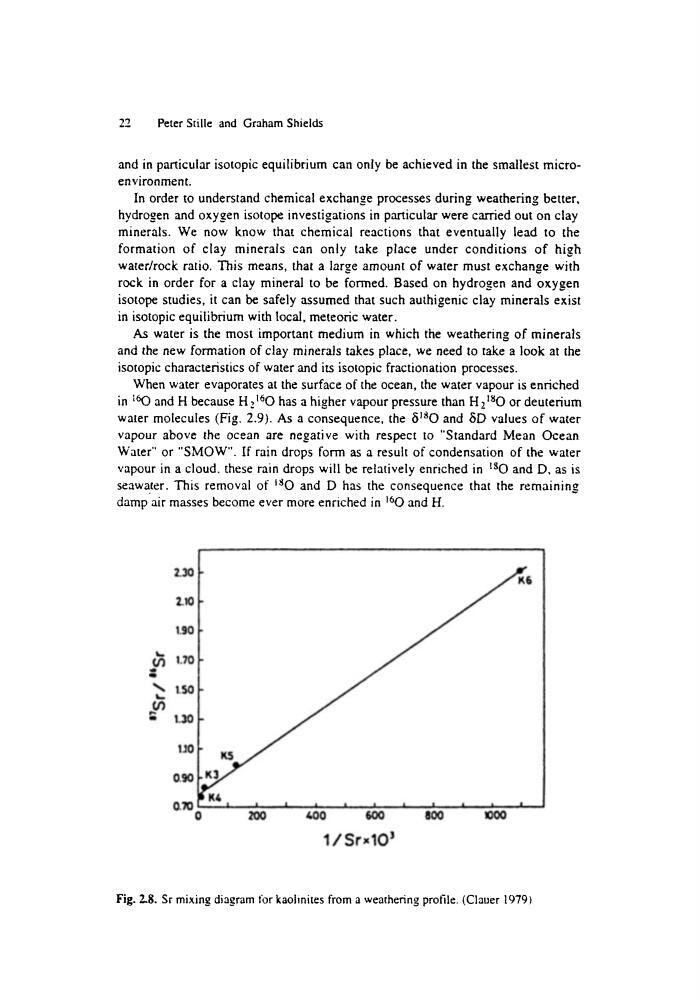
Fig. 2..$. Sr mixing diagram tbr kaolinites from a weathering profile. (Clauer 1979)
Peter Stille and Graham Shields
and in particular isotopic equilibrium can only be achieved in the smallest microenvironment.
In order to understand chemical exchange processes during weathering better,
hydrogen and oxygen isotope investigations in particular were carried out on clay
minerals. We now know that chemical reactions that eventually lead to the
formation of clay minerals can only take place under conditions of high
water/rock ratio. This means, that a large amount of water must exchange with
rock in order for a clay mineral to be formed. Based on hydrogen and oxygen
isotope studies, it can be safely assumed that such authigenic clay minerals exist
in isotopic equilibrium with local, meteoric water.
As water is the most important medium in which the weathering of minerals
and the new formation of clay minerals takes place, we need to take a look at the
isotopic characteristics of water and its isotopic fractionation processes.
When water evaporates at the surface of the ocean, the water vapour is enriched
in ~60 and H because Hzt60 has a higher vapour pressure than HzlSO or deuterium
water molecules (Fig. 2.9). As a consequence, the 6JsO and 6D values of water
vapour above the ocean are negative with respect to "Standard Mean Ocean
Water" or "SMOW". If rain drops form as a result of condensation of the water
vapour in a cloud, these rain drops will be relatively enriched in tso and D, as is
seawater. This removal of lso and D has the consequence that the remaining
damp air masses become ever more enriched in 160 and H.
O3
r
O3
2.30
2.10
1.90
1.70
1.50
1.30
1.10
0.90
0.70
0
K6
K5
K4
I
I
I
,|,,
I
.
I
I
I
I
-I
200
400
600
800
1000
1 / S r , , l O 3
Fig. 2..$. Sr mixing diagram tbr kaolinites from a weathering profile. (Clauer 1979)