

2 Weathering
21
Clauer (1979) investigated exchange reactions that took place between kaolinite
and fluid phases within a weathering profile. The research was carded out on the
weathering profile of a pegmatitic dyke, over 2.6 Ga old.
Kaolinite was collected from the very top of the profile, 8 m lower near the
~oundwater table and below the groundwater table near the base of the profile.
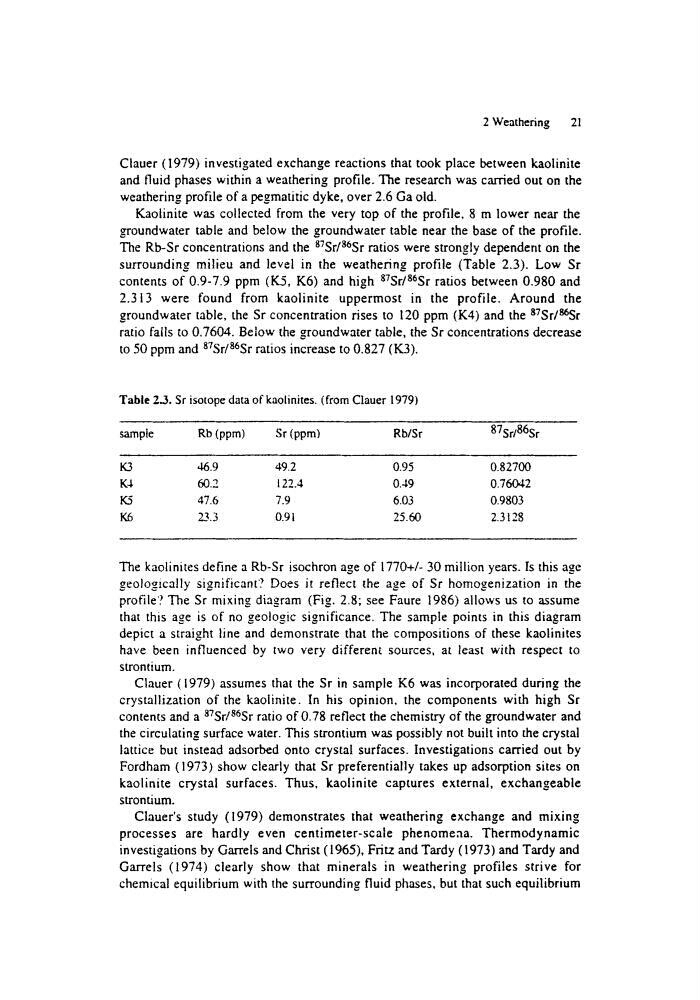
The Rb-Sr concentrations and the 87Sr/S6Sr ratios were strongly dependent on the
surrounding milieu and level in the weathering profile (Table 2.3). Low Sr
contents of 0.9-7.9 ppm (KS, K6) and high 87Sr/S6Sr ratios between 0.980 and
2.313 were found from kaolinite uppermost in the profile. Around the
groundwater table, the Sr concentration rises to 120 ppm (K4) and the STSr/S6Sr
ratio fails to 0.7604. Below the groundwater table, the Sr concentrations decrease
to 50 ppm and 87Sr/86Sr ratios increase to 0.827 (K3).
Table 2.3. Sr isotope data of kaolinites. (from Clauer 1979)
sample
Rb (ppm)
Sr (ppm)
Rb/Sr
87Sr/86Sr
K3
46.9
49.2
0.95
0.82700
I<4
60.2
122.4
0.49
0.76042
K5
47.6
7.9
6.03
0.9803
K6
23.3
0.91
25.60
2.3128
The kaolinites define a Rb-Sr isochron age of 1770+/- 30 million years. Is this age
geologically significant? Does it reflect the age of Sr homogenization in the
profile'? The Sr mixing diagram (Fig. 2.8; see Faure 1986) allows us to assume
that this age is of no geologic significance. The sample points in this diagram
depict a straight line and demonstrate that the compositions of these kaolinites
have been influenced by two very different sources, at least with respect to
strontium.
Clauer (1979) assumes that the Sr in sample K6 was incorporated during the
crystallization of the kaolinite. In his opinion, the components with high Sr
contents and a 87Sr/86Sr ratio of 0.78 reflect the chemistry of the groundwater and
the circulating surface water. This strontium was possibly not built into the crystal
lattice but instead adsorbed onto crystal surfaces. Investigations carried out by
Fordham (1973) show clearly that Sr preferentially takes up adsorption sites on
kaolinite crystal surfaces. Thus, kaolinite captures external, exchangeable
strontium.
Clauer's study (1979) demonstrates that weathering exchange and mixing
processes are hardly even centimeter-scale phenomena. Thermodynamic
investigations by Garrels and Christ (1965), Fritz and Tardy (1973) and Tardy and
Garrels (1974) clearly show that minerals in weathering profiles strive for
chemical equilibrium with the surrounding fluid phases, but that such equilibrium
21
Clauer (1979) investigated exchange reactions that took place between kaolinite
and fluid phases within a weathering profile. The research was carded out on the
weathering profile of a pegmatitic dyke, over 2.6 Ga old.
Kaolinite was collected from the very top of the profile, 8 m lower near the
~oundwater table and below the groundwater table near the base of the profile.
The Rb-Sr concentrations and the 87Sr/S6Sr ratios were strongly dependent on the
surrounding milieu and level in the weathering profile (Table 2.3). Low Sr
contents of 0.9-7.9 ppm (KS, K6) and high 87Sr/S6Sr ratios between 0.980 and
2.313 were found from kaolinite uppermost in the profile. Around the
groundwater table, the Sr concentration rises to 120 ppm (K4) and the STSr/S6Sr
ratio fails to 0.7604. Below the groundwater table, the Sr concentrations decrease
to 50 ppm and 87Sr/86Sr ratios increase to 0.827 (K3).
Table 2.3. Sr isotope data of kaolinites. (from Clauer 1979)
sample
Rb (ppm)
Sr (ppm)
Rb/Sr
87Sr/86Sr
K3
46.9
49.2
0.95
0.82700
I<4
60.2
122.4
0.49
0.76042
K5
47.6
7.9
6.03
0.9803
K6
23.3
0.91
25.60
2.3128
The kaolinites define a Rb-Sr isochron age of 1770+/- 30 million years. Is this age
geologically significant? Does it reflect the age of Sr homogenization in the
profile'? The Sr mixing diagram (Fig. 2.8; see Faure 1986) allows us to assume
that this age is of no geologic significance. The sample points in this diagram
depict a straight line and demonstrate that the compositions of these kaolinites
have been influenced by two very different sources, at least with respect to
strontium.
Clauer (1979) assumes that the Sr in sample K6 was incorporated during the
crystallization of the kaolinite. In his opinion, the components with high Sr
contents and a 87Sr/86Sr ratio of 0.78 reflect the chemistry of the groundwater and
the circulating surface water. This strontium was possibly not built into the crystal
lattice but instead adsorbed onto crystal surfaces. Investigations carried out by
Fordham (1973) show clearly that Sr preferentially takes up adsorption sites on
kaolinite crystal surfaces. Thus, kaolinite captures external, exchangeable
strontium.
Clauer's study (1979) demonstrates that weathering exchange and mixing
processes are hardly even centimeter-scale phenomena. Thermodynamic
investigations by Garrels and Christ (1965), Fritz and Tardy (1973) and Tardy and
Garrels (1974) clearly show that minerals in weathering profiles strive for
chemical equilibrium with the surrounding fluid phases, but that such equilibrium