

18
Peter St)tie and Graham Shields
exchange under low temperature conditions. It is still left to further research in
mineralogy and crystallography to tackle and solve this particular problem. New
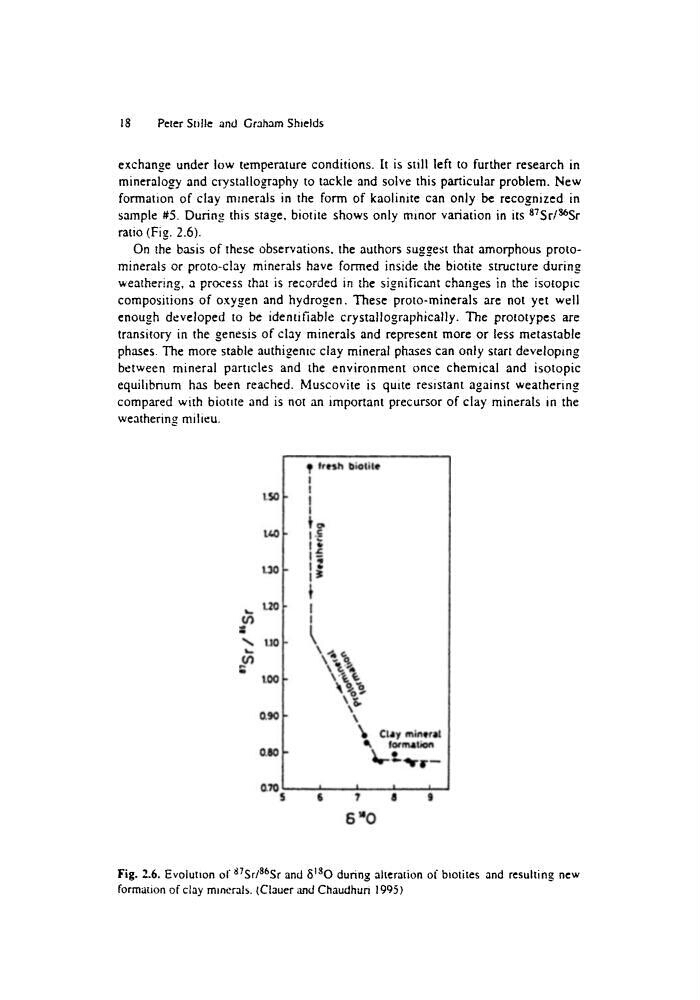
formation of clay minerals in the form of kaolinite can only be recognized in
sample #5. During this stage, biotite shows only minor variation in its s'ZSr/SeSr
ratio (Fig. 2.6).
On the basis of these observations, the authors suggest that amorphous protominerals or proto-clay minerals have formed inside the biotite structure during
weathering, a process that is recorded in the significant changes in the isotopzc
compositions of oxygen and hydrogen. These proto-minerals are not yet well
enough developed to be identifiable crystallographically, The prototypes are
transitory in the genesis of clay minerals and represent more or less metastable
phases. The more stable authigemc clay mineral phases can only start developzng
between mineral parucles and the environment once chemical and isotopic
equilibnum has been reached. Muscovite is quite resistant against weathering
compared with biotite and is not an important precursor of clay minerals in the
weathering milieu,
O' ~
1S0
1J.O
1.30
1.20
ItO
1.00
0.90
0.80
0.'/0
|f~Sh
~tO(;te
I
I
I
I
t:
{
i
k
\~Oo.
\
Cl4y miner,It
~.
formation
I
L
I
I
G
7
8
9
6 Io0
Fig. 2.6. Evolution of 87Sr/86Sr and 61SO dunng alteration of biotites and resulting new
formation of clay mmerats. (Clauer and Chaudhun 1995)
Peter St)tie and Graham Shields
exchange under low temperature conditions. It is still left to further research in
mineralogy and crystallography to tackle and solve this particular problem. New
formation of clay minerals in the form of kaolinite can only be recognized in
sample #5. During this stage, biotite shows only minor variation in its s'ZSr/SeSr
ratio (Fig. 2.6).
On the basis of these observations, the authors suggest that amorphous protominerals or proto-clay minerals have formed inside the biotite structure during
weathering, a process that is recorded in the significant changes in the isotopzc
compositions of oxygen and hydrogen. These proto-minerals are not yet well
enough developed to be identifiable crystallographically, The prototypes are
transitory in the genesis of clay minerals and represent more or less metastable
phases. The more stable authigemc clay mineral phases can only start developzng
between mineral parucles and the environment once chemical and isotopic
equilibnum has been reached. Muscovite is quite resistant against weathering
compared with biotite and is not an important precursor of clay minerals in the
weathering milieu,
O' ~
1S0
1J.O
1.30
1.20
ItO
1.00
0.90
0.80
0.'/0
|f~Sh
~tO(;te
I
I
I
I
t:
{
i
k
\~Oo.
\
Cl4y miner,It
~.
formation
I
L
I
I
G
7
8
9
6 Io0
Fig. 2.6. Evolution of 87Sr/86Sr and 61SO dunng alteration of biotites and resulting new
formation of clay mmerats. (Clauer and Chaudhun 1995)