

2 Weathering
17
k.
lb..
r
_, 2
1.50
t30
1.10
090
0.70
0
9 Fresh biotite
j , , ~ A "
9 Weathered biotite
~ . ~
2
. . /
I
25
50
75
100
aTRb / a6Sr
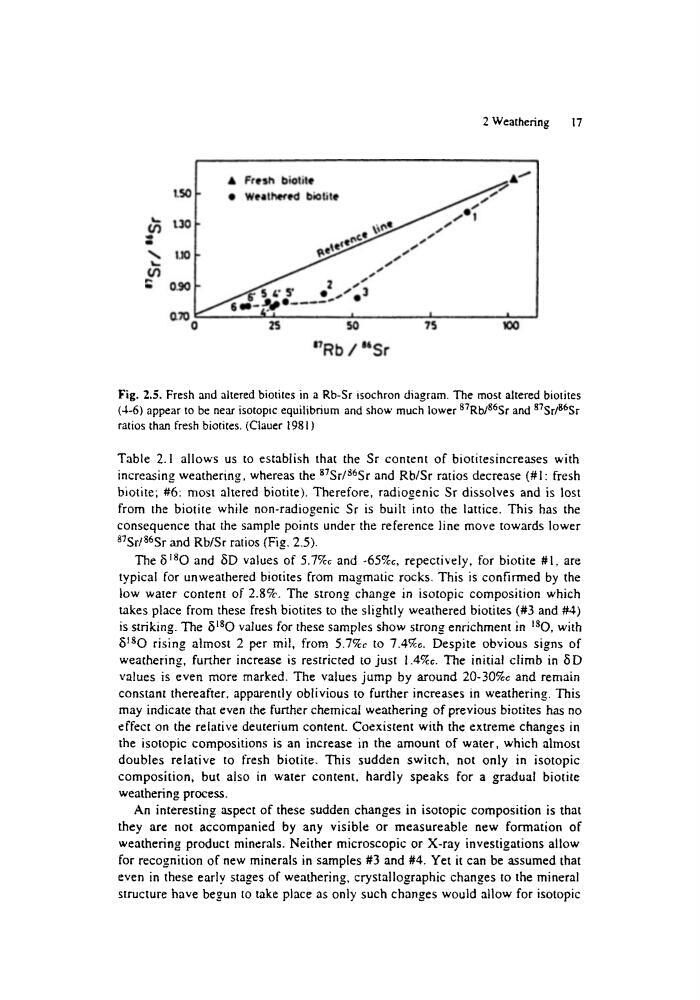
Fig. 2.5. Fresh and altered biotites in a Rb-Sr isochron diagram. The most altered biotites
(4-6) appear to be nero" isotopic equilibrium and show much lower S7Rb/86Sr and STSr/86Sr
ratios than fresh biotites. (Ctauer 1981 )
Table 2.1 allows us to establish that the Sr content of biotitesincreases with
increasing weathering, whereas the STSr/S6Sr and Rb/Sr ratios decrease (#1: fresh
biotite; #6: most altered biotite). Therefore, radiogenic Sr dissolves and is lost
from the biotite while non-radiogenic Sr is built into the lattice. This has the
consequence that the sample points under the reference line move towards lower
87Sr/86Sr and Rb/Sr ratios (Fig. 2.5).
The 8180 and 5D values of 5.7%c and -65%c, repectively, for biotite #1, are
typical for unweathered biotites from magmatic rocks. This is confirmed by the
tow water content of 2.8%. The strong change in isotopic composition which
takes place from these fresh biotites to the slightly weathered biotites (#3 and #4)
is striking. The 5180 values for these samples show strong enrichment in ~sO, with
51sO rising almost 2 per mil, from 5.7%c to 7.4%,. Despite obvious signs of
weathering, further increase is restricted to just 1.4%c. The initial climb in ~SD
values is even more marked. The values jump by around 20-30%, and remain
constant thereafter, apparently oblivious to further increases in weathering. This
may indicate that even the further chemical weathering of previous biotites has no
effect on the relative deuterium content. Coexistent with the extreme changes in
the isotopic compositions is an increase in the amount of water, which almost
doubles relative to fresh biotite. This sudden switch, not only in isotopic
composition, but also in water content, hardly speaks for a gradual biotite
weathering process.
An interesting aspect of these sudden changes in isotopic composition is that
they are not accompanied by any visible or measureable new formation of
weathering product minerals. Neither microscopic or X-ray investigations allow
for recognition of new minerals in samples #3 and #4. Yet it can be assumed that
even in these early stages of weathering, crystallographic changes to the mineral
structure have begun to take place as only such changes would allow for isotopic
17
k.
lb..
r
_, 2
1.50
t30
1.10
090
0.70
0
9 Fresh biotite
j , , ~ A "
9 Weathered biotite
~ . ~
2
. . /
I
25
50
75
100
aTRb / a6Sr
Fig. 2.5. Fresh and altered biotites in a Rb-Sr isochron diagram. The most altered biotites
(4-6) appear to be nero" isotopic equilibrium and show much lower S7Rb/86Sr and STSr/86Sr
ratios than fresh biotites. (Ctauer 1981 )
Table 2.1 allows us to establish that the Sr content of biotitesincreases with
increasing weathering, whereas the STSr/S6Sr and Rb/Sr ratios decrease (#1: fresh
biotite; #6: most altered biotite). Therefore, radiogenic Sr dissolves and is lost
from the biotite while non-radiogenic Sr is built into the lattice. This has the
consequence that the sample points under the reference line move towards lower
87Sr/86Sr and Rb/Sr ratios (Fig. 2.5).
The 8180 and 5D values of 5.7%c and -65%c, repectively, for biotite #1, are
typical for unweathered biotites from magmatic rocks. This is confirmed by the
tow water content of 2.8%. The strong change in isotopic composition which
takes place from these fresh biotites to the slightly weathered biotites (#3 and #4)
is striking. The 5180 values for these samples show strong enrichment in ~sO, with
51sO rising almost 2 per mil, from 5.7%c to 7.4%,. Despite obvious signs of
weathering, further increase is restricted to just 1.4%c. The initial climb in ~SD
values is even more marked. The values jump by around 20-30%, and remain
constant thereafter, apparently oblivious to further increases in weathering. This
may indicate that even the further chemical weathering of previous biotites has no
effect on the relative deuterium content. Coexistent with the extreme changes in
the isotopic compositions is an increase in the amount of water, which almost
doubles relative to fresh biotite. This sudden switch, not only in isotopic
composition, but also in water content, hardly speaks for a gradual biotite
weathering process.
An interesting aspect of these sudden changes in isotopic composition is that
they are not accompanied by any visible or measureable new formation of
weathering product minerals. Neither microscopic or X-ray investigations allow
for recognition of new minerals in samples #3 and #4. Yet it can be assumed that
even in these early stages of weathering, crystallographic changes to the mineral
structure have begun to take place as only such changes would allow for isotopic