

6 Isotope Geochemistry of Clay Minerals 159
along the whole profile, a rise in the potassium content in the finest fraction can be
observed at about 3000 m depth, while the K content of the coarser fraction falls
at the same depth. The increase in K content with depth in the finest fraction
corresponds to an increase in illite, while the simultaneous loss of K from the
coarse fraction corresponds to the progressive disappearance of alkali feldspar.
Note that alkali feldspars are found mainly in the coarse fraction while the finest
fraction contains almost exclusively illite and smectite.
Hower et al. assume that the following reaction takes place with increasing
depth and diagenetic alteration:
Smectite + AI -~ + K § =Illite + Si ~ + H20
(I)
Enrichment in K and AI in the finest fraction accompanies therefore the
transformation of smectite into illite (Fig. 7.1). Potassium and aluminium are
required for the formation of iltite and derive from the alkali feldspar and
muscovite, which react with and are decomposed by organic acids, which have
been released at great depths by the decarboxylation of organic matter. The same
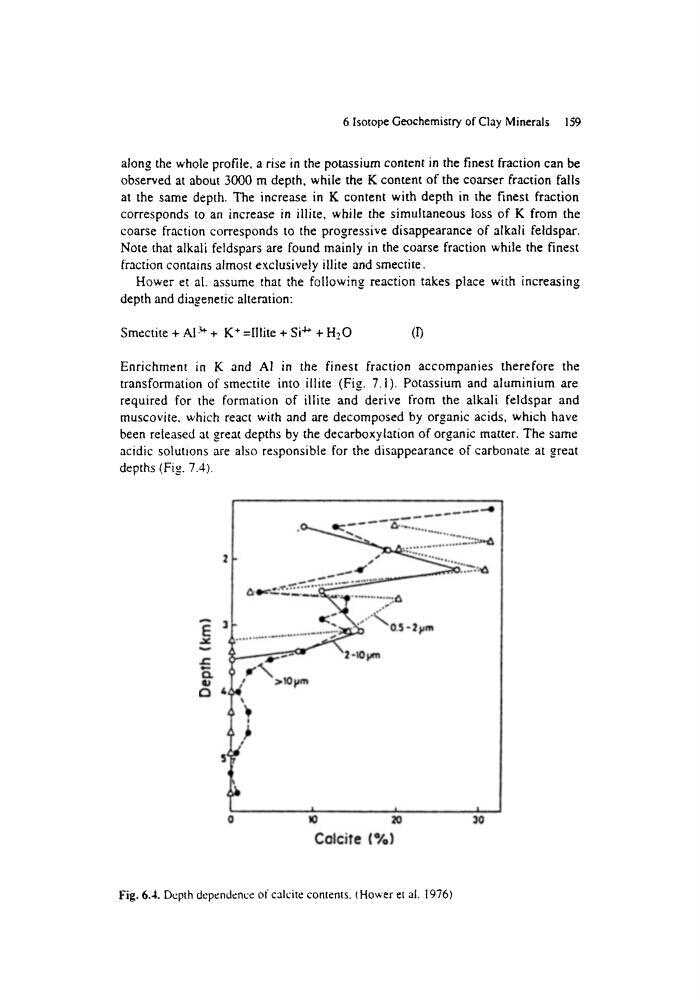
acidic solutions are also responsible for the disappearance of carbonate at great
depths (Fig. 7.4).
~
Q ~
!
I
I
,
,
|
Io
20
30
Calcite 1%)
Fig. 6.4, Depth dependence o| calcite contents. (Hower et al. 1976)
along the whole profile, a rise in the potassium content in the finest fraction can be
observed at about 3000 m depth, while the K content of the coarser fraction falls
at the same depth. The increase in K content with depth in the finest fraction
corresponds to an increase in illite, while the simultaneous loss of K from the
coarse fraction corresponds to the progressive disappearance of alkali feldspar.
Note that alkali feldspars are found mainly in the coarse fraction while the finest
fraction contains almost exclusively illite and smectite.
Hower et al. assume that the following reaction takes place with increasing
depth and diagenetic alteration:
Smectite + AI -~ + K § =Illite + Si ~ + H20
(I)
Enrichment in K and AI in the finest fraction accompanies therefore the
transformation of smectite into illite (Fig. 7.1). Potassium and aluminium are
required for the formation of iltite and derive from the alkali feldspar and
muscovite, which react with and are decomposed by organic acids, which have
been released at great depths by the decarboxylation of organic matter. The same
acidic solutions are also responsible for the disappearance of carbonate at great
depths (Fig. 7.4).
~
Q ~
!
I
I
,
,
|
Io
20
30
Calcite 1%)
Fig. 6.4, Depth dependence o| calcite contents. (Hower et al. 1976)