

I Introduction
3
and on the decay constant. The general equation for radioactive decay can be
written as:
N = N,,e -a'
(IV)
where "N" is the number of radioactive parent atoms at any time "t", "No" is the
original number of atoms at time "t=o" and "L" is the decay constant. However,
equation IV does not permit us to date geological substances directly as we do not
know "No", i.e. the number of parent atoms at the start of the chronometer.
Equation IV may be manipulated for this purpose in the following way:
D = N , , - N = Nea~ - N = N(ea' - I)
0r
where D corresponds to the number of radiogenic daughter atoms present.
1.2.1 The Rb-Sr Method
The Rb-Sr isotope system can be used to determine the age of rocks and minerals
because of lhe constancy of the law of radioactivity. Strontium has four naturally
occurring isotopes: ~Sr, SrSr, 87Sr und ~SSr. Rubidium has two naturally occurring
isotopes: gTRb and 8SRb. The strontium isotopic signature of rocks and minerals is
represented by the ratio a7Sr/S6Sr. 87Rb is the parent isotope and undergoes
radioactive decay to produce 87Sr by emission of a negative l-particle. The
radioactive decay constant of STRb, ~,~, is 1.42 * 10 -t ty-i (y:year).
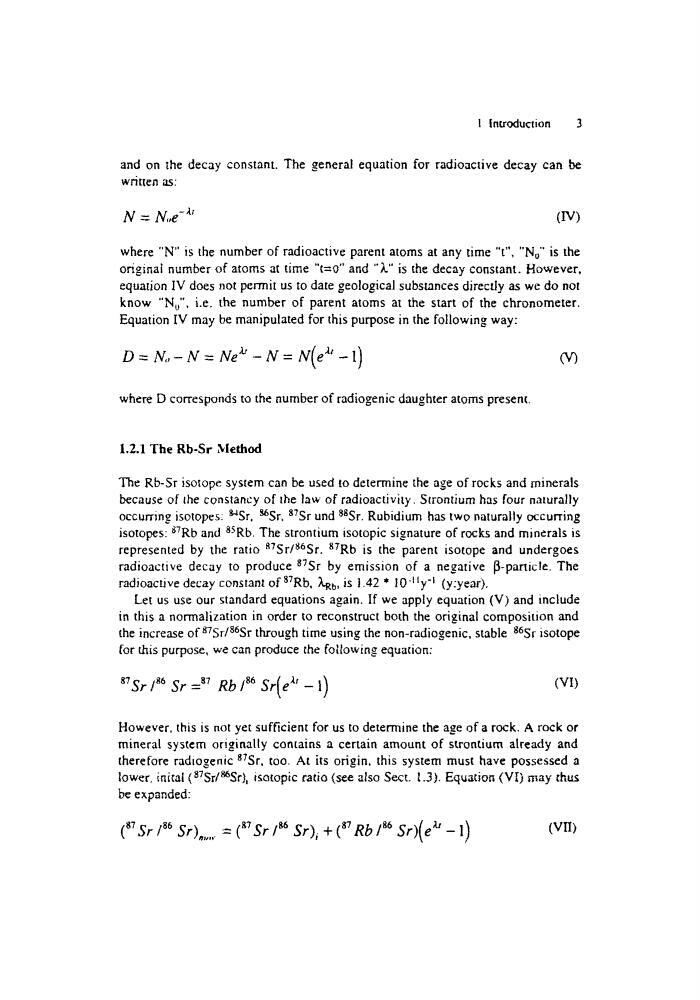
Let us use our standard equations again. If we apply equation (V) and include
in this a normalization in order to reconstruct both the original composition and
the increase of S7Sr/86Sr through time using the non-radiogenic, stable g6Sr isotope
for this purpose, we can produce the following equation:
gT Sr ig6 Sr =87 Rb / 86 Sr( e a' - 1)
(vI)
However, this is not yet sufficient for us to determine the age of a rock. A rock or
mineral system originally contains a certain amount of strontium already and
therefore radiogenic STSr, too. At its origin, this system must have possessed a
lower, inital (SVSr/86Sr), isotopic ratio (see also Sect+ 1.3). Equation (VI) may thus
be expanded:
(~7 Sr /s6 Sr),,,,,. = (~7 Sr I '6 Sr)i + (87 Rb /86 Sr)(e a, _ 1)
(vii)
3
and on the decay constant. The general equation for radioactive decay can be
written as:
N = N,,e -a'
(IV)
where "N" is the number of radioactive parent atoms at any time "t", "No" is the
original number of atoms at time "t=o" and "L" is the decay constant. However,
equation IV does not permit us to date geological substances directly as we do not
know "No", i.e. the number of parent atoms at the start of the chronometer.
Equation IV may be manipulated for this purpose in the following way:
D = N , , - N = Nea~ - N = N(ea' - I)
0r
where D corresponds to the number of radiogenic daughter atoms present.
1.2.1 The Rb-Sr Method
The Rb-Sr isotope system can be used to determine the age of rocks and minerals
because of lhe constancy of the law of radioactivity. Strontium has four naturally
occurring isotopes: ~Sr, SrSr, 87Sr und ~SSr. Rubidium has two naturally occurring
isotopes: gTRb and 8SRb. The strontium isotopic signature of rocks and minerals is
represented by the ratio a7Sr/S6Sr. 87Rb is the parent isotope and undergoes
radioactive decay to produce 87Sr by emission of a negative l-particle. The
radioactive decay constant of STRb, ~,~, is 1.42 * 10 -t ty-i (y:year).
Let us use our standard equations again. If we apply equation (V) and include
in this a normalization in order to reconstruct both the original composition and
the increase of S7Sr/86Sr through time using the non-radiogenic, stable g6Sr isotope
for this purpose, we can produce the following equation:
gT Sr ig6 Sr =87 Rb / 86 Sr( e a' - 1)
(vI)
However, this is not yet sufficient for us to determine the age of a rock. A rock or
mineral system originally contains a certain amount of strontium already and
therefore radiogenic STSr, too. At its origin, this system must have possessed a
lower, inital (SVSr/86Sr), isotopic ratio (see also Sect+ 1.3). Equation (VI) may thus
be expanded:
(~7 Sr /s6 Sr),,,,,. = (~7 Sr I '6 Sr)i + (87 Rb /86 Sr)(e a, _ 1)
(vii)