

2
Peter Stille and Graham Shields
O),,,,.,,l. - ( 0
O)sMow ] O'
61SO= (180/16
is /16
~ ' ~ - -
*1
( 0 / O)s,~low
J
(1)
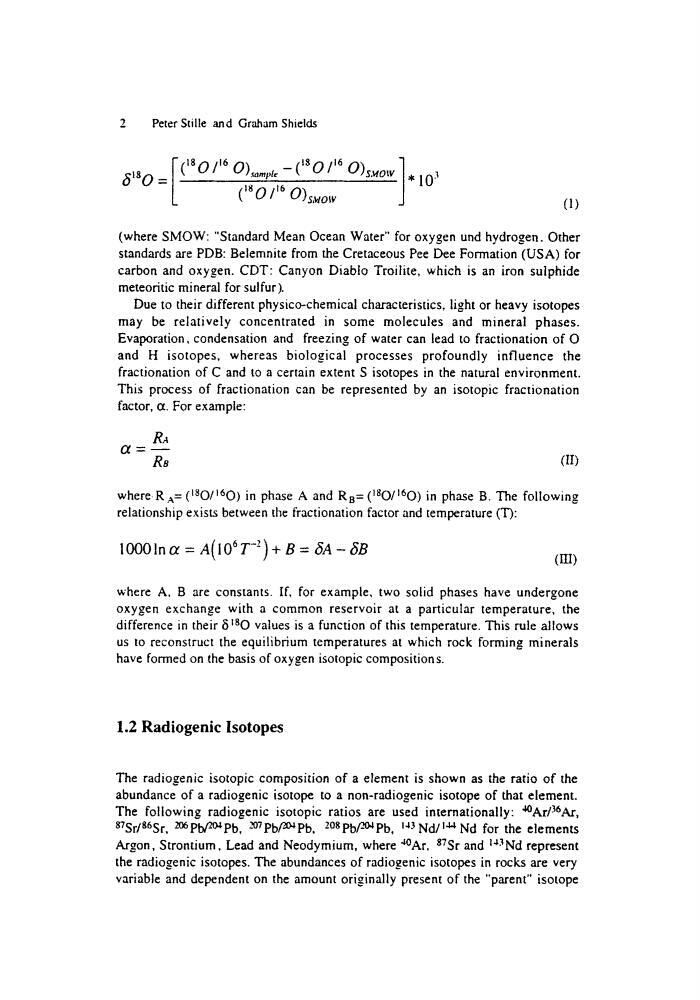
(where SMOW: "Standard Mean Ocean Water" for oxygen und hydrogen. Other
standards are PDB: Belemnite from the Cretaceous Pee Dee Formation (USA) for
carbon and oxygen. CDT: Canyon Diablo Troilite, which is an iron sulphide
meteoritic mineral for sulfur).
Due to their different physico-chemical characteristics, light or heavy isotopes
may be relatively concentrated in some molecules and mineral phases.
Evaporation, condensation and freezing of water can lead to fractionation of O
and H isotopes, whereas biological processes profoundly influence the
fractionation of C and to a certain extent S isotopes in the natural environment.
This process of fractionation can be represented by an isotopic fractionation
factor, or. For example:
Ra
( 9 ~ .-..- ~
Rs
(II)
whereRa= (180/'60) in phase A and RB= (J80/J60) in phase B. The following
relationship exists between the fractionation factor and temperature (T):
1000In o: = A(106 T --') + B = 5.4 - SB
(gI)
where A, B are constants. IL for example, two solid phases have undergone
oxygen exchange with a common reservoir at a particular temperature, the
difference in their B IsO values is a function of this temperature. This rule allows
us to reconstruct the equilibrium temperatures at which rock forming minerals
have formed on the basis of oxygen isotopic compositions.
1.2 Radiogenic Isotopes
The radiogenic isotopic composition of a element is shown as the ratio of the
abundance of a radiogenic isotope to a non-radiogenic isotope of that element.
The following radiogenic isotopic ratios are used internationally: 4~
87Sr/86Sr ' 206pbCz~pb ' .'07pb/-,.04pb ' 208pb/'~4pb ' N3 Nd/la# Nd for the elements
Argon, Strontium, Lead and Neodymium, where 4~
STSr and x'~3Nd represent
the radiogenic isotopes. The abundances of radiogenic isotopes in rocks are very
variable and dependent on the amount originally present of the "parent" isotope
Peter Stille and Graham Shields
O),,,,.,,l. - ( 0
O)sMow ] O'
61SO= (180/16
is /16
~ ' ~ - -
*1
( 0 / O)s,~low
J
(1)
(where SMOW: "Standard Mean Ocean Water" for oxygen und hydrogen. Other
standards are PDB: Belemnite from the Cretaceous Pee Dee Formation (USA) for
carbon and oxygen. CDT: Canyon Diablo Troilite, which is an iron sulphide
meteoritic mineral for sulfur).
Due to their different physico-chemical characteristics, light or heavy isotopes
may be relatively concentrated in some molecules and mineral phases.
Evaporation, condensation and freezing of water can lead to fractionation of O
and H isotopes, whereas biological processes profoundly influence the
fractionation of C and to a certain extent S isotopes in the natural environment.
This process of fractionation can be represented by an isotopic fractionation
factor, or. For example:
Ra
( 9 ~ .-..- ~
Rs
(II)
whereRa= (180/'60) in phase A and RB= (J80/J60) in phase B. The following
relationship exists between the fractionation factor and temperature (T):
1000In o: = A(106 T --') + B = 5.4 - SB
(gI)
where A, B are constants. IL for example, two solid phases have undergone
oxygen exchange with a common reservoir at a particular temperature, the
difference in their B IsO values is a function of this temperature. This rule allows
us to reconstruct the equilibrium temperatures at which rock forming minerals
have formed on the basis of oxygen isotopic compositions.
1.2 Radiogenic Isotopes
The radiogenic isotopic composition of a element is shown as the ratio of the
abundance of a radiogenic isotope to a non-radiogenic isotope of that element.
The following radiogenic isotopic ratios are used internationally: 4~
87Sr/86Sr ' 206pbCz~pb ' .'07pb/-,.04pb ' 208pb/'~4pb ' N3 Nd/la# Nd for the elements
Argon, Strontium, Lead and Neodymium, where 4~
STSr and x'~3Nd represent
the radiogenic isotopes. The abundances of radiogenic isotopes in rocks are very
variable and dependent on the amount originally present of the "parent" isotope