

130 Peter Stille and Graham Shields
Z
..B
"1o
Z
I
0 Phosp~te
@
0.5124
~' Carl~onate
F
,]
9
Foraminifera
1_
w
Error
0.5123 o
,
,.f/. '_////
T
0.5121
0.7090 r%w__ ~., '
%
L
%o
(13 0.7085
~ 0.7080
I
I
|
~
/Seawater
"T "'Y-~" '.,
~ J:3...
I
-.
t
4
6' 0
Age (Mo)
I
80
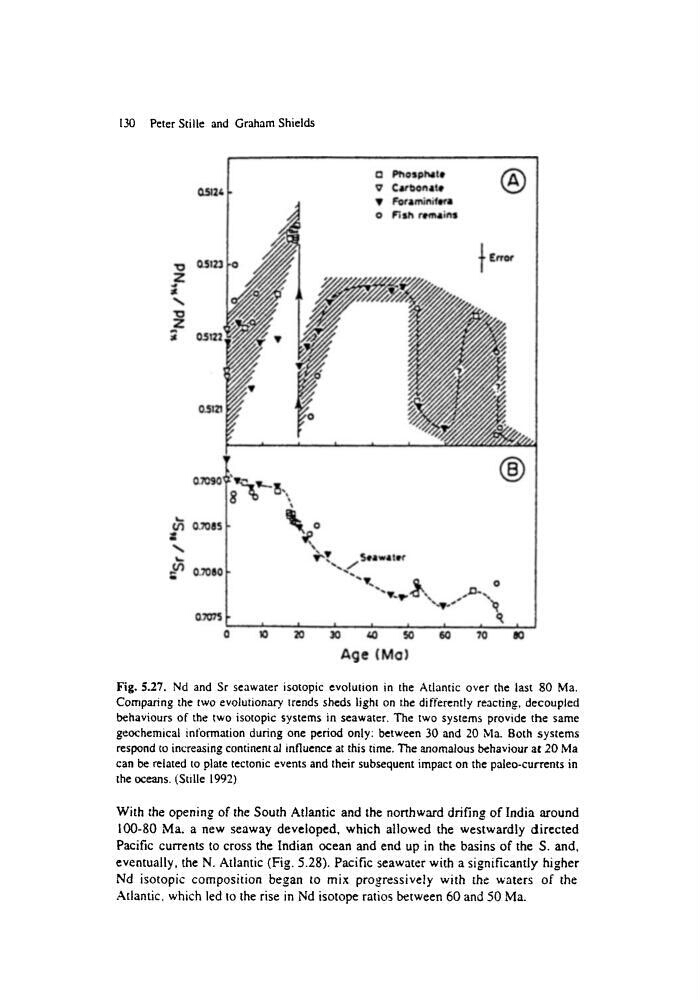
Fig. 5.27. Nd and Sr seawater isotopic evolution in the Atlantic over the last 80 Ma.
Comparing the two evolutionary trends sheds light on the differently reacting, decoupled
behaviours of the two isotopic systems in seawater. The two systems provide the same
geochemical information during one period only: between 30 and 20 Ma. Both systems
respond to increasing continental influence at this time. The anomalous behaviour a~ 20 Ma
can be related to plate tectonic events and their subsequent impact on the paleo-currents in
the oceans. (Stille 1992)
With the opening of the South Atlantic and the northward drifing of India around
100-80 Ma. a new seaway developed, which allowed the westwardly directed
Pacific currents to cross the Indian ocean and end up in the basins of the S. and,
eventually, the N. Atlantic (Fig. 5.28). Pacific seawater with a significantly higher
Nd isotopic composition began to mix progressively with the waters of the
Atlantic, which led to the rise in Nd isotope ratios between 60 and 50 Ma.
Z
..B
"1o
Z
I
0 Phosp~te
@
0.5124
~' Carl~onate
F
,]
9
Foraminifera
1_
w
Error
0.5123 o
,
,.f/. '_////
T
0.5121
0.7090 r%w__ ~., '
%
L
%o
(13 0.7085
~ 0.7080
I
I
|
~
/Seawater
"T "'Y-~" '.,
~ J:3...
I
-.
t
4
6' 0
Age (Mo)
I
80
Fig. 5.27. Nd and Sr seawater isotopic evolution in the Atlantic over the last 80 Ma.
Comparing the two evolutionary trends sheds light on the differently reacting, decoupled
behaviours of the two isotopic systems in seawater. The two systems provide the same
geochemical information during one period only: between 30 and 20 Ma. Both systems
respond to increasing continental influence at this time. The anomalous behaviour a~ 20 Ma
can be related to plate tectonic events and their subsequent impact on the paleo-currents in
the oceans. (Stille 1992)
With the opening of the South Atlantic and the northward drifing of India around
100-80 Ma. a new seaway developed, which allowed the westwardly directed
Pacific currents to cross the Indian ocean and end up in the basins of the S. and,
eventually, the N. Atlantic (Fig. 5.28). Pacific seawater with a significantly higher
Nd isotopic composition began to mix progressively with the waters of the
Atlantic, which led to the rise in Nd isotope ratios between 60 and 50 Ma.