

5 Isotopic Composition of Seawater 129
manifest itself in the Tethys where the Nd system remained strongly influenced by
continental input. This jump takes place without any reaction from the Sr system
and thus cannot be related to a sudden switch in input from continental to basaltic,
oceanic sources. Such a switch would not have led to a decoupling of the Sr and
the Nd systems. That is to say, an increase in the amount of mantle influenced Sr
and Nd would have led to a rise in the Nd isotopic compositions coupled with a
fall in Sr isotope composition. This is not the case here.
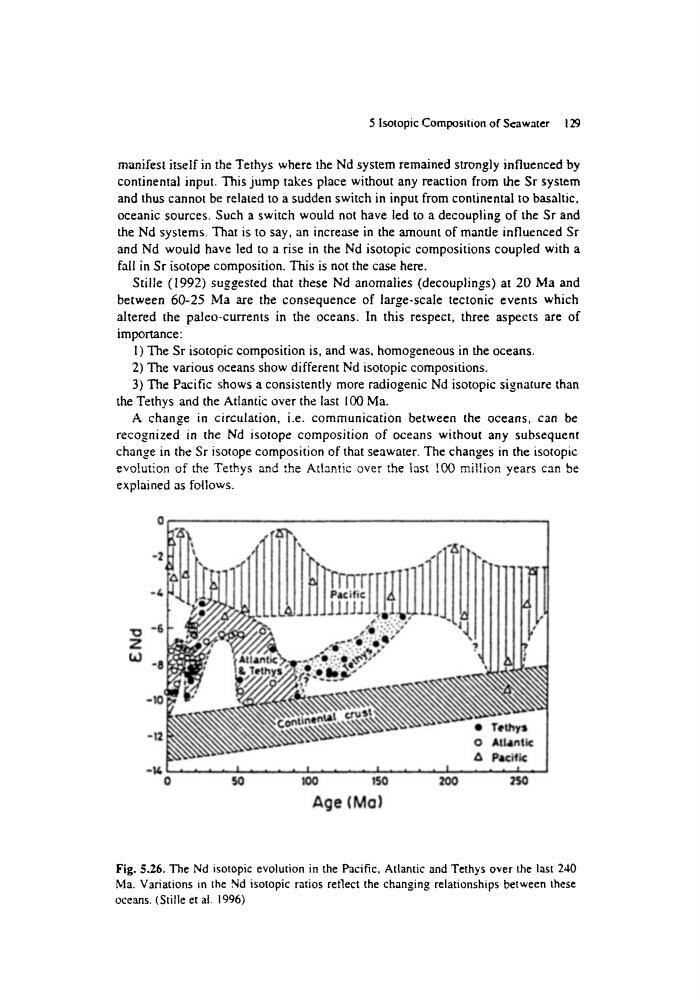
Stille (1992) suggested that these Nd anomalies (decouplings) at 20 Ma and
between 60-25 Ma are the consequence of large-scale tectonic events which
altered the paleo-currents in the oceans. In this respect, three aspects are of
importance:
1) The Sr isotopic composition is, and was, homogeneous in the oceans.
2) The various oceans show different Nd isotopic compositions.
3) The Pacific shows a consistently more radiogenic Nd isotopic signature than
the Tethys and the Atlantic over the last 100 Ma.
A change in circulation, i.e. communication between the oceans, can be
recognized in the Nd isotope composition of oceans without any subsequent
change in the Sr isotope composition of that seawater. The changes in the isotopic
evolution of the Tethys and the Atlantic over the last 100 mitfion years can be
explained as follows.
-2
-t.
"10 - 6
z
-12 !
-I/, 0
~, Pacific
I
I
l
1
!
.
50
100
150
200
250
Age (Mo)
Fig. 5.26. The Nd isotopic evolution in the Pacific, Atlantic and Tethys over the last 240
Ma. Variations in the Nd isotopic ratios reflect the changing relationships between these
oceans. (Stille et al. 1996)
manifest itself in the Tethys where the Nd system remained strongly influenced by
continental input. This jump takes place without any reaction from the Sr system
and thus cannot be related to a sudden switch in input from continental to basaltic,
oceanic sources. Such a switch would not have led to a decoupling of the Sr and
the Nd systems. That is to say, an increase in the amount of mantle influenced Sr
and Nd would have led to a rise in the Nd isotopic compositions coupled with a
fall in Sr isotope composition. This is not the case here.
Stille (1992) suggested that these Nd anomalies (decouplings) at 20 Ma and
between 60-25 Ma are the consequence of large-scale tectonic events which
altered the paleo-currents in the oceans. In this respect, three aspects are of
importance:
1) The Sr isotopic composition is, and was, homogeneous in the oceans.
2) The various oceans show different Nd isotopic compositions.
3) The Pacific shows a consistently more radiogenic Nd isotopic signature than
the Tethys and the Atlantic over the last 100 Ma.
A change in circulation, i.e. communication between the oceans, can be
recognized in the Nd isotope composition of oceans without any subsequent
change in the Sr isotope composition of that seawater. The changes in the isotopic
evolution of the Tethys and the Atlantic over the last 100 mitfion years can be
explained as follows.
-2
-t.
"10 - 6
z
-12 !
-I/, 0
~, Pacific
I
I
l
1
!
.
50
100
150
200
250
Age (Mo)
Fig. 5.26. The Nd isotopic evolution in the Pacific, Atlantic and Tethys over the last 240
Ma. Variations in the Nd isotopic ratios reflect the changing relationships between these
oceans. (Stille et al. 1996)