

5 Isotopic Composition of Seawater 1 t9
As a consequence of such variation, Nd isotopes have great potential for
oceanographic investigations as they allow us to differentiate several water
bodies, to recognize ocean currents, and to reconstruct exchange processes within
a single ocean basin (Sect. 5.3).
5.2.2 Possibilities for the Derivation of the Nd Isotopic Composition of PaleoOceans
The first studies which looked at the Nd isotopic composition of paleo-oceans
were carried out on metal-rich sediments, Mn-crusts and nodules. As already
mentioned, these preferentially incorporate Nd, which retains the isotopic
composition of seawater. Worth mentioning in this connection are the studies of
Chyi e t al, (1984) and Hooker et al. (1981). Analogous to studies on recent metalrich sediments, Mn crusts and ores, they investigated ancient marine ore bodies
with knc~wn ages and so> for the first time, were able to derive the Nd isotopic
compositions of Jurassic and Cambrian seawater. Their investigations also
involved marine carbonates, phosphates and cherts.
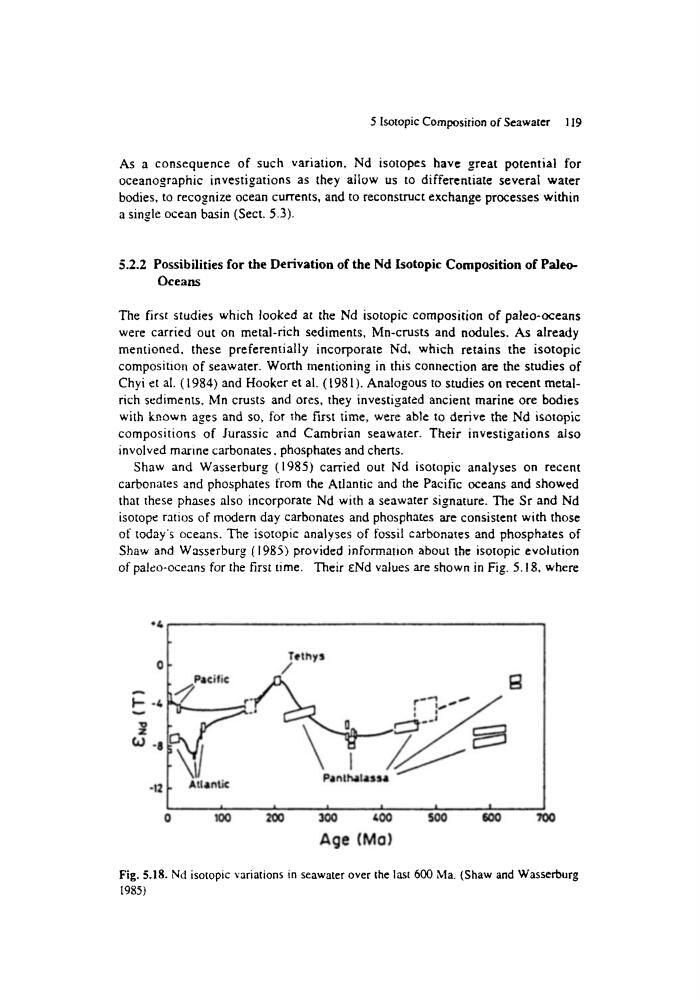
Shaw and Wasserburg (1985) carried out Nd isotopic analyses on recent
carbonates and phosphates from the Atlantic and the Pacific oceans and showed
that these phases also incorporate Nd with a seawater signature. The Sr and Nd
isotope ratios of modern day carbonates and phosphates are consistent with those
of today's oceans. The isotopic analyses of fossil carbonates and phosphates of
Shaw and Wasserburg (1985) provided information about the isotopic evolution
of paleo-oceans for the first time. Their ENd values are shown in Fig. 5.18, where
*4
0
I----4
"O
Tethy$
/
/'~Palclf ic
A
Atlantic
Panthatassa
-12
0
100
200
300
~00
500
600
700
Age (Me)
Fig. 5.18. Nd isotopic variations in seawater over the last 600 Ma. (Shaw and Wasserburg
1985)
As a consequence of such variation, Nd isotopes have great potential for
oceanographic investigations as they allow us to differentiate several water
bodies, to recognize ocean currents, and to reconstruct exchange processes within
a single ocean basin (Sect. 5.3).
5.2.2 Possibilities for the Derivation of the Nd Isotopic Composition of PaleoOceans
The first studies which looked at the Nd isotopic composition of paleo-oceans
were carried out on metal-rich sediments, Mn-crusts and nodules. As already
mentioned, these preferentially incorporate Nd, which retains the isotopic
composition of seawater. Worth mentioning in this connection are the studies of
Chyi e t al, (1984) and Hooker et al. (1981). Analogous to studies on recent metalrich sediments, Mn crusts and ores, they investigated ancient marine ore bodies
with knc~wn ages and so> for the first time, were able to derive the Nd isotopic
compositions of Jurassic and Cambrian seawater. Their investigations also
involved marine carbonates, phosphates and cherts.
Shaw and Wasserburg (1985) carried out Nd isotopic analyses on recent
carbonates and phosphates from the Atlantic and the Pacific oceans and showed
that these phases also incorporate Nd with a seawater signature. The Sr and Nd
isotope ratios of modern day carbonates and phosphates are consistent with those
of today's oceans. The isotopic analyses of fossil carbonates and phosphates of
Shaw and Wasserburg (1985) provided information about the isotopic evolution
of paleo-oceans for the first time. Their ENd values are shown in Fig. 5.18, where
*4
0
I----4
"O
Tethy$
/
/'~Palclf ic
A
Atlantic
Panthatassa
-12
0
100
200
300
~00
500
600
700
Age (Me)
Fig. 5.18. Nd isotopic variations in seawater over the last 600 Ma. (Shaw and Wasserburg
1985)