

118 Peter Stille and Graham Shields
Let us apply the lowest of the Nd residence times, 400 years, from Piep~as et al.
(1979). Thus, 1600 years is shown to be the Atlantic-Pacific oceans' mixing time.
Therefore, this lower residence time of 400 yr appears the most reasonable as
1600 years matches much better the calculated whole ocean mixing time (about
1500 years). Therefore, it is clear that the 'effectively dissolved' load of Nd and
the REE in river water has been vastly underestimated. It is important to note the
relationship between residence time and ocean mixing time in equation (XIV).
From this relationship we can see that the mixing time must be about 4 times
longer than the residence time of Nd.
These results explain the observation that there are different Nd isotopic ratios
in the different ocean basins (Fig. 5.16). On the basis of the Nd residence time
which must be shorter than the ocean mixing time, we can see that Nd can never
be sufficiently circulated for isotopic homogenization similar to St. Piepgras and
Wasserburg (1980) demonstrated that inhomogeneities in the Nd isotopic ratio can
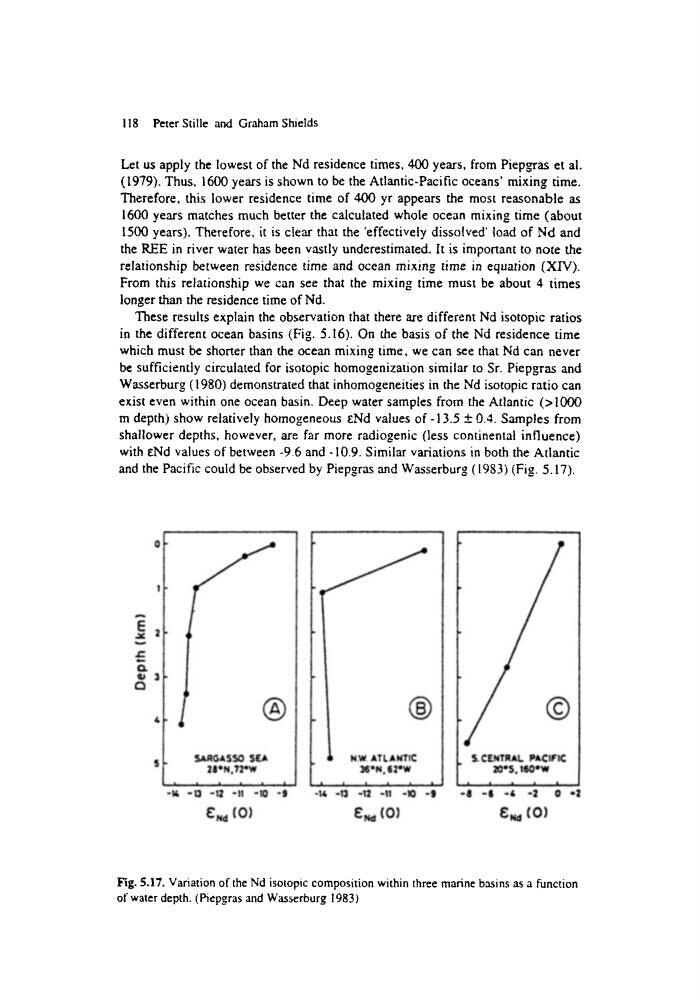
exist even within one ocean basin. Deep water samples from the Atlantic (>1000
m depth) show relatively homogeneous eNd values of-13.5 + 0.4. Samples from
shallower depths, however, are far more radiogenic (less continental influence)
with v_.Nd values of between -9.6 and -10.9. Similar variations in both the Atlantic
and the Pacific could be observed by Piepgras and Wasserburg (1983) (Fig. 5.17).
@
E 9 ,,- 2
3
C3
|
J
S. CENTRAL PACIFIC
20"5.150~
a
/
i
- 8 - 6 -& -2
0 -'2
ENd (O1
S A R G A S 5 0
S E A
N W A T L A N T I C
2 a Q N , ? 2 ~
3 6 a N . 6 2 " W
i
i
t
l
z
- ~ - u - , z
- . -io -s
- ~ 4 - , 3 -,2 - . qo -~
Fig. 5.17. Variation of the Nd isotopic composition within three marine basins as a function
of water depth. (FSepgras and Wassenburg 1983)
Let us apply the lowest of the Nd residence times, 400 years, from Piep~as et al.
(1979). Thus, 1600 years is shown to be the Atlantic-Pacific oceans' mixing time.
Therefore, this lower residence time of 400 yr appears the most reasonable as
1600 years matches much better the calculated whole ocean mixing time (about
1500 years). Therefore, it is clear that the 'effectively dissolved' load of Nd and
the REE in river water has been vastly underestimated. It is important to note the
relationship between residence time and ocean mixing time in equation (XIV).
From this relationship we can see that the mixing time must be about 4 times
longer than the residence time of Nd.
These results explain the observation that there are different Nd isotopic ratios
in the different ocean basins (Fig. 5.16). On the basis of the Nd residence time
which must be shorter than the ocean mixing time, we can see that Nd can never
be sufficiently circulated for isotopic homogenization similar to St. Piepgras and
Wasserburg (1980) demonstrated that inhomogeneities in the Nd isotopic ratio can
exist even within one ocean basin. Deep water samples from the Atlantic (>1000
m depth) show relatively homogeneous eNd values of-13.5 + 0.4. Samples from
shallower depths, however, are far more radiogenic (less continental influence)
with v_.Nd values of between -9.6 and -10.9. Similar variations in both the Atlantic
and the Pacific could be observed by Piepgras and Wasserburg (1983) (Fig. 5.17).
@
E 9 ,,- 2
3
C3
|
J
S. CENTRAL PACIFIC
20"5.150~
a
/
i
- 8 - 6 -& -2
0 -'2
ENd (O1
S A R G A S 5 0
S E A
N W A T L A N T I C
2 a Q N , ? 2 ~
3 6 a N . 6 2 " W
i
i
t
l
z
- ~ - u - , z
- . -io -s
- ~ 4 - , 3 -,2 - . qo -~
Fig. 5.17. Variation of the Nd isotopic composition within three marine basins as a function
of water depth. (FSepgras and Wassenburg 1983)