

104 Peter Stille and Graham Shields
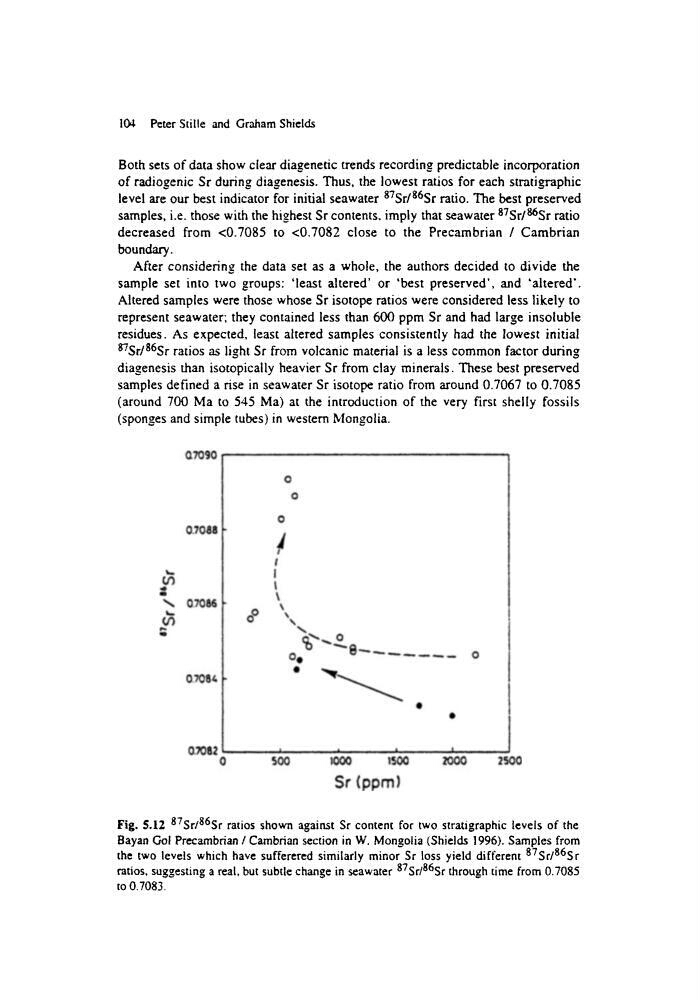
Both sets of data show clear diagenetic trends recording predictable incorporation
of radiogenic Sr during diagenesis. Thus, the lowest ratios for each stratigraphic
level are our best indicator for initial seawater 87Sr/g6Sr ratio. The best preserved
samples, i.e. those with the highest Sr contents, imply that seawater 87Sr/86Sr ratio
decreased from <0.7085 to <0.7082 close to the Precambrian I Cambrian
boundary.
After considering the data set as a whole, the authors decided to divide the
sample set into two groups: 'least altered' or 'best preserved', and 'altered'.
Altered samples were those whose Sr isotope ratios were considered less likely to
represent seawater; they contained less than 600 ppm Sr and had large insoluble
residues. As expected, least altered samples consistently had the lowest initial
STSr/86Sr ratios as light Sr from volcanic material is a less common factor during
diagenesis than isotopicaily heavier Sr from clay minerals. These best preserved
samples defined a rise in seawater Sr isotope ratio from around 0.7067 to 0.7085
(around 700 Ma to 545 Ma) at the introduction of the very first shelly fossils
(sponges and simple tubes) in western Mongolia.
07090
0.7088
07086
07084
0
0
0
r
I
I
I
\
\
N
r176 ~ g . . . . . . .
o
Oe
0.7082
A
'
"~0
i
o
soo
~ooo
o
~oo
2soo
Sr (ppm)
Fig. 5.12 87Sr/86Sr ratios shown against Sr content for two stratigraphic levels of the
Bayan (3ol Precambrian / Cambrian section in W. Mongolia (Shields 1996). Samples from
the two levels which have sufferered similarly minor Sr loss yield different 87Sr/86Sr
ratios, suggesting a real, but subtle change in seawater 87Sr/86Sr through time from 0.7085
to 0.7083.
Both sets of data show clear diagenetic trends recording predictable incorporation
of radiogenic Sr during diagenesis. Thus, the lowest ratios for each stratigraphic
level are our best indicator for initial seawater 87Sr/g6Sr ratio. The best preserved
samples, i.e. those with the highest Sr contents, imply that seawater 87Sr/86Sr ratio
decreased from <0.7085 to <0.7082 close to the Precambrian I Cambrian
boundary.
After considering the data set as a whole, the authors decided to divide the
sample set into two groups: 'least altered' or 'best preserved', and 'altered'.
Altered samples were those whose Sr isotope ratios were considered less likely to
represent seawater; they contained less than 600 ppm Sr and had large insoluble
residues. As expected, least altered samples consistently had the lowest initial
STSr/86Sr ratios as light Sr from volcanic material is a less common factor during
diagenesis than isotopicaily heavier Sr from clay minerals. These best preserved
samples defined a rise in seawater Sr isotope ratio from around 0.7067 to 0.7085
(around 700 Ma to 545 Ma) at the introduction of the very first shelly fossils
(sponges and simple tubes) in western Mongolia.
07090
0.7088
07086
07084
0
0
0
r
I
I
I
\
\
N
r176 ~ g . . . . . . .
o
Oe
0.7082
A
'
"~0
i
o
soo
~ooo
o
~oo
2soo
Sr (ppm)
Fig. 5.12 87Sr/86Sr ratios shown against Sr content for two stratigraphic levels of the
Bayan (3ol Precambrian / Cambrian section in W. Mongolia (Shields 1996). Samples from
the two levels which have sufferered similarly minor Sr loss yield different 87Sr/86Sr
ratios, suggesting a real, but subtle change in seawater 87Sr/86Sr through time from 0.7085
to 0.7083.