

5 Isotopic Composition of Seawater 103
HCl-soluble fractions and Sr isotope ratios of the acetic acid soluble fraction for
over 100 bulk limestone rocks. Samples underwent an initial selection procedure
similar to that described in Fig. 5.9. After isotopic analysis, covariation of
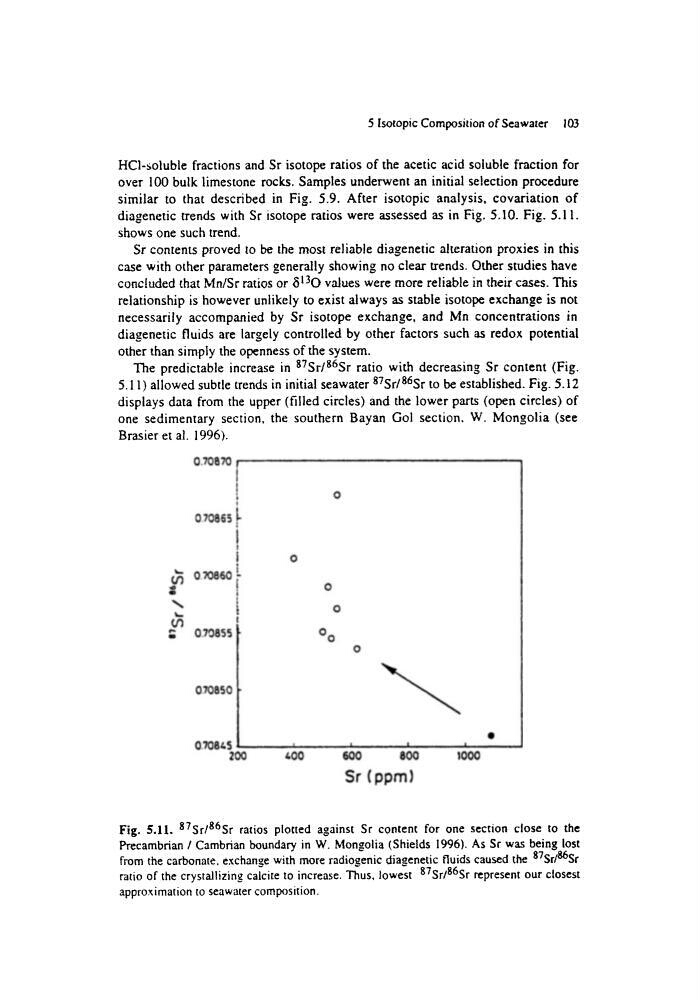
diagenetic trends with Sr isotope ratios were assessed as in Fig. 5.10. Fig. 5.1 1.
shows one such trend.
Sr contents proved to be the most reliable diagenetic alteration proxies in this
case with other parameters generally showing no clear trends. Other studies have
concluded that Mn/Sr ratios or (~130 values were more reliable in their cases. This
relationship is however unlikely to exist always as stable isotope exchange is not
necessarily accompanied by Sr isotope exchange, and Mn concentrations in
diagenetic fluids are largely controlled by other factors such as redox potential
other than simply the openness of the system.
The predictable increase in 87Sr/S6Sr ratio with decreasing Sr content (Fig.
5.11) allowed subtle trends in initial seawater 87Sr/86Sr to be established. Fig. 5.12
displays data from the upper (filled circles) and the lower parts (open circles) of
one sedimentary section, the southern Bayan Gol section, W. Mongolia (see
Brasier et al. 1996).
070870
070855'
(~ 0 70860
,~ 0.70855
070850
0708z.5
200
400
o
o
o
o o
o
i
I
i
600
800
1000
Sr (ppm)
Fig. 5.11. 87Sr/86Sr ratios plotted against Sr content for one section close to the
Precambrian / Cambrian boundary in W. Mongolia (Shields 1996). As Sr was being lost
from the carbonate, exchange with more radiogenic diagenetic fluids caused the 87Sr/86Sr
ratio of the crystallizing calcite to increase. Thus, lowest 87Sr/g6Sr represent our closest
approximation to seawater composition.
HCl-soluble fractions and Sr isotope ratios of the acetic acid soluble fraction for
over 100 bulk limestone rocks. Samples underwent an initial selection procedure
similar to that described in Fig. 5.9. After isotopic analysis, covariation of
diagenetic trends with Sr isotope ratios were assessed as in Fig. 5.10. Fig. 5.1 1.
shows one such trend.
Sr contents proved to be the most reliable diagenetic alteration proxies in this
case with other parameters generally showing no clear trends. Other studies have
concluded that Mn/Sr ratios or (~130 values were more reliable in their cases. This
relationship is however unlikely to exist always as stable isotope exchange is not
necessarily accompanied by Sr isotope exchange, and Mn concentrations in
diagenetic fluids are largely controlled by other factors such as redox potential
other than simply the openness of the system.
The predictable increase in 87Sr/S6Sr ratio with decreasing Sr content (Fig.
5.11) allowed subtle trends in initial seawater 87Sr/86Sr to be established. Fig. 5.12
displays data from the upper (filled circles) and the lower parts (open circles) of
one sedimentary section, the southern Bayan Gol section, W. Mongolia (see
Brasier et al. 1996).
070870
070855'
(~ 0 70860
,~ 0.70855
070850
0708z.5
200
400
o
o
o
o o
o
i
I
i
600
800
1000
Sr (ppm)
Fig. 5.11. 87Sr/86Sr ratios plotted against Sr content for one section close to the
Precambrian / Cambrian boundary in W. Mongolia (Shields 1996). As Sr was being lost
from the carbonate, exchange with more radiogenic diagenetic fluids caused the 87Sr/86Sr
ratio of the crystallizing calcite to increase. Thus, lowest 87Sr/g6Sr represent our closest
approximation to seawater composition.