

5 Isotopic Composition of Seawater 101
confirmed by the work of Asmerom et al. (1991). This latter study is marked by
samples with very high Sr contents and internally consistent strati~aphic trends in
Sr isotope ratio and as such can be regarded as the beginning of our well
constrained Precambrian Sr isotope record. Further additions to our knowledge of
late Precambrian Sr isotopic evolution were made by Derry et al. (1992) and can
be seen summarised in Brasier et al. (1996).
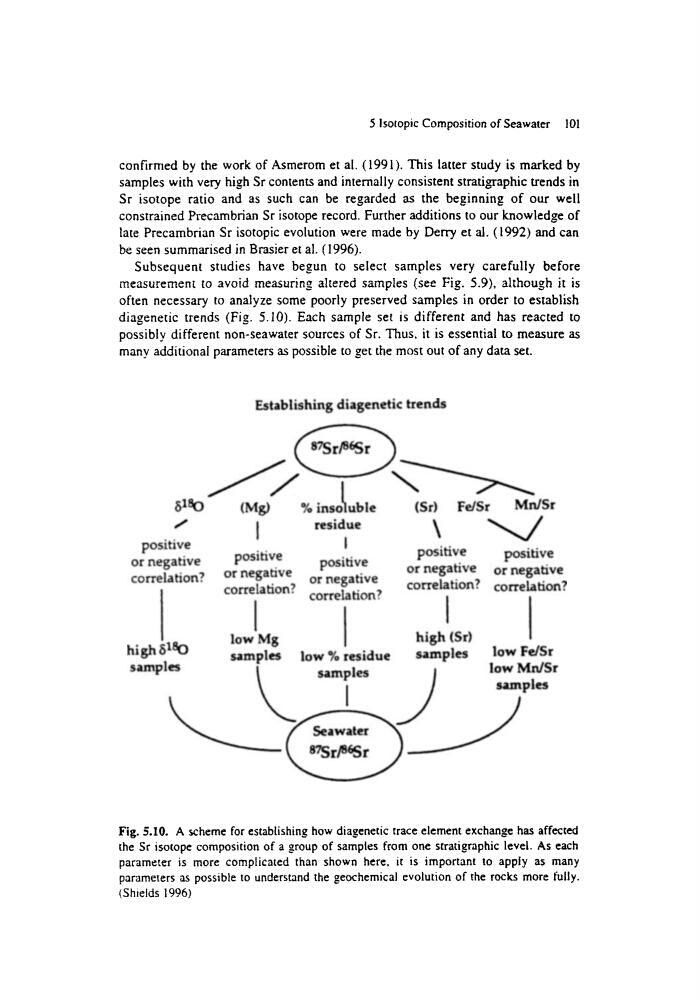
Subsequent studies have begun to select samples very carefully before
measurement to avoid measuring altered samples (see Fig. 5.9), although it is
often necessary to analyze some poorly preserved samples in order to establish
diagenetic trends (Fig. 5.10). Each sample set is different and has reacted to
possibly different non-seawater sources of Sr. Thus, it is essential to measure as
many additional parameters as possible to get the most out of any data set.
518o
f
positive
or negative
correlation?
I
high 5180
samples
Establishing diagenetic trends
I
positive
positive
positive
positive
or negative
or negative
or negative
or negative
correlation? correlation?
correlation? correlation?
high (Sr)
low % residue
s a m p l e s
I
low Mg
s a m p l e s
low Fe/Sr
low M n / S r
samples
J
Fig. 5.10. A scheme for establishing how diagenetic trace element exchange has affected
the Sr isotope composition of a group of samples from one stratigraphic level. As each
parameter is more complicated than shown here, it is important to apply as many
parameters as possible to understand the geochemical evolution of the rocks more tully.
(Shields 1996)
confirmed by the work of Asmerom et al. (1991). This latter study is marked by
samples with very high Sr contents and internally consistent strati~aphic trends in
Sr isotope ratio and as such can be regarded as the beginning of our well
constrained Precambrian Sr isotope record. Further additions to our knowledge of
late Precambrian Sr isotopic evolution were made by Derry et al. (1992) and can
be seen summarised in Brasier et al. (1996).
Subsequent studies have begun to select samples very carefully before
measurement to avoid measuring altered samples (see Fig. 5.9), although it is
often necessary to analyze some poorly preserved samples in order to establish
diagenetic trends (Fig. 5.10). Each sample set is different and has reacted to
possibly different non-seawater sources of Sr. Thus, it is essential to measure as
many additional parameters as possible to get the most out of any data set.
518o
f
positive
or negative
correlation?
I
high 5180
samples
Establishing diagenetic trends
I
positive
positive
positive
positive
or negative
or negative
or negative
or negative
correlation? correlation?
correlation? correlation?
high (Sr)
low % residue
s a m p l e s
I
low Mg
s a m p l e s
low Fe/Sr
low M n / S r
samples
J
Fig. 5.10. A scheme for establishing how diagenetic trace element exchange has affected
the Sr isotope composition of a group of samples from one stratigraphic level. As each
parameter is more complicated than shown here, it is important to apply as many
parameters as possible to understand the geochemical evolution of the rocks more tully.
(Shields 1996)