

96
Peter Stille and Graham Shields
o
0
I
C
8
0
0
I
. . . . .
e _ _ _
~ 9
o
9
p
17.16 - 17.19
17.22-17.32
17.77
18.33 - 18.38
18.75 - 18.89
19.09 - 19.32
i
elq
!
01
I
!
!
i
I
!
I
lip
I
I
1
I
I
I
I
I
o.7o~5 o.~e6
o.s222s os12s os123s
8~Sr/a6Sr
Sr age
~ N d / '~Nd
(Me)
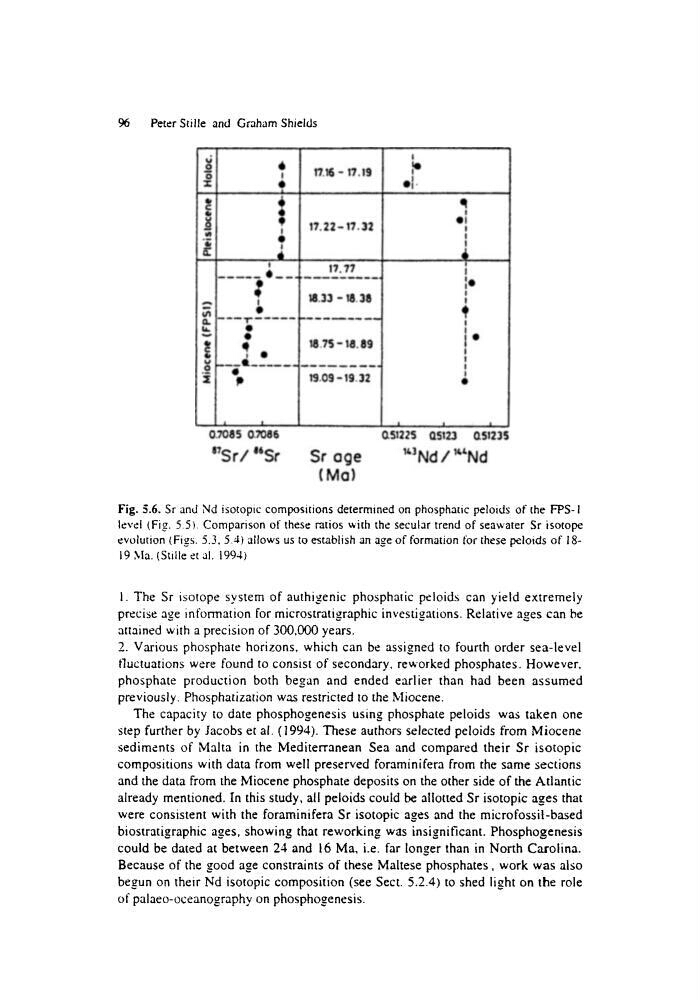
Fig. 5.6. Sr and Nd isotopic compositions determined on phosphatic peloids of the FPS-1
level (Fig. 5.5). Comparison of these ratios with the secular trend of seawater Sr isotope
evolution (Figs. 5.3, 5/-1.) allows us to establish an age of formation t'or these peloids of 1819 Ma. (Stille et al. 1994)
1. The Sr isotope system of authigenic phosphatic peloids can yield extremely
precise age information for microstratigraphic investigations. Relative ages can be
attained with a precision of 300,000 years.
2. Various phosphate horizons, which can be assigned to fourth order sea-level
tluctuations were found to consist of secondary, reworked phosphates. However,
phosphate production both began and ended earlier than had been assumed
previously. Phosphatization was restricted to the Miocene.
The capacity to date phosphogenesis using phosphate peloids was taken one
step further by Jacobs et al. (1994). These authors selected peloids from Miocene
sediments of Malta in the Mediterranean Sea and compared their Sr isotopic
compositions with data from well preserved foraminifera from the same sections
and the data from the Miocene phosphate deposits on the other side of the Atlantic
already mentioned. In this study, all peloids could be allotted Sr isotopic ages that
were consistent with the foraminifera Sr isotopic ages and the microfossil-based
biostratigraphic ages, showing that reworking was insignificant. Phosphogenesis
could be dated at between 24 and 16 Ma, i.e. far longer than in North Carolina.
Because of the good age constraints of these Maltese phosphates, work was also
begun on their Nd isotopic composition (see Sect. 5.2.4) to shed light on the role
of palaeo-oceanography on phosphogenesis.
Peter Stille and Graham Shields
o
0
I
C
8
0
0
I
. . . . .
e _ _ _
~ 9
o
9
p
17.16 - 17.19
17.22-17.32
17.77
18.33 - 18.38
18.75 - 18.89
19.09 - 19.32
i
elq
!
01
I
!
!
i
I
!
I
lip
I
I
1
I
I
I
I
I
o.7o~5 o.~e6
o.s222s os12s os123s
8~Sr/a6Sr
Sr age
~ N d / '~Nd
(Me)
Fig. 5.6. Sr and Nd isotopic compositions determined on phosphatic peloids of the FPS-1
level (Fig. 5.5). Comparison of these ratios with the secular trend of seawater Sr isotope
evolution (Figs. 5.3, 5/-1.) allows us to establish an age of formation t'or these peloids of 1819 Ma. (Stille et al. 1994)
1. The Sr isotope system of authigenic phosphatic peloids can yield extremely
precise age information for microstratigraphic investigations. Relative ages can be
attained with a precision of 300,000 years.
2. Various phosphate horizons, which can be assigned to fourth order sea-level
tluctuations were found to consist of secondary, reworked phosphates. However,
phosphate production both began and ended earlier than had been assumed
previously. Phosphatization was restricted to the Miocene.
The capacity to date phosphogenesis using phosphate peloids was taken one
step further by Jacobs et al. (1994). These authors selected peloids from Miocene
sediments of Malta in the Mediterranean Sea and compared their Sr isotopic
compositions with data from well preserved foraminifera from the same sections
and the data from the Miocene phosphate deposits on the other side of the Atlantic
already mentioned. In this study, all peloids could be allotted Sr isotopic ages that
were consistent with the foraminifera Sr isotopic ages and the microfossil-based
biostratigraphic ages, showing that reworking was insignificant. Phosphogenesis
could be dated at between 24 and 16 Ma, i.e. far longer than in North Carolina.
Because of the good age constraints of these Maltese phosphates, work was also
begun on their Nd isotopic composition (see Sect. 5.2.4) to shed light on the role
of palaeo-oceanography on phosphogenesis.