

539
length, porosity, and in their dispersion and
diffusion properties.
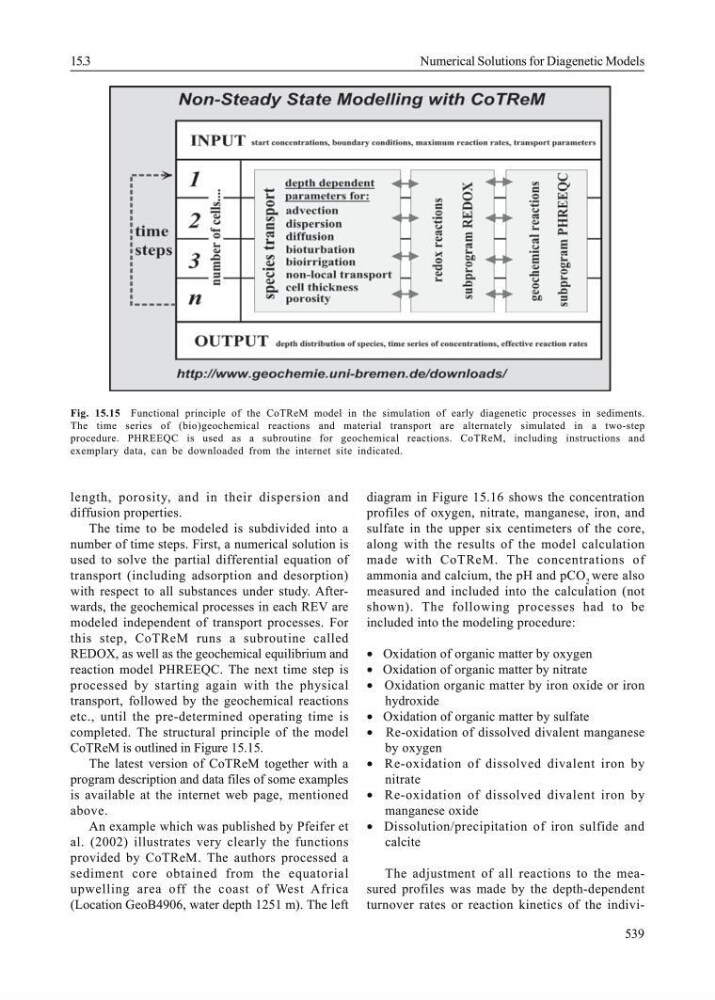
The time to be modeled is subdivided into a
number of time steps. First, a numerical solution is
used to solve the partial differential equation of
transport (including adsorption and desorption)
with respect to all substances under study. Afterwards, the geochemical processes in each REV are
modeled independent of transport processes. For
this step, CoTReM runs a subroutine called
REDOX, as well as the geochemical equilibrium and
reaction model PHREEQC. The next time step is
processed by starting again with the physical
transport, followed by the geochemical reactions
etc., until the pre-determined operating time is
completed. The structural principle of the model
CoTReM is outlined in Figure 15.15.
The latest version of CoTReM together with a
program description and data files of some examples
is available at the internet web page, mentioned
above.
An example which was published by Pfeifer et
al. (2002) illustrates very clearly the functions
provided by CoTReM. The authors processed a
sediment core obtained from the equatorial
upwelling area off the coast of West Africa
(Location GeoB4906, water depth 1251 m). The left
diagram in Figure 15.16 shows the concentration
profiles of oxygen, nitrate, manganese, iron, and
sulfate in the upper six centimeters of the core,
along with the results of the model calculation
made with CoTReM. The concentrations of
ammonia and calcium, the pH and pCO 2 were also
measured and included into the calculation (not
shown). The following processes had to be
included into the modeling procedure:
• Oxidation of organic matter by oxygen
• Oxidation of organic matter by nitrate
• Oxidation organic matter by iron oxide or iron
hydroxide
• Oxidation of organic matter by sulfate
• Re-oxidation of dissolved divalent manganese
by oxygen
• Re-oxidation of dissolved divalent iron by
nitrate
• Re-oxidation of dissolved divalent iron by
manganese oxide
• Dissolution/precipitation of iron sulfide and
calcite
The adjustment of all reactions to the measured profiles was made by the depth-dependent
turnover rates or reaction kinetics of the indiviFig. 15.15 Functional principle of the CoTReM model in the simulation of early diagenetic processes in sediments.
The time series of (bio)geochemical reactions and material transport are alternately simulated in a two-step
procedure. PHREEQC is used as a subroutine for geochemical reactions. CoTReM, including instructions and
exemplary data, can be downloaded from the internet site indicated.
15.3
Numerical Solutions for Diagenetic Models
length, porosity, and in their dispersion and
diffusion properties.
The time to be modeled is subdivided into a
number of time steps. First, a numerical solution is
used to solve the partial differential equation of
transport (including adsorption and desorption)
with respect to all substances under study. Afterwards, the geochemical processes in each REV are
modeled independent of transport processes. For
this step, CoTReM runs a subroutine called
REDOX, as well as the geochemical equilibrium and
reaction model PHREEQC. The next time step is
processed by starting again with the physical
transport, followed by the geochemical reactions
etc., until the pre-determined operating time is
completed. The structural principle of the model
CoTReM is outlined in Figure 15.15.
The latest version of CoTReM together with a
program description and data files of some examples
is available at the internet web page, mentioned
above.
An example which was published by Pfeifer et
al. (2002) illustrates very clearly the functions
provided by CoTReM. The authors processed a
sediment core obtained from the equatorial
upwelling area off the coast of West Africa
(Location GeoB4906, water depth 1251 m). The left
diagram in Figure 15.16 shows the concentration
profiles of oxygen, nitrate, manganese, iron, and
sulfate in the upper six centimeters of the core,
along with the results of the model calculation
made with CoTReM. The concentrations of
ammonia and calcium, the pH and pCO 2 were also
measured and included into the calculation (not
shown). The following processes had to be
included into the modeling procedure:
• Oxidation of organic matter by oxygen
• Oxidation of organic matter by nitrate
• Oxidation organic matter by iron oxide or iron
hydroxide
• Oxidation of organic matter by sulfate
• Re-oxidation of dissolved divalent manganese
by oxygen
• Re-oxidation of dissolved divalent iron by
nitrate
• Re-oxidation of dissolved divalent iron by
manganese oxide
• Dissolution/precipitation of iron sulfide and
calcite
The adjustment of all reactions to the measured profiles was made by the depth-dependent
turnover rates or reaction kinetics of the indiviFig. 15.15 Functional principle of the CoTReM model in the simulation of early diagenetic processes in sediments.
The time series of (bio)geochemical reactions and material transport are alternately simulated in a two-step
procedure. PHREEQC is used as a subroutine for geochemical reactions. CoTReM, including instructions and
exemplary data, can be downloaded from the internet site indicated.
15.3
Numerical Solutions for Diagenetic Models