

501
(18,000 years ago). An increase in temperature of
3.3
o
C that followed the last glaciation will shift of
the hydrate stability by ~140 meters, which coupled with a concomitant sea-level rise of ~120
meters, results in an approximate net shift of the
hydrate stability horizon of ~20 meters (Bangs et
al. 2005). Among other evidence, the authors use
a diffusion driven attenuation of the freshening
signal induced by hydrate dissociation when the
GHSZ shifted to a shallower depth. They show
that the observed dissolved chloride distribution
at a site drilled through the double BSR is
consistent with a BSR shift that occurred 4,000 to
8,000 years ago (Fig. 14.17). This time frame, when
analyzed in the context of thermal propagation lag
in the sediment section and potential lag due to
latent heat needed to dissociate hydrate, is
consistent with P/T changes in the water column
that occurred at the end of the LGM (Bangs et al.
2005). A shift of the depth of hydrate stability
associated with post-glaciation P/T changes, has
also been suggested by others for Northern Cascadia (Westbrook et al. 1994), southwestern Japan
(Foucher et al. 2002) and the Norwegian margin
(Mienert et al. 1998).
Pore Water Brines
In the large body of gas-hydrate bearing
locations drilled to date, the dissolved chloride
show lower than seawater values (see reviews by
Ussler and Paull 2001; Hesse 2003). However,
there are examples of gas hydrate bearing sites in
which the dissolved chloride in the pore fluids is
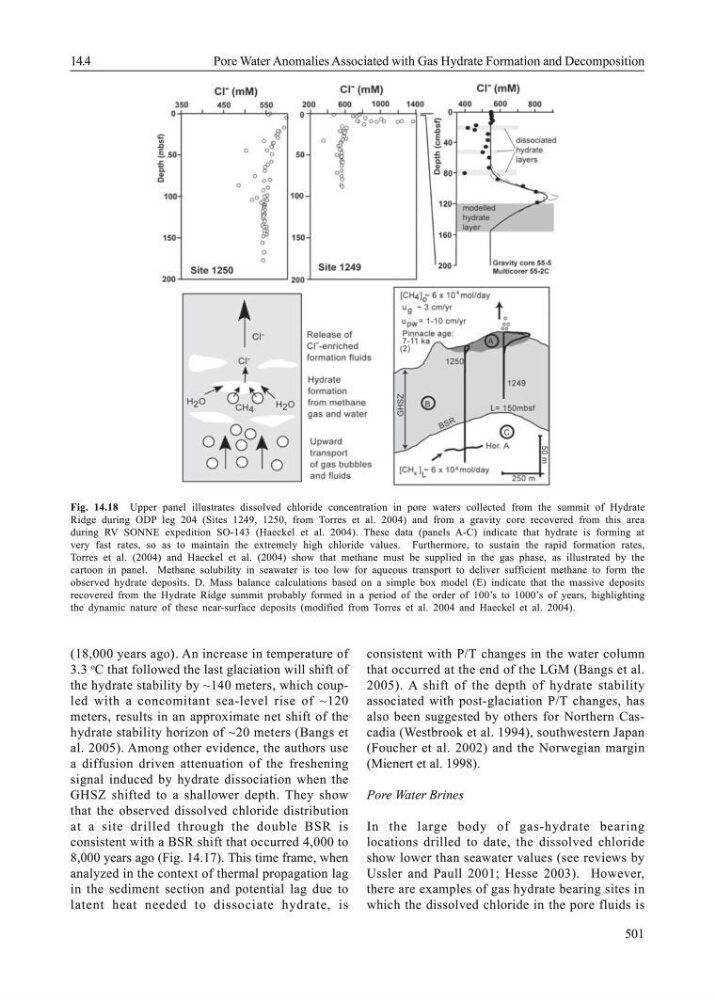
Fig. 14.18 Upper panel illustrates dissolved chloride concentration in pore waters collected from the summit of Hydrate
Ridge during ODP leg 204 (Sites 1249, 1250, from Torres et al. 2004) and from a gravity core recovered from this area
during RV SONNE expedition SO-143 (Haeckel et al. 2004). These data (panels A-C) indicate that hydrate is forming at
very fast rates, so as to maintain the extremely high chloride values. Furthermore, to sustain the rapid formation rates,
Torres et al. (2004) and Haeckel et al. (2004) show that methane must be supplied in the gas phase, as illustrated by the
cartoon in panel. Methane solubility in seawater is too low for aqueous transport to deliver sufficient methane to form the
observed hydrate deposits. D. Mass balance calculations based on a simple box model (E) indicate that the massive deposits
recovered from the Hydrate Ridge summit probably formed in a period of the order of 100’s to 1000’s of years, highlighting
the dynamic nature of these near-surface deposits (modified from Torres et al. 2004 and Haeckel et al. 2004).
14.4
Pore Water Anomalies Associated with Gas Hydrate Formation and Decomposition
(18,000 years ago). An increase in temperature of
3.3
o
C that followed the last glaciation will shift of
the hydrate stability by ~140 meters, which coupled with a concomitant sea-level rise of ~120
meters, results in an approximate net shift of the
hydrate stability horizon of ~20 meters (Bangs et
al. 2005). Among other evidence, the authors use
a diffusion driven attenuation of the freshening
signal induced by hydrate dissociation when the
GHSZ shifted to a shallower depth. They show
that the observed dissolved chloride distribution
at a site drilled through the double BSR is
consistent with a BSR shift that occurred 4,000 to
8,000 years ago (Fig. 14.17). This time frame, when
analyzed in the context of thermal propagation lag
in the sediment section and potential lag due to
latent heat needed to dissociate hydrate, is
consistent with P/T changes in the water column
that occurred at the end of the LGM (Bangs et al.
2005). A shift of the depth of hydrate stability
associated with post-glaciation P/T changes, has
also been suggested by others for Northern Cascadia (Westbrook et al. 1994), southwestern Japan
(Foucher et al. 2002) and the Norwegian margin
(Mienert et al. 1998).
Pore Water Brines
In the large body of gas-hydrate bearing
locations drilled to date, the dissolved chloride
show lower than seawater values (see reviews by
Ussler and Paull 2001; Hesse 2003). However,
there are examples of gas hydrate bearing sites in
which the dissolved chloride in the pore fluids is
Fig. 14.18 Upper panel illustrates dissolved chloride concentration in pore waters collected from the summit of Hydrate
Ridge during ODP leg 204 (Sites 1249, 1250, from Torres et al. 2004) and from a gravity core recovered from this area
during RV SONNE expedition SO-143 (Haeckel et al. 2004). These data (panels A-C) indicate that hydrate is forming at
very fast rates, so as to maintain the extremely high chloride values. Furthermore, to sustain the rapid formation rates,
Torres et al. (2004) and Haeckel et al. (2004) show that methane must be supplied in the gas phase, as illustrated by the
cartoon in panel. Methane solubility in seawater is too low for aqueous transport to deliver sufficient methane to form the
observed hydrate deposits. D. Mass balance calculations based on a simple box model (E) indicate that the massive deposits
recovered from the Hydrate Ridge summit probably formed in a period of the order of 100’s to 1000’s of years, highlighting
the dynamic nature of these near-surface deposits (modified from Torres et al. 2004 and Haeckel et al. 2004).
14.4
Pore Water Anomalies Associated with Gas Hydrate Formation and Decomposition