

491
comprehensive review of processes involved in
movement of methane in marine sediment, with an
emphasis on how porosity, pore size distribution
and permeability of the sediment control the rates
and mode of transport of gas. They discuss
issues associated with capillary theory, multiphase flow, invasion percolation, catenary
transport, and flow in faults and fractures, which
are important to fully understand gas hydrate
formation dynamics in marine systems, but are
beyond the scope of this book. Here we provide a
simplified overview of two mechanisms that are
important in gas transport, but refer the reader to
Clennell et al. (2000) for a more quantitative
treatment of these processes.
Gas Migration Induced by Diapirism
In regions of known diapirism, when overpressure
builds up due to gravitational or fluid loading,
gas migration can occur via faults and fractures.
Here a combination of overpressure and the
buoyancy of expanding gas drive the flow. If the
flow reaches the surface, a mud volcano will form.
The high advective rates transport methane
bearing fluids, and relatively high temperatures
and sometimes enhanced salinities preclude gas
hydrate formation during methane migration to
the seafloor. These characteristics are typical in
regions such as the Gulf of Mexico (Ruppel et al.
2005), where overpressured fracture zones that
surround moving salt diapirs provide active
conduits for vertical migration from deep
reservoirs to shallow subsurface (e.g. Sassen et
al. 1994). Carbon elemental and isotopic analyses
demonstrate high input of thermogenic methane
in this region (Sassen et al. 1994). Other examples
exist in the Eastern Mediterranean (De Lange and
Brumsack 1998) and the Black Sea (Bohrmann et
al. 2003). Another region of shallow hydrate
formation associated with mud volcanism is the
Håkon Mosby mud volcano in the NorwegianGreenland Sea. Mud flow in the volcano is
thought to be driven by the rise of lower density
pre-glacial biogenic silica oozes buried beneath
higher density glacial marine sediments. The
methane in the hydrate here has a mixture of
thermogenic and biogenic sources (Lein et al.
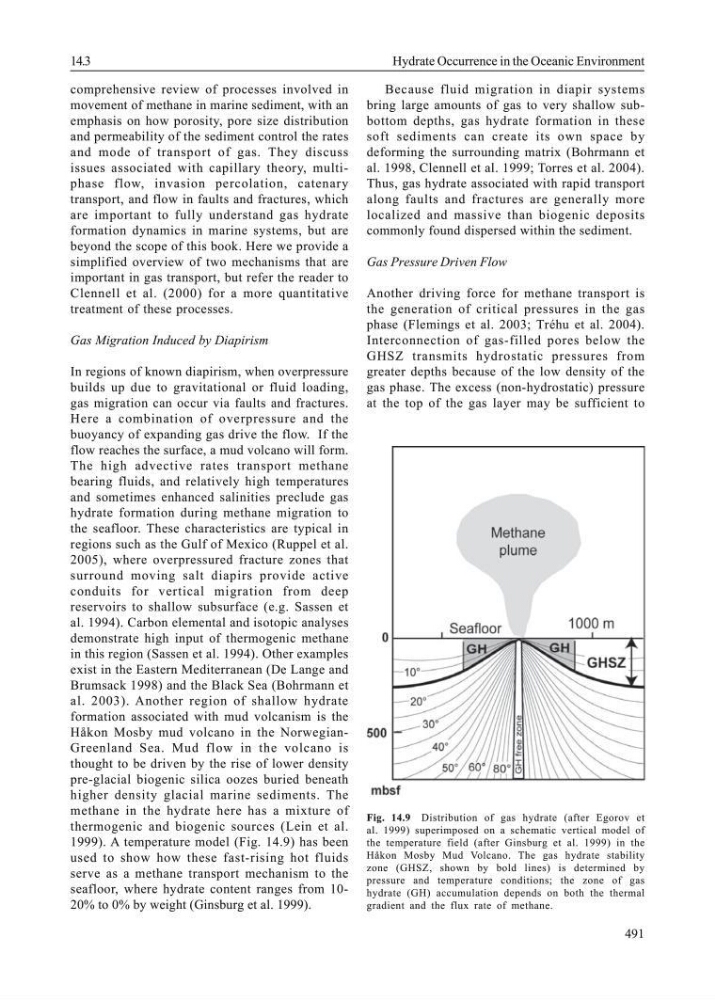
1999). A temperature model (Fig. 14.9) has been
used to show how these fast-rising hot fluids
serve as a methane transport mechanism to the
seafloor, where hydrate content ranges from 1020% to 0% by weight (Ginsburg et al. 1999).
Because fluid migration in diapir systems
bring large amounts of gas to very shallow subbottom depths, gas hydrate formation in these
soft sediments can create its own space by
deforming the surrounding matrix (Bohrmann et
al. 1998, Clennell et al. 1999; Torres et al. 2004).
Thus, gas hydrate associated with rapid transport
along faults and fractures are generally more
localized and massive than biogenic deposits
commonly found dispersed within the sediment.
Gas Pressure Driven Flow
Another driving force for methane transport is
the generation of critical pressures in the gas
phase (Flemings et al. 2003; Tréhu et al. 2004).
Interconnection of gas-filled pores below the
GHSZ transmits hydrostatic pressures from
greater depths because of the low density of the
gas phase. The excess (non-hydrostatic) pressure
at the top of the gas layer may be sufficient to
Fig. 14.9 Distribution of gas hydrate (after Egorov et
al. 1999) superimposed on a schematic vertical model of
the temperature field (after Ginsburg et al. 1999) in the
Håkon Mosby Mud Volcano. The gas hydrate stability
zone (GHSZ, shown by bold lines) is determined by
pressure and temperature conditions; the zone of gas
hydrate (GH) accumulation depends on both the thermal
gradient and the flux rate of methane.
14.3
Hydrate Occurrence in the Oceanic Environment
comprehensive review of processes involved in
movement of methane in marine sediment, with an
emphasis on how porosity, pore size distribution
and permeability of the sediment control the rates
and mode of transport of gas. They discuss
issues associated with capillary theory, multiphase flow, invasion percolation, catenary
transport, and flow in faults and fractures, which
are important to fully understand gas hydrate
formation dynamics in marine systems, but are
beyond the scope of this book. Here we provide a
simplified overview of two mechanisms that are
important in gas transport, but refer the reader to
Clennell et al. (2000) for a more quantitative
treatment of these processes.
Gas Migration Induced by Diapirism
In regions of known diapirism, when overpressure
builds up due to gravitational or fluid loading,
gas migration can occur via faults and fractures.
Here a combination of overpressure and the
buoyancy of expanding gas drive the flow. If the
flow reaches the surface, a mud volcano will form.
The high advective rates transport methane
bearing fluids, and relatively high temperatures
and sometimes enhanced salinities preclude gas
hydrate formation during methane migration to
the seafloor. These characteristics are typical in
regions such as the Gulf of Mexico (Ruppel et al.
2005), where overpressured fracture zones that
surround moving salt diapirs provide active
conduits for vertical migration from deep
reservoirs to shallow subsurface (e.g. Sassen et
al. 1994). Carbon elemental and isotopic analyses
demonstrate high input of thermogenic methane
in this region (Sassen et al. 1994). Other examples
exist in the Eastern Mediterranean (De Lange and
Brumsack 1998) and the Black Sea (Bohrmann et
al. 2003). Another region of shallow hydrate
formation associated with mud volcanism is the
Håkon Mosby mud volcano in the NorwegianGreenland Sea. Mud flow in the volcano is
thought to be driven by the rise of lower density
pre-glacial biogenic silica oozes buried beneath
higher density glacial marine sediments. The
methane in the hydrate here has a mixture of
thermogenic and biogenic sources (Lein et al.
1999). A temperature model (Fig. 14.9) has been
used to show how these fast-rising hot fluids
serve as a methane transport mechanism to the
seafloor, where hydrate content ranges from 1020% to 0% by weight (Ginsburg et al. 1999).
Because fluid migration in diapir systems
bring large amounts of gas to very shallow subbottom depths, gas hydrate formation in these
soft sediments can create its own space by
deforming the surrounding matrix (Bohrmann et
al. 1998, Clennell et al. 1999; Torres et al. 2004).
Thus, gas hydrate associated with rapid transport
along faults and fractures are generally more
localized and massive than biogenic deposits
commonly found dispersed within the sediment.
Gas Pressure Driven Flow
Another driving force for methane transport is
the generation of critical pressures in the gas
phase (Flemings et al. 2003; Tréhu et al. 2004).
Interconnection of gas-filled pores below the
GHSZ transmits hydrostatic pressures from
greater depths because of the low density of the
gas phase. The excess (non-hydrostatic) pressure
at the top of the gas layer may be sufficient to
Fig. 14.9 Distribution of gas hydrate (after Egorov et
al. 1999) superimposed on a schematic vertical model of
the temperature field (after Ginsburg et al. 1999) in the
Håkon Mosby Mud Volcano. The gas hydrate stability
zone (GHSZ, shown by bold lines) is determined by
pressure and temperature conditions; the zone of gas
hydrate (GH) accumulation depends on both the thermal
gradient and the flux rate of methane.
14.3
Hydrate Occurrence in the Oceanic Environment