

14 Gas Hydrates in Marine Sediments
482
14.2 Hydrate Crystal Chemistry
and Stability of Gas Hydrates
14.2.1 Cages and Three Crystal Structures
Gas hydrates are non-stoichiometric, solid compounds
similar to ice crystals (Sloan 1998). In these compounds,
also called clathrates (latin clatratus for cage), water
molecules form cage-like structures in which low
molecular weight gases are enclosed as guest
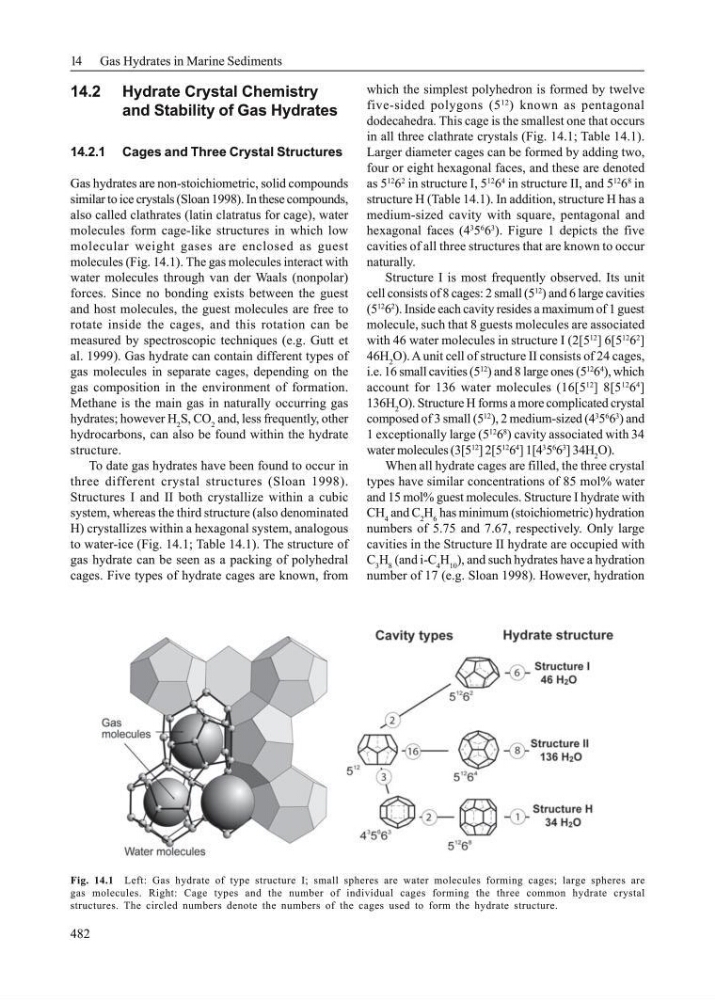
molecules (Fig. 14.1). The gas molecules interact with
water molecules through van der Waals (nonpolar)
forces. Since no bonding exists between the guest
and host molecules, the guest molecules are free to
rotate inside the cages, and this rotation can be
measured by spectroscopic techniques (e.g. Gutt et
al. 1999). Gas hydrate can contain different types of
gas molecules in separate cages, depending on the
gas composition in the environment of formation.
Methane is the main gas in naturally occurring gas
hydrates; however H 2 S, CO 2 and, less frequently, other
hydrocarbons, can also be found within the hydrate
structure.
To date gas hydrates have been found to occur in
three different crystal structures (Sloan 1998).
Structures I and II both crystallize within a cubic
system, whereas the third structure (also denominated
H) crystallizes within a hexagonal system, analogous
to water-ice (Fig. 14.1; Table 14.1). The structure of
gas hydrate can be seen as a packing of polyhedral
cages. Five types of hydrate cages are known, from
which the simplest polyhedron is formed by twelve
five-sided polygons (5
12
) known as pentagonal
dodecahedra. This cage is the smallest one that occurs
in all three clathrate crystals (Fig. 14.1; Table 14.1).
Larger diameter cages can be formed by adding two,
four or eight hexagonal faces, and these are denoted
as 5
12
6
2
in structure I, 5
12
6
4
in structure II, and 5
12
6
8
in
structure H (Table 14.1). In addition, structure H has a
medium-sized cavity with square, pentagonal and
hexagonal faces (4
3
5
6
6
3
). Figure 1 depicts the five
cavities of all three structures that are known to occur
naturally.
Structure I is most frequently observed. Its unit
cell consists of 8 cages: 2 small (5
12
) and 6 large cavities
(5
12
6
2
). Inside each cavity resides a maximum of 1 guest
molecule, such that 8 guests molecules are associated
with 46 water molecules in structure I (2[5
12
] 6[5
12
6
2
]
46H 2 O). A unit cell of structure II consists of 24 cages,
i.e. 16 small cavities (5
12
) and 8 large ones (5
12
6
4
), which
account for 136 water molecules (16[5
12
] 8[5
12
6
4
]
136H 2 O). Structure H forms a more complicated crystal
composed of 3 small (5
12
), 2 medium-sized (4
3
5
6
6
3
) and
1 exceptionally large (5
12
6
8
) cavity associated with 34
water molecules (3[5
12
] 2[5
12
6
4
] 1[4
3
5
6
6
3
] 34H 2 O).
When all hydrate cages are filled, the three crystal
types have similar concentrations of 85 mol% water
and 15 mol% guest molecules. Structure I hydrate with
CH 4 and C 2 H 6 has minimum (stoichiometric) hydration
numbers of 5.75 and 7.67, respectively. Only large
cavities in the Structure II hydrate are occupied with
C 3 H 8 (and i-C 4 H 10 ), and such hydrates have a hydration
number of 17 (e.g. Sloan 1998). However, hydration
Fig. 14.1 Left: Gas hydrate of type structure I; small spheres are water molecules forming cages; large spheres are
gas molecules. Right: Cage types and the number of individual cages forming the three common hydrate crystal
structures. The circled numbers denote the numbers of the cages used to form the hydrate structure.
482
14.2 Hydrate Crystal Chemistry
and Stability of Gas Hydrates
14.2.1 Cages and Three Crystal Structures
Gas hydrates are non-stoichiometric, solid compounds
similar to ice crystals (Sloan 1998). In these compounds,
also called clathrates (latin clatratus for cage), water
molecules form cage-like structures in which low
molecular weight gases are enclosed as guest
molecules (Fig. 14.1). The gas molecules interact with
water molecules through van der Waals (nonpolar)
forces. Since no bonding exists between the guest
and host molecules, the guest molecules are free to
rotate inside the cages, and this rotation can be
measured by spectroscopic techniques (e.g. Gutt et
al. 1999). Gas hydrate can contain different types of
gas molecules in separate cages, depending on the
gas composition in the environment of formation.
Methane is the main gas in naturally occurring gas
hydrates; however H 2 S, CO 2 and, less frequently, other
hydrocarbons, can also be found within the hydrate
structure.
To date gas hydrates have been found to occur in
three different crystal structures (Sloan 1998).
Structures I and II both crystallize within a cubic
system, whereas the third structure (also denominated
H) crystallizes within a hexagonal system, analogous
to water-ice (Fig. 14.1; Table 14.1). The structure of
gas hydrate can be seen as a packing of polyhedral
cages. Five types of hydrate cages are known, from
which the simplest polyhedron is formed by twelve
five-sided polygons (5
12
) known as pentagonal
dodecahedra. This cage is the smallest one that occurs
in all three clathrate crystals (Fig. 14.1; Table 14.1).
Larger diameter cages can be formed by adding two,
four or eight hexagonal faces, and these are denoted
as 5
12
6
2
in structure I, 5
12
6
4
in structure II, and 5
12
6
8
in
structure H (Table 14.1). In addition, structure H has a
medium-sized cavity with square, pentagonal and
hexagonal faces (4
3
5
6
6
3
). Figure 1 depicts the five
cavities of all three structures that are known to occur
naturally.
Structure I is most frequently observed. Its unit
cell consists of 8 cages: 2 small (5
12
) and 6 large cavities
(5
12
6
2
). Inside each cavity resides a maximum of 1 guest
molecule, such that 8 guests molecules are associated
with 46 water molecules in structure I (2[5
12
] 6[5
12
6
2
]
46H 2 O). A unit cell of structure II consists of 24 cages,
i.e. 16 small cavities (5
12
) and 8 large ones (5
12
6
4
), which
account for 136 water molecules (16[5
12
] 8[5
12
6
4
]
136H 2 O). Structure H forms a more complicated crystal
composed of 3 small (5
12
), 2 medium-sized (4
3
5
6
6
3
) and
1 exceptionally large (5
12
6
8
) cavity associated with 34
water molecules (3[5
12
] 2[5
12
6
4
] 1[4
3
5
6
6
3
] 34H 2 O).
When all hydrate cages are filled, the three crystal
types have similar concentrations of 85 mol% water
and 15 mol% guest molecules. Structure I hydrate with
CH 4 and C 2 H 6 has minimum (stoichiometric) hydration
numbers of 5.75 and 7.67, respectively. Only large
cavities in the Structure II hydrate are occupied with
C 3 H 8 (and i-C 4 H 10 ), and such hydrates have a hydration
number of 17 (e.g. Sloan 1998). However, hydration
Fig. 14.1 Left: Gas hydrate of type structure I; small spheres are water molecules forming cages; large spheres are
gas molecules. Right: Cage types and the number of individual cages forming the three common hydrate crystal
structures. The circled numbers denote the numbers of the cages used to form the hydrate structure.