

13 Input from the Deep: Hot Vents and Cold Seeps
466
from those of bare-ridge massive sulfides. In these
deposits, reaction of heated seawater with basaltic
rocks controls the initial composition of the
hydrothermal fluid, but interaction of the fluid
with sediments in the upflow dramatically modifies
the fluid chemistry. Chemical buffering of the
fluids by sediments results in generally higher pH,
and reactions with organic matter in the sediments
result in significantly lower f O2 than in bare-ridge
systems (Von Damm et al. 1985a; Bowers et al.
1985). Pyrrhotite tends to be the dominant Fesulfide phase, and other minerals typically formed
at low f O2 may also be common (e.g. Koski et al.
1988; Zierenberg et al. 1993).
The metal zonation within black smoker
chimneys and hydrothermal mounds reflects the
precipitation of sulfide minerals according to their
respective solubilities at different temperatures
and pH (e.g., Fig. 13.7). For the most part, metals
such as Cu and Zn are carried in solution as
aqueous chloride complexes with stabilities that
are enhanced at high temperatures and low pH
(Bourcier and Barnes 1987; Crerar and Barnes
1976; Hemley et al. 1992). During mixing with and
cooling by seawater, decreasing temperature and
increasing pH cause the sequential deposition of
chalcopyrite and sphalerite. The Cu-rich cores of
black smokers generally reflect saturation with
respect to chalcopyrite at high temperatures,
whereas the outer Zn-rich zones reflect saturation
with sphalerite at lower temperatures (e.g., caused
by mixing with seawater that penetrates through
the chimney walls). Although the pH of a hydrothermal fluid will increase dramatically as a result
of mixing, during conductive cooling the pH
changes in the fluid are moderated by the
production of acid associated with sulfide
precipitation (e.g., FeCl 2 + 2H 2 S + 1/2O 2 = FeS 2 +
2Cl
-
+ 2H
+
+ H 2 O), and the lower pH of the cooled
fluids may inhibit the precipitation of certain
minerals (Janecky and Seyfried 1984).
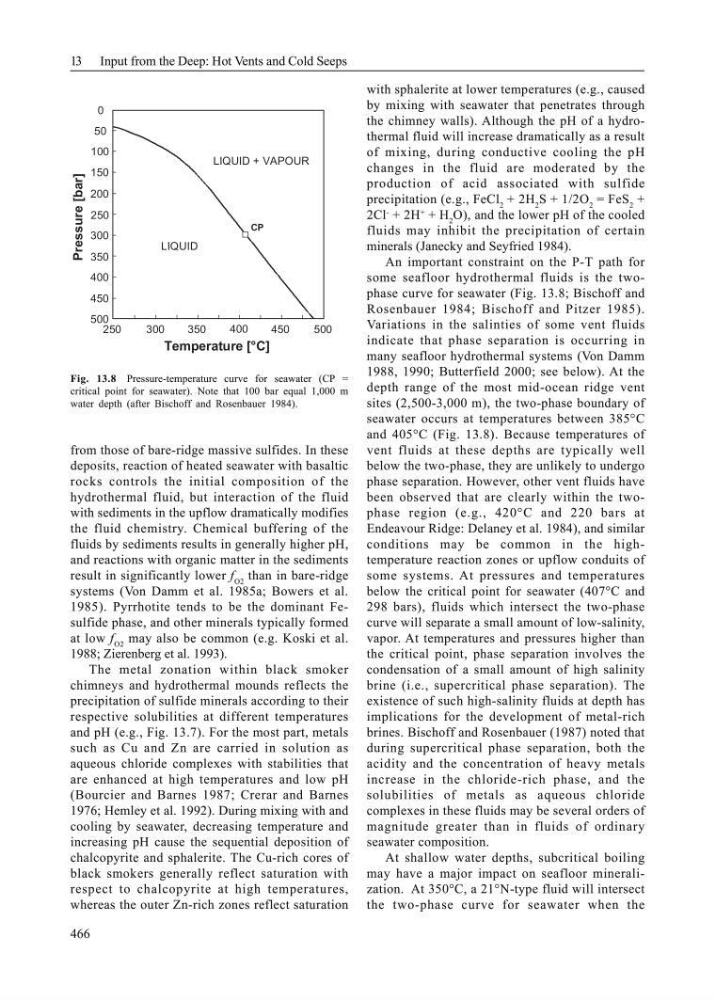
An important constraint on the P-T path for
some seafloor hydrothermal fluids is the twophase curve for seawater (Fig. 13.8; Bischoff and
Rosenbauer 1984; Bischoff and Pitzer 1985).
Variations in the salinties of some vent fluids
indicate that phase separation is occurring in
many seafloor hydrothermal systems (Von Damm
1988, 1990; Butterfield 2000; see below). At the
depth range of the most mid-ocean ridge vent
sites (2,500-3,000 m), the two-phase boundary of
seawater occurs at temperatures between 385°C
and 405°C (Fig. 13.8). Because temperatures of
vent fluids at these depths are typically well
below the two-phase, they are unlikely to undergo
phase separation. However, other vent fluids have
been observed that are clearly within the twophase region (e.g., 420°C and 220 bars at
Endeavour Ridge: Delaney et al. 1984), and similar
conditions may be common in the hightemperature reaction zones or upflow conduits of
some systems. At pressures and temperatures
below the critical point for seawater (407°C and
298 bars), fluids which intersect the two-phase
curve will separate a small amount of low-salinity,
vapor. At temperatures and pressures higher than
the critical point, phase separation involves the
condensation of a small amount of high salinity
brine (i.e., supercritical phase separation). The
existence of such high-salinity fluids at depth has
implications for the development of metal-rich
brines. Bischoff and Rosenbauer (1987) noted that
during supercritical phase separation, both the
acidity and the concentration of heavy metals
increase in the chloride-rich phase, and the
solubilities of metals as aqueous chloride
complexes in these fluids may be several orders of
magnitude greater than in fluids of ordinary
seawater composition.
At shallow water depths, subcritical boiling
may have a major impact on seafloor mineralization. At 350°C, a 21°N-type fluid will intersect
the two-phase curve for seawater when the
CP
LIQUID + VAPOUR
LIQUID
Pressure [bar]
Temperature [°C]
250
300
350
400
450
500
0
50
100
150
200
250
300
350
400
450
500
Fig. 13.8 Pressure-temperature curve for seawater (CP =
critical point for seawater). Note that 100 bar equal 1,000 m
water depth (after Bischoff and Rosenbauer 1984).
466
from those of bare-ridge massive sulfides. In these
deposits, reaction of heated seawater with basaltic
rocks controls the initial composition of the
hydrothermal fluid, but interaction of the fluid
with sediments in the upflow dramatically modifies
the fluid chemistry. Chemical buffering of the
fluids by sediments results in generally higher pH,
and reactions with organic matter in the sediments
result in significantly lower f O2 than in bare-ridge
systems (Von Damm et al. 1985a; Bowers et al.
1985). Pyrrhotite tends to be the dominant Fesulfide phase, and other minerals typically formed
at low f O2 may also be common (e.g. Koski et al.
1988; Zierenberg et al. 1993).
The metal zonation within black smoker
chimneys and hydrothermal mounds reflects the
precipitation of sulfide minerals according to their
respective solubilities at different temperatures
and pH (e.g., Fig. 13.7). For the most part, metals
such as Cu and Zn are carried in solution as
aqueous chloride complexes with stabilities that
are enhanced at high temperatures and low pH
(Bourcier and Barnes 1987; Crerar and Barnes
1976; Hemley et al. 1992). During mixing with and
cooling by seawater, decreasing temperature and
increasing pH cause the sequential deposition of
chalcopyrite and sphalerite. The Cu-rich cores of
black smokers generally reflect saturation with
respect to chalcopyrite at high temperatures,
whereas the outer Zn-rich zones reflect saturation
with sphalerite at lower temperatures (e.g., caused
by mixing with seawater that penetrates through
the chimney walls). Although the pH of a hydrothermal fluid will increase dramatically as a result
of mixing, during conductive cooling the pH
changes in the fluid are moderated by the
production of acid associated with sulfide
precipitation (e.g., FeCl 2 + 2H 2 S + 1/2O 2 = FeS 2 +
2Cl
-
+ 2H
+
+ H 2 O), and the lower pH of the cooled
fluids may inhibit the precipitation of certain
minerals (Janecky and Seyfried 1984).
An important constraint on the P-T path for
some seafloor hydrothermal fluids is the twophase curve for seawater (Fig. 13.8; Bischoff and
Rosenbauer 1984; Bischoff and Pitzer 1985).
Variations in the salinties of some vent fluids
indicate that phase separation is occurring in
many seafloor hydrothermal systems (Von Damm
1988, 1990; Butterfield 2000; see below). At the
depth range of the most mid-ocean ridge vent
sites (2,500-3,000 m), the two-phase boundary of
seawater occurs at temperatures between 385°C
and 405°C (Fig. 13.8). Because temperatures of
vent fluids at these depths are typically well
below the two-phase, they are unlikely to undergo
phase separation. However, other vent fluids have
been observed that are clearly within the twophase region (e.g., 420°C and 220 bars at
Endeavour Ridge: Delaney et al. 1984), and similar
conditions may be common in the hightemperature reaction zones or upflow conduits of
some systems. At pressures and temperatures
below the critical point for seawater (407°C and
298 bars), fluids which intersect the two-phase
curve will separate a small amount of low-salinity,
vapor. At temperatures and pressures higher than
the critical point, phase separation involves the
condensation of a small amount of high salinity
brine (i.e., supercritical phase separation). The
existence of such high-salinity fluids at depth has
implications for the development of metal-rich
brines. Bischoff and Rosenbauer (1987) noted that
during supercritical phase separation, both the
acidity and the concentration of heavy metals
increase in the chloride-rich phase, and the
solubilities of metals as aqueous chloride
complexes in these fluids may be several orders of
magnitude greater than in fluids of ordinary
seawater composition.
At shallow water depths, subcritical boiling
may have a major impact on seafloor mineralization. At 350°C, a 21°N-type fluid will intersect
the two-phase curve for seawater when the
CP
LIQUID + VAPOUR
LIQUID
Pressure [bar]
Temperature [°C]
250
300
350
400
450
500
0
50
100
150
200
250
300
350
400
450
500
Fig. 13.8 Pressure-temperature curve for seawater (CP =
critical point for seawater). Note that 100 bar equal 1,000 m
water depth (after Bischoff and Rosenbauer 1984).