

13 Input from the Deep: Hot Vents and Cold Seeps
460
reaction zone situated close to the top of the
subaxial magma chamber. The major physical and
chemical changes to the seawater include increasing temperature, decreasing pH, and decreasing
E H (Table 13.1).
Temperatures higher than 400°C are reached
as seawater is circulated close to the frozen top
of the subaxial magma chamber (Cann and Strens
1982; Lowell et al. 1995). High-resolution seismic
reflection studies have indicated that some of
these magma reservoirs may occur only 1.5-3.5
km below the seafloor (Detrick et al. 1987; Collier
and Sinha 1990, 1992; Fig. 13.3). The heat from
the magma chamber drives the hydrothermal
convection system and gives rise to black
smokers at the seafloor. The crustal residence
time of seawater in the convection system has
been constrained to be 3 years or less (Kadko
and Moore, 1988). Data from water/rock interaction experiments indicate that, with increasing
temperatures, the Mg
2+
dissolved in seawater
(ca. 1280 ppm or 52 mmol/kg) combines with OHgroups (which originate from the dissociation of
seawater at higher temperatures) to form
Mg(OH) 2 . The Mg
2+
is incorporated in secondary
minerals such as smectite (<200°C) and chlorite
(>200°C) (Hajash 1975; Seyfried and Mottl 1982;
Seyfried et al. 1988; Alt 1995). The removal of
OH-groups by Mg(OH) 2 creates an excess of H
+
ions and is the principal acid-generating reaction
responsible for the drop in pH from seawater
values (pH 7.8 at 2°C) to values as low as pH 3
(lower pH values are observed in some back-arc
settings where magmatic gases are present in the
hydrothermal fluids: e.g., Fouquet et al. 1993a).
Further exchange of H
+
for Ca
2+
and K
+
in the
rock, releases these elements into the hydrothermal fluid and initially balances the removal of
Mg
2+
from seawater. However, at the high
temperatures in the reaction zone, the formation
of epidote (Ca fixation) contributes further to the
acidity of the hydrothermal fluid. These reactions
take place at water/rock ratios of less than five
and commonly close to one (Von Damm 1995). In
most cases, the removal of Mg
2+
from seawater is
quantitative. Therefore, the concentrations of
major elements in mixtures of seawater and
hydrothermal fluid can be extrapolated back to a
common high-temperature “end-member” along
mixing lines projected to Mg = 0 (see below).
Seawater sulfate (SO 4
2) also is removed, mainly
by precipitation of anhydrite and partly by
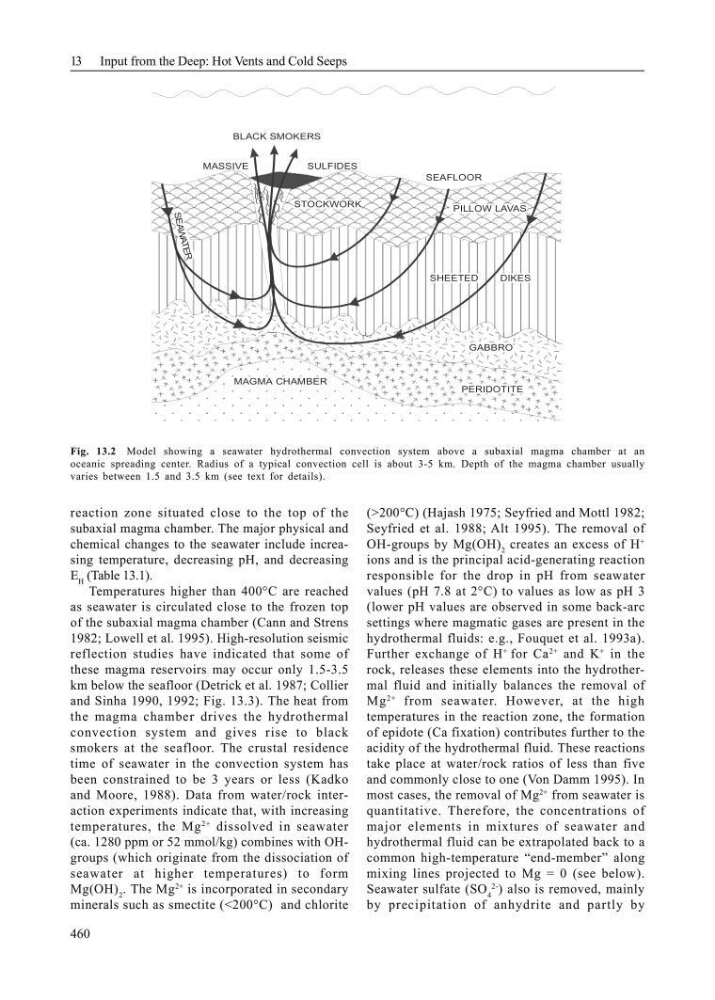
Fig. 13.2 Model showing a seawater hydrothermal convection system above a subaxial magma chamber at an
oceanic spreading center. Radius of a typical convection cell is about 3-5 km. Depth of the magma chamber usually
varies between 1.5 and 3.5 km (see text for details).
GABBRO
PERIDOTITE
MAGMA CHAMBER
DIKES
SHEETED
S
EA
W
A
TE
R
STOCKWORK
MASSIVE
BLACK SMOKERS
SULFIDES
SEAFLOOR
PILLOW LAVAS
460
reaction zone situated close to the top of the
subaxial magma chamber. The major physical and
chemical changes to the seawater include increasing temperature, decreasing pH, and decreasing
E H (Table 13.1).
Temperatures higher than 400°C are reached
as seawater is circulated close to the frozen top
of the subaxial magma chamber (Cann and Strens
1982; Lowell et al. 1995). High-resolution seismic
reflection studies have indicated that some of
these magma reservoirs may occur only 1.5-3.5
km below the seafloor (Detrick et al. 1987; Collier
and Sinha 1990, 1992; Fig. 13.3). The heat from
the magma chamber drives the hydrothermal
convection system and gives rise to black
smokers at the seafloor. The crustal residence
time of seawater in the convection system has
been constrained to be 3 years or less (Kadko
and Moore, 1988). Data from water/rock interaction experiments indicate that, with increasing
temperatures, the Mg
2+
dissolved in seawater
(ca. 1280 ppm or 52 mmol/kg) combines with OHgroups (which originate from the dissociation of
seawater at higher temperatures) to form
Mg(OH) 2 . The Mg
2+
is incorporated in secondary
minerals such as smectite (<200°C) and chlorite
(>200°C) (Hajash 1975; Seyfried and Mottl 1982;
Seyfried et al. 1988; Alt 1995). The removal of
OH-groups by Mg(OH) 2 creates an excess of H
+
ions and is the principal acid-generating reaction
responsible for the drop in pH from seawater
values (pH 7.8 at 2°C) to values as low as pH 3
(lower pH values are observed in some back-arc
settings where magmatic gases are present in the
hydrothermal fluids: e.g., Fouquet et al. 1993a).
Further exchange of H
+
for Ca
2+
and K
+
in the
rock, releases these elements into the hydrothermal fluid and initially balances the removal of
Mg
2+
from seawater. However, at the high
temperatures in the reaction zone, the formation
of epidote (Ca fixation) contributes further to the
acidity of the hydrothermal fluid. These reactions
take place at water/rock ratios of less than five
and commonly close to one (Von Damm 1995). In
most cases, the removal of Mg
2+
from seawater is
quantitative. Therefore, the concentrations of
major elements in mixtures of seawater and
hydrothermal fluid can be extrapolated back to a
common high-temperature “end-member” along
mixing lines projected to Mg = 0 (see below).
Seawater sulfate (SO 4
2) also is removed, mainly
by precipitation of anhydrite and partly by
Fig. 13.2 Model showing a seawater hydrothermal convection system above a subaxial magma chamber at an
oceanic spreading center. Radius of a typical convection cell is about 3-5 km. Depth of the magma chamber usually
varies between 1.5 and 3.5 km (see text for details).
GABBRO
PERIDOTITE
MAGMA CHAMBER
DIKES
SHEETED
S
EA
W
A
TE
R
STOCKWORK
MASSIVE
BLACK SMOKERS
SULFIDES
SEAFLOOR
PILLOW LAVAS