

411
nese crusts in evaluating paleoceanographic conditions in the world ocean but also the relative paucity
of data, especially in the Pacific Ocean.
11.4.11 Economic Prospects
In 1965, J.L. Mero proposed that manganese nodules
could serve as an economic resource for Ni, Cu and
Co. In his book, he painted a picture of an essentially
limitless resource of over one trillion tonnes of manganese nodules on the Pacific deep-sea floor which were
growing at a rate faster than could possibly be exploited
(Mero 1965). Although he grossly overestimated the
economic potential of the nodules, his work was
hugely influential and set in train a number of major
national programs to explore the resource potential of
manganese nodules. In 1972-1982, the U.S.
International Decade of Ocean Exploration (IDOE)
program was initiated to facilitate scientific research
on deep-sea Mn nodules in the equatorial North Pacific
as it was then known. Strong German, French and
Soviet programmes were also undertaken to evaluate
nodules as an economic resource. The period 19721982 became the „Golden Age“ for manganese nodule
research. During this period, there were 30-40 U.S.
cruises, 26 German cruises and 42 French cruises to
study nodules focussed mainly on this region. In
addition, seven consortia were formed to investigate
the possible commercial exploitation of the nodules.
Mero (1977) subsequently estimated that the North
Pacific high-grade area covering an area of about 6
million km
2
contained about 11,000 Mt of Mn, 115 Mt
of Co, 650 Mt of Ni and 520 Mt of Cu. He also claimed
that „within the next five to ten years, assuming no
political and/or legal interference, the nodules should
be in full-scale economic production as a valuable
source of important industrial metals.“ More recently,
Morgan (2000) has estimated that there are 34,000
Mt of nodules located in an area of 9 million km
2
in
the C-C F.Z. and that these nodules contain approximately 7,500 Mt of Mn, 78 Mt of Co, 340 Mt of Ni and
265 Mt of Cu.
Several factors combined to end this optimism
(Glasby 2000, 2002). For example, a major factor in this
belief was the assumption of world metal prices would
continue to rise in real terms based on the prediction
of global mineral shortages by the Club of Rome.
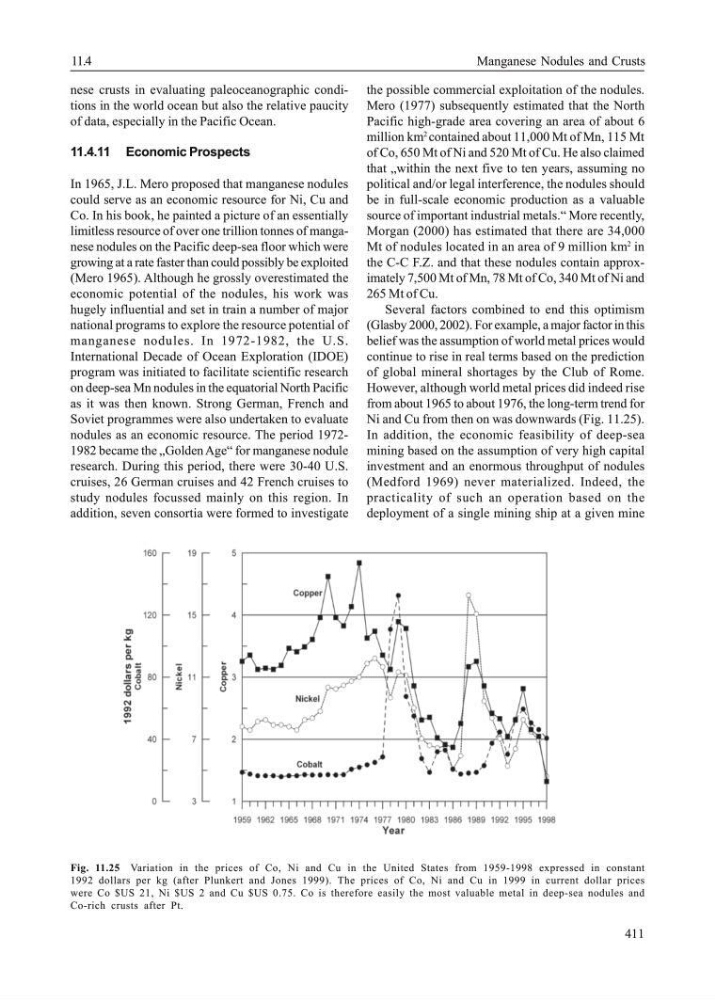
However, although world metal prices did indeed rise
from about 1965 to about 1976, the long-term trend for
Ni and Cu from then on was downwards (Fig. 11.25).
In addition, the economic feasibility of deep-sea
mining based on the assumption of very high capital
investment and an enormous throughput of nodules
(Medford 1969) never materialized. Indeed, the
practicality of such an operation based on the
deployment of a single mining ship at a given mine
Fig. 11.25 Variation in the prices of Co, Ni and Cu in the United States from 1959-1998 expressed in constant
1992 dollars per kg (after Plunkert and Jones 1999). The prices of Co, Ni and Cu in 1999 in current dollar prices
were Co $US 21, Ni $US 2 and Cu $US 0.75. Co is therefore easily the most valuable metal in deep-sea nodules and
Co-rich crusts after Pt.
11.4
Manganese Nodules and Crusts
nese crusts in evaluating paleoceanographic conditions in the world ocean but also the relative paucity
of data, especially in the Pacific Ocean.
11.4.11 Economic Prospects
In 1965, J.L. Mero proposed that manganese nodules
could serve as an economic resource for Ni, Cu and
Co. In his book, he painted a picture of an essentially
limitless resource of over one trillion tonnes of manganese nodules on the Pacific deep-sea floor which were
growing at a rate faster than could possibly be exploited
(Mero 1965). Although he grossly overestimated the
economic potential of the nodules, his work was
hugely influential and set in train a number of major
national programs to explore the resource potential of
manganese nodules. In 1972-1982, the U.S.
International Decade of Ocean Exploration (IDOE)
program was initiated to facilitate scientific research
on deep-sea Mn nodules in the equatorial North Pacific
as it was then known. Strong German, French and
Soviet programmes were also undertaken to evaluate
nodules as an economic resource. The period 19721982 became the „Golden Age“ for manganese nodule
research. During this period, there were 30-40 U.S.
cruises, 26 German cruises and 42 French cruises to
study nodules focussed mainly on this region. In
addition, seven consortia were formed to investigate
the possible commercial exploitation of the nodules.
Mero (1977) subsequently estimated that the North
Pacific high-grade area covering an area of about 6
million km
2
contained about 11,000 Mt of Mn, 115 Mt
of Co, 650 Mt of Ni and 520 Mt of Cu. He also claimed
that „within the next five to ten years, assuming no
political and/or legal interference, the nodules should
be in full-scale economic production as a valuable
source of important industrial metals.“ More recently,
Morgan (2000) has estimated that there are 34,000
Mt of nodules located in an area of 9 million km
2
in
the C-C F.Z. and that these nodules contain approximately 7,500 Mt of Mn, 78 Mt of Co, 340 Mt of Ni and
265 Mt of Cu.
Several factors combined to end this optimism
(Glasby 2000, 2002). For example, a major factor in this
belief was the assumption of world metal prices would
continue to rise in real terms based on the prediction
of global mineral shortages by the Club of Rome.
However, although world metal prices did indeed rise
from about 1965 to about 1976, the long-term trend for
Ni and Cu from then on was downwards (Fig. 11.25).
In addition, the economic feasibility of deep-sea
mining based on the assumption of very high capital
investment and an enormous throughput of nodules
(Medford 1969) never materialized. Indeed, the
practicality of such an operation based on the
deployment of a single mining ship at a given mine
Fig. 11.25 Variation in the prices of Co, Ni and Cu in the United States from 1959-1998 expressed in constant
1992 dollars per kg (after Plunkert and Jones 1999). The prices of Co, Ni and Cu in 1999 in current dollar prices
were Co $US 21, Ni $US 2 and Cu $US 0.75. Co is therefore easily the most valuable metal in deep-sea nodules and
Co-rich crusts after Pt.
11.4
Manganese Nodules and Crusts