

397
11.4.7 Micronodules
Manganese micronodules are an important reservoir
for Mn and associated transition elements in oxic deepsea sediments (Stoffers et al. 1984). They are generally
<1 mm in diameter. By contrast, macronodules are
generally >3-6 mm. There is therefore a size gap in
which no Mn deposits are found. This is a consequence of the fact that macronodules require a discrete
nucleus several mm in diameter on which to form (Heath
1981). The abundance of micronodules appears to be
inversely related to the sedimentation rate with highest
abundances occurring in dark brown clays where sedimentation rates are low. The shape and internal
structure of the micronodules is dependent on the
nature of the seed material around which they form, of
which calcareous tests, siliceous tests and volcaniclastic material are the most important. Micronodules
tend to predominate in the coarse fraction of the
sediment. The mineralogy and composition of the
micronodules tend to be similar to that of the
associated nodules, although differences do exist.
Micronodules tend to have higher Mn/Fe ratios than
nodules from the same sediment core. These differences are related to the depth of occurrence of the
micronodules within the sediment column and reflect
the importance of diagenetic processes in remobilizing
elements within the sediment. In this sense, micronodules may be considered a transient feature which
serves as a medium for recycling elements within the
sediment and ultimately into manganese nodules. The
study of micronodules has received relatively little
attention because of the difficulty of hand picking them
from the sediment.
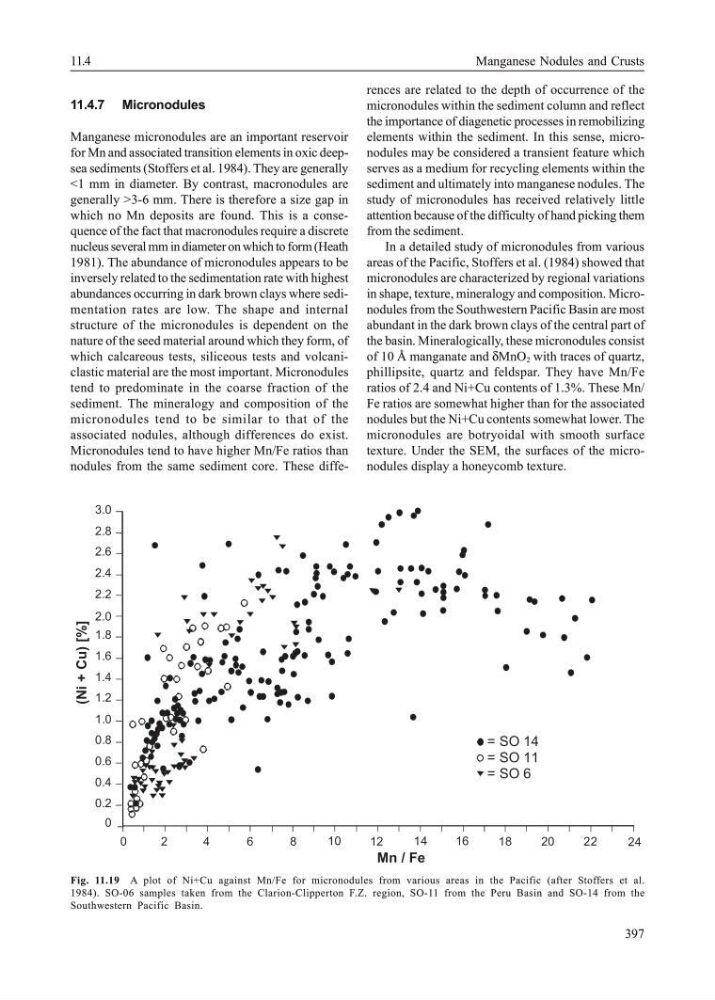
In a detailed study of micronodules from various
areas of the Pacific, Stoffers et al. (1984) showed that
micronodules are characterized by regional variations
in shape, texture, mineralogy and composition. Micronodules from the Southwestern Pacific Basin are most
abundant in the dark brown clays of the central part of
the basin. Mineralogically, these micronodules consist
of 10 Å manganate and δMnO 2 with traces of quartz,
phillipsite, quartz and feldspar. They have Mn/Fe
ratios of 2.4 and Ni+Cu contents of 1.3%. These Mn/
Fe ratios are somewhat higher than for the associated
nodules but the Ni+Cu contents somewhat lower. The
micronodules are botryoidal with smooth surface
texture. Under the SEM, the surfaces of the micronodules display a honeycomb texture.
0
2
4
6
8
10
12
14
16
18
20
22
Mn / Fe
0
0.2
0.4
0.6
0.8
1.0
1.2
1.4
1.6
1.8
2.0
2.2
2.4
2.6
2.8
3.0
(Ni + Cu) [%]
= SO 14
= SO 11
= SO 6
24
Fig. 11.19 A plot of Ni+Cu against Mn/Fe for micronodules from various areas in the Pacific (after Stoffers et al.
1984). SO-06 samples taken from the Clarion-Clipperton F.Z. region, SO-11 from the Peru Basin and SO-14 from the
Southwestern Pacific Basin.
11.4
Manganese Nodules and Crusts
11.4.7 Micronodules
Manganese micronodules are an important reservoir
for Mn and associated transition elements in oxic deepsea sediments (Stoffers et al. 1984). They are generally
<1 mm in diameter. By contrast, macronodules are
generally >3-6 mm. There is therefore a size gap in
which no Mn deposits are found. This is a consequence of the fact that macronodules require a discrete
nucleus several mm in diameter on which to form (Heath
1981). The abundance of micronodules appears to be
inversely related to the sedimentation rate with highest
abundances occurring in dark brown clays where sedimentation rates are low. The shape and internal
structure of the micronodules is dependent on the
nature of the seed material around which they form, of
which calcareous tests, siliceous tests and volcaniclastic material are the most important. Micronodules
tend to predominate in the coarse fraction of the
sediment. The mineralogy and composition of the
micronodules tend to be similar to that of the
associated nodules, although differences do exist.
Micronodules tend to have higher Mn/Fe ratios than
nodules from the same sediment core. These differences are related to the depth of occurrence of the
micronodules within the sediment column and reflect
the importance of diagenetic processes in remobilizing
elements within the sediment. In this sense, micronodules may be considered a transient feature which
serves as a medium for recycling elements within the
sediment and ultimately into manganese nodules. The
study of micronodules has received relatively little
attention because of the difficulty of hand picking them
from the sediment.
In a detailed study of micronodules from various
areas of the Pacific, Stoffers et al. (1984) showed that
micronodules are characterized by regional variations
in shape, texture, mineralogy and composition. Micronodules from the Southwestern Pacific Basin are most
abundant in the dark brown clays of the central part of
the basin. Mineralogically, these micronodules consist
of 10 Å manganate and δMnO 2 with traces of quartz,
phillipsite, quartz and feldspar. They have Mn/Fe
ratios of 2.4 and Ni+Cu contents of 1.3%. These Mn/
Fe ratios are somewhat higher than for the associated
nodules but the Ni+Cu contents somewhat lower. The
micronodules are botryoidal with smooth surface
texture. Under the SEM, the surfaces of the micronodules display a honeycomb texture.
0
2
4
6
8
10
12
14
16
18
20
22
Mn / Fe
0
0.2
0.4
0.6
0.8
1.0
1.2
1.4
1.6
1.8
2.0
2.2
2.4
2.6
2.8
3.0
(Ni + Cu) [%]
= SO 14
= SO 11
= SO 6
24
Fig. 11.19 A plot of Ni+Cu against Mn/Fe for micronodules from various areas in the Pacific (after Stoffers et al.
1984). SO-06 samples taken from the Clarion-Clipperton F.Z. region, SO-11 from the Peru Basin and SO-14 from the
Southwestern Pacific Basin.
11.4
Manganese Nodules and Crusts