

396
11 Manganese: Predominant Role of Nodules and Crusts
At the Pitcairn hotspot, massive hydrothermal Mn
crusts display the highest Mn/Fe ratios (2,440), the
lowest contents of Ni (18ppm) and Zn (21ppm) as well
as the lowest aluminosilicate fraction (<1%) in individual
horizons (sample 69-3 DS at a depth of 7-8 mm). This
type of crust may therefore be considered to represent
the most extreme hydrothermal endmember. The other
types of hydrothermal Mn crust are probably formed
as a result of the interpenetration and replacement of
volcanoclastic sands or biogenic carbonates by
hydrothermal Mn oxides. The low contents of Fe,
Ni and Zn in the massive crusts were thought to
reflect the rapid incorporation of these elements into
sulphide minerals within the interior of the hotspot
volcano such that only a small proportion of these
elements are available for incorporation in the
crusts. The small positive Eu anomaly in the crusts
on a NASC-normalized basis indicated lower
temperatures of the hydrothermal fluids within the
hotspot volcano (<250ºC) compared to those at midocean ridges (c.350ºC). A laser-ablation ICP-MS profile
in one of the crusts revealed varying REE concentrations
and patterns in the different layers of the crust. These
data showed that the hydrothermal component was
variable during the formation of the crust and was
almost 100% in the upper layers of this crust but about
80% in the lower layers.
In addition to submarine hydrothermal manganese
crusts formed near submarine hydrothermal vents,
submarine hydrothermal plumes can transport
detectable amounts of manganese up to 1,000 km from
the crests of mid-ocean ridges (Burton and Statham
1988) (see section 11.2). Under favourable circumstances, part of this manganese can then settle out
over manganese nodule fields and contribute to nodule
growth. As an example, Chen and Owen (1989)
identified a hydrothermal component in deep-sea
manganese nodules from the southeast Pacific based
on Q-mode factor analysis of compositional data for
76 nodules. The hydrothermal component was shown
to have a Mn/Fe ratio of 0.31 which is typical of
metalliferous sediments and to be distributed in two
areas, one west of the East Pacific Rise between 3 and
25°S and the other east of the East Pacific Rise south
of 25°S. These observations are supported by the
subsequent identification of hydrothermal helium
plumes in the South Pacific by Lupton (1998) in which
a pair of intense hydrothermal plumes was observed
to extend westwards from the East Pacific Rise at 10°S
and 15°S at a water depth of 2,500 m and a plume of
lesser intensity to extend eastwards into the Chile
Basin at 30°S. The study of Chen and Owen (1989)
therefore showed that a hydrothermal component can
be incorporated into deep-sea manganese nodules
forming within 1,000 km or so of an active mid-ocean
ridge and not just into metalliferous sediments as is
commonly assumed (Kunzendorf et al. 1993; Marchig
2000; Dekov et al. 2003; van de Fliert et al. 2003a).
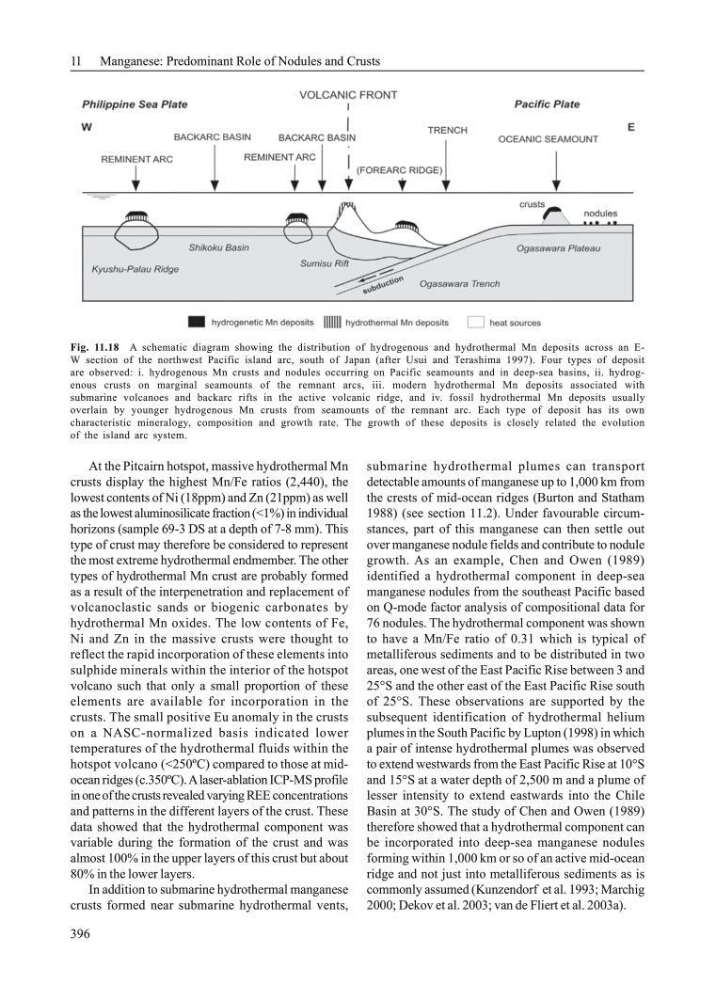
Fig. 11.18 A schematic diagram showing the distribution of hydrogenous and hydrothermal Mn deposits across an EW section of the northwest Pacific island arc, south of Japan (after Usui and Terashima 1997). Four types of deposit
are observed: i. hydrogenous Mn crusts and nodules occurring on Pacific seamounts and in deep-sea basins, ii. hydrogenous crusts on marginal seamounts of the remnant arcs, iii. modern hydrothermal Mn deposits associated with
submarine volcanoes and backarc rifts in the active volcanic ridge, and iv. fossil hydrothermal Mn deposits usually
overlain by younger hydrogenous Mn crusts from seamounts of the remnant arc. Each type of deposit has its own
characteristic mineralogy, composition and growth rate. The growth of these deposits is closely related the evolution
of the island arc system.
11 Manganese: Predominant Role of Nodules and Crusts
At the Pitcairn hotspot, massive hydrothermal Mn
crusts display the highest Mn/Fe ratios (2,440), the
lowest contents of Ni (18ppm) and Zn (21ppm) as well
as the lowest aluminosilicate fraction (<1%) in individual
horizons (sample 69-3 DS at a depth of 7-8 mm). This
type of crust may therefore be considered to represent
the most extreme hydrothermal endmember. The other
types of hydrothermal Mn crust are probably formed
as a result of the interpenetration and replacement of
volcanoclastic sands or biogenic carbonates by
hydrothermal Mn oxides. The low contents of Fe,
Ni and Zn in the massive crusts were thought to
reflect the rapid incorporation of these elements into
sulphide minerals within the interior of the hotspot
volcano such that only a small proportion of these
elements are available for incorporation in the
crusts. The small positive Eu anomaly in the crusts
on a NASC-normalized basis indicated lower
temperatures of the hydrothermal fluids within the
hotspot volcano (<250ºC) compared to those at midocean ridges (c.350ºC). A laser-ablation ICP-MS profile
in one of the crusts revealed varying REE concentrations
and patterns in the different layers of the crust. These
data showed that the hydrothermal component was
variable during the formation of the crust and was
almost 100% in the upper layers of this crust but about
80% in the lower layers.
In addition to submarine hydrothermal manganese
crusts formed near submarine hydrothermal vents,
submarine hydrothermal plumes can transport
detectable amounts of manganese up to 1,000 km from
the crests of mid-ocean ridges (Burton and Statham
1988) (see section 11.2). Under favourable circumstances, part of this manganese can then settle out
over manganese nodule fields and contribute to nodule
growth. As an example, Chen and Owen (1989)
identified a hydrothermal component in deep-sea
manganese nodules from the southeast Pacific based
on Q-mode factor analysis of compositional data for
76 nodules. The hydrothermal component was shown
to have a Mn/Fe ratio of 0.31 which is typical of
metalliferous sediments and to be distributed in two
areas, one west of the East Pacific Rise between 3 and
25°S and the other east of the East Pacific Rise south
of 25°S. These observations are supported by the
subsequent identification of hydrothermal helium
plumes in the South Pacific by Lupton (1998) in which
a pair of intense hydrothermal plumes was observed
to extend westwards from the East Pacific Rise at 10°S
and 15°S at a water depth of 2,500 m and a plume of
lesser intensity to extend eastwards into the Chile
Basin at 30°S. The study of Chen and Owen (1989)
therefore showed that a hydrothermal component can
be incorporated into deep-sea manganese nodules
forming within 1,000 km or so of an active mid-ocean
ridge and not just into metalliferous sediments as is
commonly assumed (Kunzendorf et al. 1993; Marchig
2000; Dekov et al. 2003; van de Fliert et al. 2003a).
Fig. 11.18 A schematic diagram showing the distribution of hydrogenous and hydrothermal Mn deposits across an EW section of the northwest Pacific island arc, south of Japan (after Usui and Terashima 1997). Four types of deposit
are observed: i. hydrogenous Mn crusts and nodules occurring on Pacific seamounts and in deep-sea basins, ii. hydrogenous crusts on marginal seamounts of the remnant arcs, iii. modern hydrothermal Mn deposits associated with
submarine volcanoes and backarc rifts in the active volcanic ridge, and iv. fossil hydrothermal Mn deposits usually
overlain by younger hydrogenous Mn crusts from seamounts of the remnant arc. Each type of deposit has its own
characteristic mineralogy, composition and growth rate. The growth of these deposits is closely related the evolution
of the island arc system.