

387
sediment column. In most cases (as in the Peru Basin),
these nodules are formed in oxic sediments overlying
reducing sediments. The diagenetic supply of metals
to the nodules normally takes place at or near the
sediment surface. Because the metals are released
within the sediment column and migrate upwards, they
tend to be incorporated on the underside of nodules.
This frequently results in differences in composition
between the upper and lower surfaces of diagenetic
nodules. Manganese micronodules may play a key
role in retaining transition elements in the sediment
column until they are released on further burial of the
micronodules.
Diagenetic processes may therefore involve
recycling of elements within the sediment column prior
to their incorporation in nodules. The characteristics
of each of these nodule types have been given in the
previous sections. In addition to influencing the mineralogy and composition of the nodules, diagenetic
processes also influence their surface texture; hydrogenous nodules tend to have smooth surface texture
and diagenetic nodules botryoidal to rough surface
texture.
From the above comments, it will be seen that the
principal factor driving the diagenetic milieu in the
sediments is the biological productivity of the oceanic
surface waters. A map of biological productivity of
Pacific ocean surface waters shows that the productivity of the northern sector of the Southwestern
Pacific Basin is 50-100 gC m
-2
yr
-1
, in the C-C F.Z. is in
the range 100-150 gC m
-2
yr
-1
and in the Peru Basin is
100-150 gC m
-2
yr
-1
(Fig. 12.5) (cf. Cronan 1987, 1997;
Müller et al. 1988). The importance of the productivity
of the surface waters to the diagenetic component of
manganese nodules in the C-C F.Z. is well illustrated
in Figure 11.13 which shows that the diagenetic
component of the nodules increases from west to east
as the equatorial zone of high productivity is approached (cf. Skornyakova and Murdmaa 1992;
Morgan 2000).
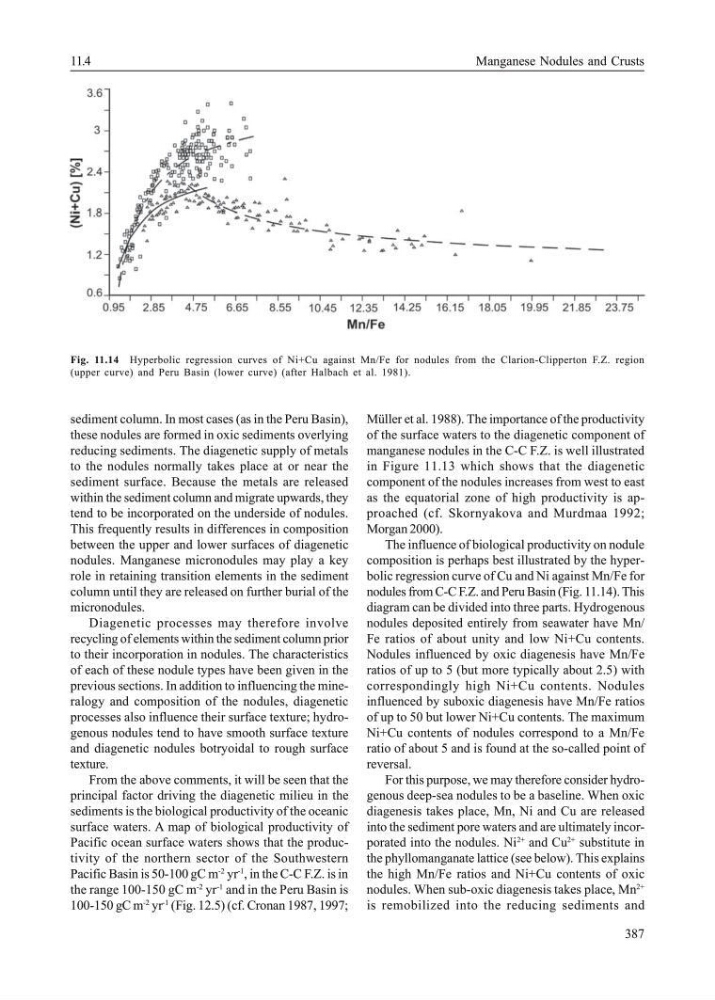
The influence of biological productivity on nodule
composition is perhaps best illustrated by the hyperbolic regression curve of Cu and Ni against Mn/Fe for
nodules from C-C F.Z. and Peru Basin (Fig. 11.14). This
diagram can be divided into three parts. Hydrogenous
nodules deposited entirely from seawater have Mn/
Fe ratios of about unity and low Ni+Cu contents.
Nodules influenced by oxic diagenesis have Mn/Fe
ratios of up to 5 (but more typically about 2.5) with
correspondingly high Ni+Cu contents. Nodules
influenced by suboxic diagenesis have Mn/Fe ratios
of up to 50 but lower Ni+Cu contents. The maximum
Ni+Cu contents of nodules correspond to a Mn/Fe
ratio of about 5 and is found at the so-called point of
reversal.
For this purpose, we may therefore consider hydrogenous deep-sea nodules to be a baseline. When oxic
diagenesis takes place, Mn, Ni and Cu are released
into the sediment pore waters and are ultimately incorporated into the nodules. Ni
2+
and Cu
2+
substitute in
the phyllomanganate lattice (see below). This explains
the high Mn/Fe ratios and Ni+Cu contents of oxic
nodules. When sub-oxic diagenesis takes place, Mn
2+
is remobilized into the reducing sediments and
11.4
Manganese Nodules and Crusts
Fig. 11.14 Hyperbolic regression curves of Ni+Cu against Mn/Fe for nodules from the Clarion-Clipperton F.Z. region
(upper curve) and Peru Basin (lower curve) (after Halbach et al. 1981).
sediment column. In most cases (as in the Peru Basin),
these nodules are formed in oxic sediments overlying
reducing sediments. The diagenetic supply of metals
to the nodules normally takes place at or near the
sediment surface. Because the metals are released
within the sediment column and migrate upwards, they
tend to be incorporated on the underside of nodules.
This frequently results in differences in composition
between the upper and lower surfaces of diagenetic
nodules. Manganese micronodules may play a key
role in retaining transition elements in the sediment
column until they are released on further burial of the
micronodules.
Diagenetic processes may therefore involve
recycling of elements within the sediment column prior
to their incorporation in nodules. The characteristics
of each of these nodule types have been given in the
previous sections. In addition to influencing the mineralogy and composition of the nodules, diagenetic
processes also influence their surface texture; hydrogenous nodules tend to have smooth surface texture
and diagenetic nodules botryoidal to rough surface
texture.
From the above comments, it will be seen that the
principal factor driving the diagenetic milieu in the
sediments is the biological productivity of the oceanic
surface waters. A map of biological productivity of
Pacific ocean surface waters shows that the productivity of the northern sector of the Southwestern
Pacific Basin is 50-100 gC m
-2
yr
-1
, in the C-C F.Z. is in
the range 100-150 gC m
-2
yr
-1
and in the Peru Basin is
100-150 gC m
-2
yr
-1
(Fig. 12.5) (cf. Cronan 1987, 1997;
Müller et al. 1988). The importance of the productivity
of the surface waters to the diagenetic component of
manganese nodules in the C-C F.Z. is well illustrated
in Figure 11.13 which shows that the diagenetic
component of the nodules increases from west to east
as the equatorial zone of high productivity is approached (cf. Skornyakova and Murdmaa 1992;
Morgan 2000).
The influence of biological productivity on nodule
composition is perhaps best illustrated by the hyperbolic regression curve of Cu and Ni against Mn/Fe for
nodules from C-C F.Z. and Peru Basin (Fig. 11.14). This
diagram can be divided into three parts. Hydrogenous
nodules deposited entirely from seawater have Mn/
Fe ratios of about unity and low Ni+Cu contents.
Nodules influenced by oxic diagenesis have Mn/Fe
ratios of up to 5 (but more typically about 2.5) with
correspondingly high Ni+Cu contents. Nodules
influenced by suboxic diagenesis have Mn/Fe ratios
of up to 50 but lower Ni+Cu contents. The maximum
Ni+Cu contents of nodules correspond to a Mn/Fe
ratio of about 5 and is found at the so-called point of
reversal.
For this purpose, we may therefore consider hydrogenous deep-sea nodules to be a baseline. When oxic
diagenesis takes place, Mn, Ni and Cu are released
into the sediment pore waters and are ultimately incorporated into the nodules. Ni
2+
and Cu
2+
substitute in
the phyllomanganate lattice (see below). This explains
the high Mn/Fe ratios and Ni+Cu contents of oxic
nodules. When sub-oxic diagenesis takes place, Mn
2+
is remobilized into the reducing sediments and
11.4
Manganese Nodules and Crusts
Fig. 11.14 Hyperbolic regression curves of Ni+Cu against Mn/Fe for nodules from the Clarion-Clipperton F.Z. region
(upper curve) and Peru Basin (lower curve) (after Halbach et al. 1981).