

385
Peru Basin
The Peru Basin is a relatively shallow oceanic basin
with depths typically in the range 3,900-4,300 m which
is close to the depth of the Carbonate Compensation
Depth (CCD) (4,250 m) and lies in a region of high
biological productivity. Manganese nodules were
initially recovered during cruises SO-04 and SO-11 of
R.V. Sonne and investigated in part because of their
economic potential (Thijssen et al. 1985; von Stackelberg 1997, 2000). Subsequently, the nodule field was
investigated during cruises SO-61, SO-79 and SO-106
as part of the DISCOL program, a long-term, largescale disturbance-recolonization experiment to assess
the potential environmental impact of nodule mining
(von Stackelberg 1997; Thiel 2001).
Peru Basin nodules are quite different from those
in other regions of the ocean floor. They tend to be
large and mamillated with an average Mn/Fe ratio of
4.7 and an average Ni+Cu content of about 2.1%
(Thijssen et al. 1985). Table 11.4 lists the average
composition of nodules from the Peru Basin. The
nodules are friable and contain fragments of fish bones
or broken nodules as nodule nuclei. Nodule density
averages >10 kg m
-2
but achieves a maximum value of
53 kg m
-2
. The highest abundance of nodules is found
near the CCD. Although only 3.8% of the nodules by
number are in the >80 mm size class, these nodules
make up 56% of the total weight of the nodules. The
largest nodule recovered was 190 mm in diameter. The
morphology of the nodules is a function of the size
class. Nodules <20 mm in diameter are dominantly
fragments of larger nodules and less commonly
discrete ellipsoidal nodules with botryoidal surface
texture. Nodules in the 20-60 mm size classes are
dominantly ellipsoidal to discoidal with the position
of the sediment-water interface clearly defined. The
upper surface of these nodules is mamillated with
micro-botryoidal surface texture whereas the lower
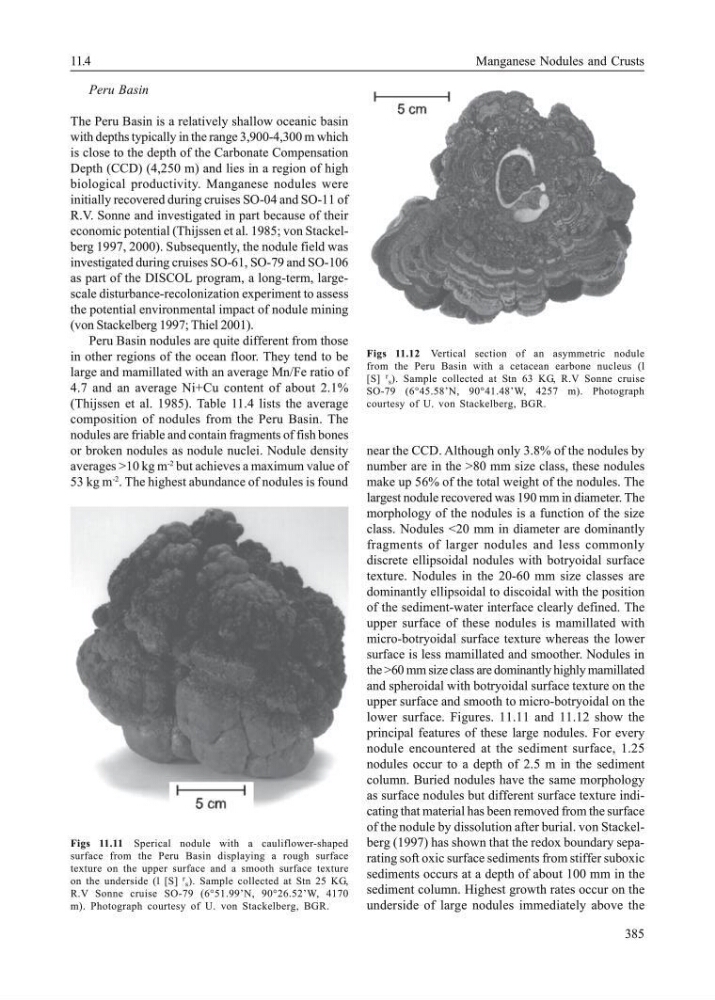
surface is less mamillated and smoother. Nodules in
the >60 mm size class are dominantly highly mamillated
and spheroidal with botryoidal surface texture on the
upper surface and smooth to micro-botryoidal on the
lower surface. Figures. 11.11 and 11.12 show the
principal features of these large nodules. For every
nodule encountered at the sediment surface, 1.25
nodules occur to a depth of 2.5 m in the sediment
column. Buried nodules have the same morphology
as surface nodules but different surface texture indicating that material has been removed from the surface
of the nodule by dissolution after burial. von Stackelberg (1997) has shown that the redox boundary separating soft oxic surface sediments from stiffer suboxic
sediments occurs at a depth of about 100 mm in the
sediment column. Highest growth rates occur on the
underside of large nodules immediately above the
11.4
Manganese Nodules and Crusts
Figs 11.11 Sperical nodule with a cauliflower-shaped
surface from the Peru Basin displaying a rough surface
texture on the upper surface and a smooth surface texture
on the underside (l [S] r s ). Sample collected at Stn 25 KG,
R.V Sonne cruise SO-79 (6°51.99’N, 90°26.52’W, 4170
m). Photograph courtesy of U. von Stackelberg, BGR.
Figs 11.12 Vertical section of an asymmetric nodule
from the Peru Basin with a cetacean earbone nucleus (l
[S] r s ). Sample collected at Stn 63 KG, R.V Sonne cruise
SO-79 (6°45.58’N, 90°41.48’W, 4257 m). Photograph
courtesy of U. von Stackelberg, BGR.
Peru Basin
The Peru Basin is a relatively shallow oceanic basin
with depths typically in the range 3,900-4,300 m which
is close to the depth of the Carbonate Compensation
Depth (CCD) (4,250 m) and lies in a region of high
biological productivity. Manganese nodules were
initially recovered during cruises SO-04 and SO-11 of
R.V. Sonne and investigated in part because of their
economic potential (Thijssen et al. 1985; von Stackelberg 1997, 2000). Subsequently, the nodule field was
investigated during cruises SO-61, SO-79 and SO-106
as part of the DISCOL program, a long-term, largescale disturbance-recolonization experiment to assess
the potential environmental impact of nodule mining
(von Stackelberg 1997; Thiel 2001).
Peru Basin nodules are quite different from those
in other regions of the ocean floor. They tend to be
large and mamillated with an average Mn/Fe ratio of
4.7 and an average Ni+Cu content of about 2.1%
(Thijssen et al. 1985). Table 11.4 lists the average
composition of nodules from the Peru Basin. The
nodules are friable and contain fragments of fish bones
or broken nodules as nodule nuclei. Nodule density
averages >10 kg m
-2
but achieves a maximum value of
53 kg m
-2
. The highest abundance of nodules is found
near the CCD. Although only 3.8% of the nodules by
number are in the >80 mm size class, these nodules
make up 56% of the total weight of the nodules. The
largest nodule recovered was 190 mm in diameter. The
morphology of the nodules is a function of the size
class. Nodules <20 mm in diameter are dominantly
fragments of larger nodules and less commonly
discrete ellipsoidal nodules with botryoidal surface
texture. Nodules in the 20-60 mm size classes are
dominantly ellipsoidal to discoidal with the position
of the sediment-water interface clearly defined. The
upper surface of these nodules is mamillated with
micro-botryoidal surface texture whereas the lower
surface is less mamillated and smoother. Nodules in
the >60 mm size class are dominantly highly mamillated
and spheroidal with botryoidal surface texture on the
upper surface and smooth to micro-botryoidal on the
lower surface. Figures. 11.11 and 11.12 show the
principal features of these large nodules. For every
nodule encountered at the sediment surface, 1.25
nodules occur to a depth of 2.5 m in the sediment
column. Buried nodules have the same morphology
as surface nodules but different surface texture indicating that material has been removed from the surface
of the nodule by dissolution after burial. von Stackelberg (1997) has shown that the redox boundary separating soft oxic surface sediments from stiffer suboxic
sediments occurs at a depth of about 100 mm in the
sediment column. Highest growth rates occur on the
underside of large nodules immediately above the
11.4
Manganese Nodules and Crusts
Figs 11.11 Sperical nodule with a cauliflower-shaped
surface from the Peru Basin displaying a rough surface
texture on the upper surface and a smooth surface texture
on the underside (l [S] r s ). Sample collected at Stn 25 KG,
R.V Sonne cruise SO-79 (6°51.99’N, 90°26.52’W, 4170
m). Photograph courtesy of U. von Stackelberg, BGR.
Figs 11.12 Vertical section of an asymmetric nodule
from the Peru Basin with a cetacean earbone nucleus (l
[S] r s ). Sample collected at Stn 63 KG, R.V Sonne cruise
SO-79 (6°45.58’N, 90°41.48’W, 4257 m). Photograph
courtesy of U. von Stackelberg, BGR.