

383
Southwestern Pacific Basin nodules are considered
to be hydrogenous in origin based on their average
Mn/Fe ratio of about unity, Ni+Cu contents of <1%,
δMnO 2 as the principal Mn oxide phase and growth
rates of 1-2 mm Ma
-1
(Dymond et al. 1984).
Clarion-Clipperton Fracture Zone Belt
The C-C F.Z. belt is the area bounded by the Clarion
F.Z. to north and the Clipperton F.Z. to the south. The
water depth varies from 5,300 m in the west to 4,300 m
in the east (Andreev and Gramberg 1998). The C-C
F.Z. is a high productivity area characterized by the
occurrence of siliceous sediments. The sedimentation
is controlled largely by bottom current activity. The
area is dominated by an abyssal hill topography. There
is a great variability in nodule distribution and type
which depends on the sediment type and accumulation
rate, bottom current activity, benthic biological activity
(bioturbation), bottom topography, availability of
potential nodule nuclei and productivity of the surface
waters (Friedrich et al. 1983; Halbach et al. 1988; von
Stackelberg and Beiersdorf 1991; Skornyakova and
Murdmaa 1992; Jeong et al. 1994, 1996; Knoop et al.
1998; Morgan 2000).
Within the C-C F.Z., there appear to be two discrete
nodule types; larger ‘mature’ nodules and smaller
‘immature’ nodules. The larger ‘mature’ nodules make
up 26% of the nodules by number but 92% by weight.
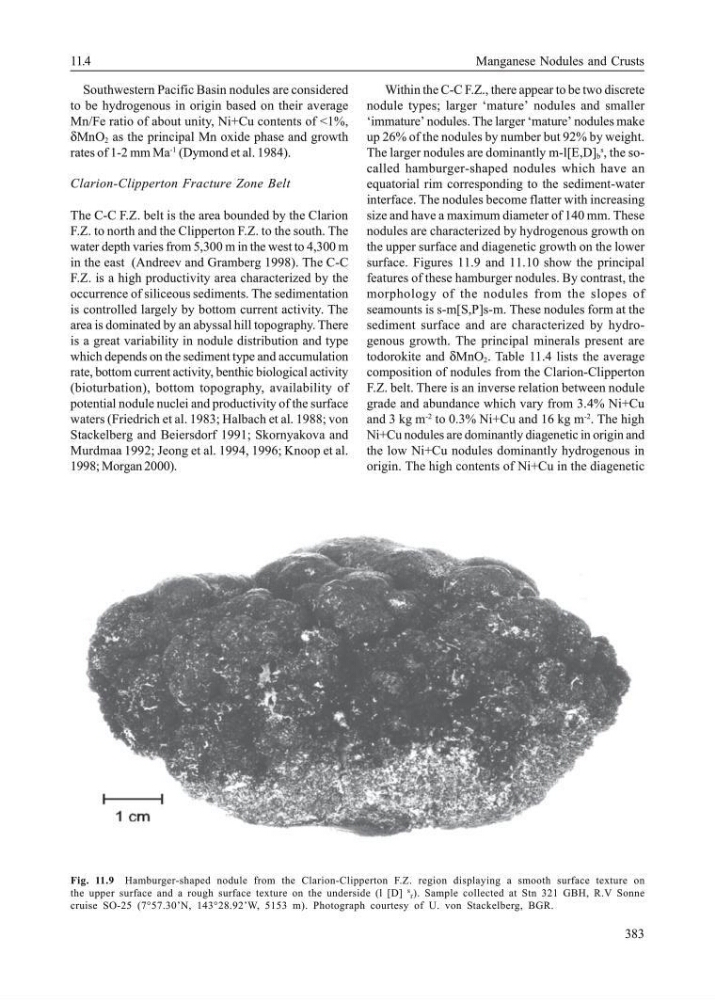
The larger nodules are dominantly m-l[E,D] b
s
, the socalled hamburger-shaped nodules which have an
equatorial rim corresponding to the sediment-water
interface. The nodules become flatter with increasing
size and have a maximum diameter of 140 mm. These
nodules are characterized by hydrogenous growth on
the upper surface and diagenetic growth on the lower
surface. Figures 11.9 and 11.10 show the principal
features of these hamburger nodules. By contrast, the
morphology of the nodules from the slopes of
seamounts is s-m[S,P]s-m. These nodules form at the
sediment surface and are characterized by hydrogenous growth. The principal minerals present are
todorokite and δMnO 2 . Table 11.4 lists the average
composition of nodules from the Clarion-Clipperton
F.Z. belt. There is an inverse relation between nodule
grade and abundance which vary from 3.4% Ni+Cu
and 3 kg m
-2
to 0.3% Ni+Cu and 16 kg m
-2
. The high
Ni+Cu nodules are dominantly diagenetic in origin and
the low Ni+Cu nodules dominantly hydrogenous in
origin. The high contents of Ni+Cu in the diagenetic
11.4
Manganese Nodules and Crusts
Fig. 11.9 Hamburger-shaped nodule from the Clarion-Clipperton F.Z. region displaying a smooth surface texture on
the upper surface and a rough surface texture on the underside (l [D] s r ). Sample collected at Stn 321 GBH, R.V Sonne
cruise SO-25 (7°57.30’N, 143°28.92’W, 5153 m). Photograph courtesy of U. von Stackelberg, BGR.
Southwestern Pacific Basin nodules are considered
to be hydrogenous in origin based on their average
Mn/Fe ratio of about unity, Ni+Cu contents of <1%,
δMnO 2 as the principal Mn oxide phase and growth
rates of 1-2 mm Ma
-1
(Dymond et al. 1984).
Clarion-Clipperton Fracture Zone Belt
The C-C F.Z. belt is the area bounded by the Clarion
F.Z. to north and the Clipperton F.Z. to the south. The
water depth varies from 5,300 m in the west to 4,300 m
in the east (Andreev and Gramberg 1998). The C-C
F.Z. is a high productivity area characterized by the
occurrence of siliceous sediments. The sedimentation
is controlled largely by bottom current activity. The
area is dominated by an abyssal hill topography. There
is a great variability in nodule distribution and type
which depends on the sediment type and accumulation
rate, bottom current activity, benthic biological activity
(bioturbation), bottom topography, availability of
potential nodule nuclei and productivity of the surface
waters (Friedrich et al. 1983; Halbach et al. 1988; von
Stackelberg and Beiersdorf 1991; Skornyakova and
Murdmaa 1992; Jeong et al. 1994, 1996; Knoop et al.
1998; Morgan 2000).
Within the C-C F.Z., there appear to be two discrete
nodule types; larger ‘mature’ nodules and smaller
‘immature’ nodules. The larger ‘mature’ nodules make
up 26% of the nodules by number but 92% by weight.
The larger nodules are dominantly m-l[E,D] b
s
, the socalled hamburger-shaped nodules which have an
equatorial rim corresponding to the sediment-water
interface. The nodules become flatter with increasing
size and have a maximum diameter of 140 mm. These
nodules are characterized by hydrogenous growth on
the upper surface and diagenetic growth on the lower
surface. Figures 11.9 and 11.10 show the principal
features of these hamburger nodules. By contrast, the
morphology of the nodules from the slopes of
seamounts is s-m[S,P]s-m. These nodules form at the
sediment surface and are characterized by hydrogenous growth. The principal minerals present are
todorokite and δMnO 2 . Table 11.4 lists the average
composition of nodules from the Clarion-Clipperton
F.Z. belt. There is an inverse relation between nodule
grade and abundance which vary from 3.4% Ni+Cu
and 3 kg m
-2
to 0.3% Ni+Cu and 16 kg m
-2
. The high
Ni+Cu nodules are dominantly diagenetic in origin and
the low Ni+Cu nodules dominantly hydrogenous in
origin. The high contents of Ni+Cu in the diagenetic
11.4
Manganese Nodules and Crusts
Fig. 11.9 Hamburger-shaped nodule from the Clarion-Clipperton F.Z. region displaying a smooth surface texture on
the upper surface and a rough surface texture on the underside (l [D] s r ). Sample collected at Stn 321 GBH, R.V Sonne
cruise SO-25 (7°57.30’N, 143°28.92’W, 5153 m). Photograph courtesy of U. von Stackelberg, BGR.