

382
11 Manganese: Predominant Role of Nodules and Crusts
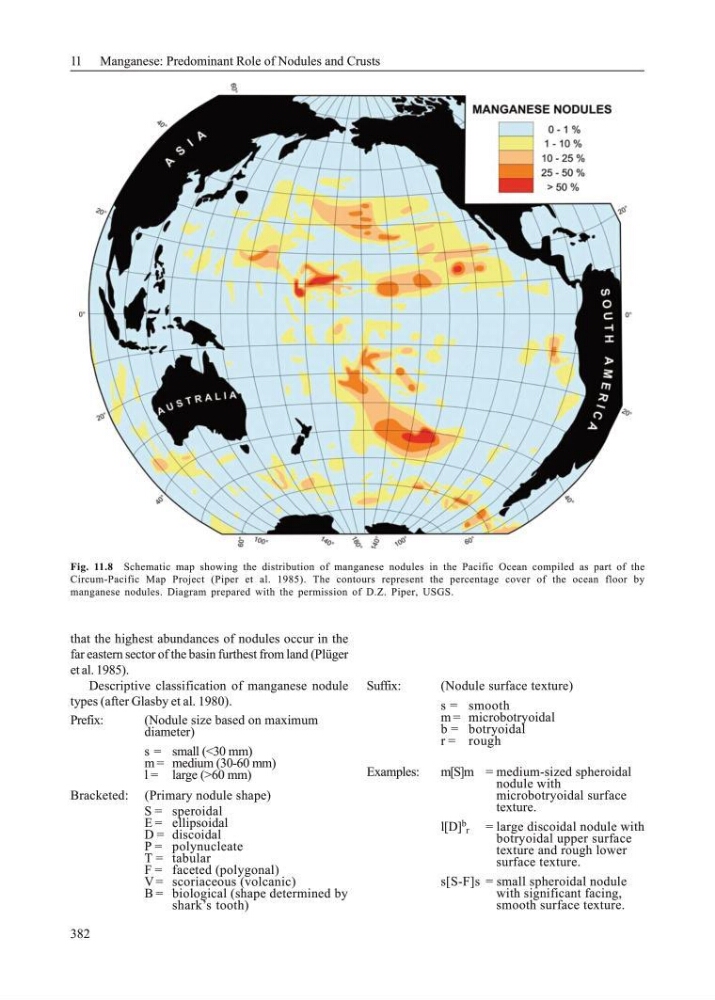
that the highest abundances of nodules occur in the
far eastern sector of the basin furthest from land (Plüger
et al. 1985).
Descriptive classification of manganese nodule
types (after Glasby et al. 1980).
Prefix:
(Nodule size based on maximum
diameter)
s = small (<30 mm)
m = medium (30-60 mm)
l = large (>60 mm)
Bracketed: (Primary nodule shape)
S = speroidal
E = ellipsoidal
D = discoidal
P = polynucleate
T = tabular
F = faceted (polygonal)
V = scoriaceous (volcanic)
B = biological (shape determined by
shark’s tooth)
Suffix:
(Nodule surface texture)
s = smooth
m = microbotryoidal
b = botryoidal
r = rough
Examples:
m[S]m = medium-sized spheroidal
nodule with
microbotryoidal surface
texture.
l[D] b
r
= large discoidal nodule with
botryoidal upper surface
texture and rough lower
surface texture.
s[S-F]s = small spheroidal nodule
with significant facing,
smooth surface texture.
Fig. 11.8 Schematic map showing the distribution of manganese nodules in the Pacific Ocean compiled as part of the
Circum-Pacific Map Project (Piper et al. 1985). The contours represent the percentage cover of the ocean floor by
manganese nodules. Diagram prepared with the permission of D.Z. Piper, USGS.
11 Manganese: Predominant Role of Nodules and Crusts
that the highest abundances of nodules occur in the
far eastern sector of the basin furthest from land (Plüger
et al. 1985).
Descriptive classification of manganese nodule
types (after Glasby et al. 1980).
Prefix:
(Nodule size based on maximum
diameter)
s = small (<30 mm)
m = medium (30-60 mm)
l = large (>60 mm)
Bracketed: (Primary nodule shape)
S = speroidal
E = ellipsoidal
D = discoidal
P = polynucleate
T = tabular
F = faceted (polygonal)
V = scoriaceous (volcanic)
B = biological (shape determined by
shark’s tooth)
Suffix:
(Nodule surface texture)
s = smooth
m = microbotryoidal
b = botryoidal
r = rough
Examples:
m[S]m = medium-sized spheroidal
nodule with
microbotryoidal surface
texture.
l[D] b
r
= large discoidal nodule with
botryoidal upper surface
texture and rough lower
surface texture.
s[S-F]s = small spheroidal nodule
with significant facing,
smooth surface texture.
Fig. 11.8 Schematic map showing the distribution of manganese nodules in the Pacific Ocean compiled as part of the
Circum-Pacific Map Project (Piper et al. 1985). The contours represent the percentage cover of the ocean floor by
manganese nodules. Diagram prepared with the permission of D.Z. Piper, USGS.