

355
10.5.2 δ
δ δ
δ δ 15 N in Marine Organic Matter
Principles of Fractionation
The nitrogen isotopic composition of marine organic matter produced in the photic zone depends
on the isotope ratio of nitrate and the degree to
which this inorganic pool is utilized (Wada 1980;
Altabet et al. 1991; Voss et al. 1996). The preferential uptake of 14 NO 3
- leads to a depletion of 15 N in
organic matter relative to the dissolved inorganic
nitrogen used as a substrate for growth (Montoya
1994). Subsequently, the remaining nitrogen pool
becomes progressively enriched in 15 N according
to Rayleigh fractionation kinetics (Cifuentes et al.
1988). The degree of isotopic fractionation associated with primary productivity varies between taxa
and with growth conditions. Culture experiments
suggest that diatoms may discriminate more
strongly than flagellates (Wada and Hattori 1978).
The ensuing transfer of nitrogen through trophic
levels is associated with a systematic increase in
δ 15 N, with each trophic step resulting in an
enrichment of 3.5‰ (Montoya 1994). This effect,
however, should not affect the bulk sedimentary
δ 15 N values because of mass balance considerations.
An important use of nitrogen stable isotope ratios is the reconstruction of the degree of nitrate
utilization in surface waters at the time the organic
matter was produced. The applicability of this tool
in paleoceanographic studies has been shown
repeatedly (e.g. Altabet and Francois 1994;
Holmes et al. 1997; Freudenthal et al. 2001). To determine changes in the fraction of unutilized nitrate in surface waters, Altabet and Francois
(1994) defined the following equations:
δ 15 NO 3
- (f) = δ 15 NO 3
-
(f=1) - ε u · ln (f)
(10.20)
δ 15 N-PN (f) = δ 15 NO 3
-
(f) - ε u
(instantaneous product)
(10.21)
δ 15 N-PN (f) =
δ 15 NO 3
-
(f=1) + f /(1-f) · ε u · ln (f)
(accumulated product)
(10.22)
where f is the fraction of unutilized NO 3
- remaining
(i.e. [NO 3
- ]/[ NO 3
- ] initial ), ε u is the fractionation factor associated with the NO 3
- uptake, and δ 15 N-PN
and δ 15 NO 3
- refers to the measured δ 15 N of the
particulate nitrogen and of NO 3
- , respectively. The
success of these equations in determining surface
nitrate utilization depends on the estimation of the
fractionation factor ε u exhibited by phytoplankton
during photosynthesis. The magnitude of ε u sets
an upper limit to the amplitude in δ 15 N observed.
ε u may be obtained from the slope of the regression line between the photosynthate δ 15 N (routinely, sedimentary δ 15 N is used) and ln[NO 3
- ] surface .
A limited number of culture experiments with marine phytoplankton have shown significant variations in ε u between phylogenetic groups (1‰ to
9‰) and growth conditions (0‰ to 16‰; Montoya
1994). Field estimates of ε u in regions of moderate
to high nitrate concentrations in the open ocean
have fallen within a narrower range of 5‰ to 9‰
(Altabet and Francois 1994). At 90% utilization of
NO 3
- , this latter range in ε u corresponds to an increase of 12‰ to 21‰ in δ 15 N.
[NO 3
- ] initial is the nitrate concentration of
newly upwelled water or surface waters before the
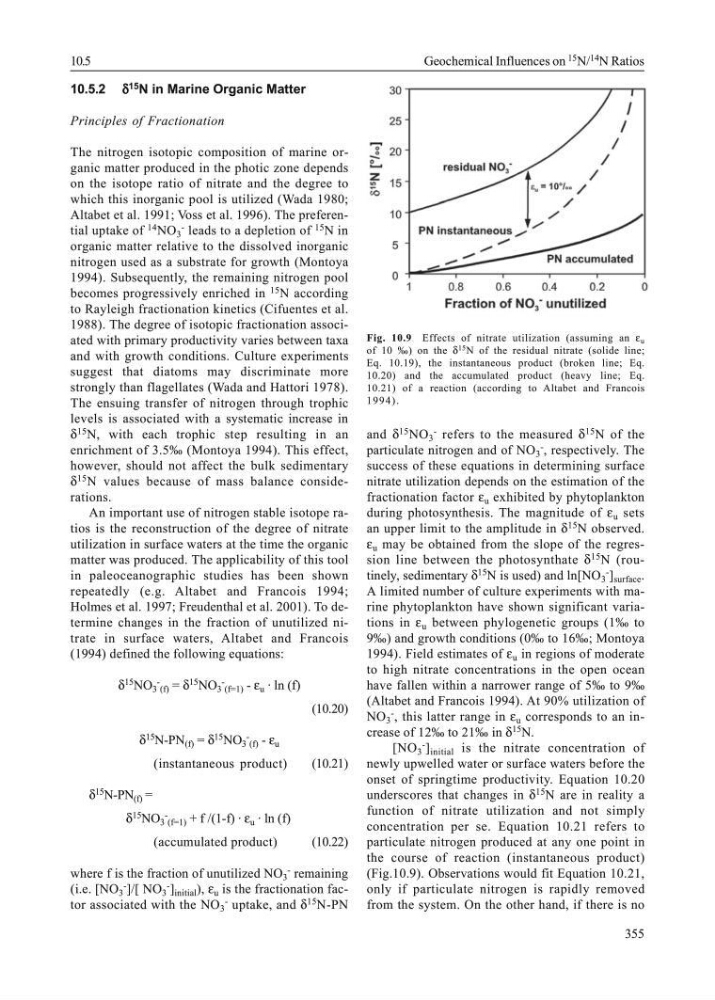
onset of springtime productivity. Equation 10.20
underscores that changes in δ 15 N are in reality a
function of nitrate utilization and not simply
concentration per se. Equation 10.21 refers to
particulate nitrogen produced at any one point in
the course of reaction (instantaneous product)
(Fig.10.9). Observations would fit Equation 10.21,
only if particulate nitrogen is rapidly removed
from the system. On the other hand, if there is no
Fig. 10.9 Effects of nitrate utilization (assuming an ε u
of 10 ‰) on the δ 15 N of the residual nitrate (solide line;
Eq. 10.19), the instantaneous product (broken line; Eq.
10.20) and the accumulated product (heavy line; Eq.
10.21) of a reaction (according to Altabet and Francois
1994).
10.5
Geochemical Influences on 15 N/ 14 N Ratios
10.5.2 δ
δ δ
δ δ 15 N in Marine Organic Matter
Principles of Fractionation
The nitrogen isotopic composition of marine organic matter produced in the photic zone depends
on the isotope ratio of nitrate and the degree to
which this inorganic pool is utilized (Wada 1980;
Altabet et al. 1991; Voss et al. 1996). The preferential uptake of 14 NO 3
- leads to a depletion of 15 N in
organic matter relative to the dissolved inorganic
nitrogen used as a substrate for growth (Montoya
1994). Subsequently, the remaining nitrogen pool
becomes progressively enriched in 15 N according
to Rayleigh fractionation kinetics (Cifuentes et al.
1988). The degree of isotopic fractionation associated with primary productivity varies between taxa
and with growth conditions. Culture experiments
suggest that diatoms may discriminate more
strongly than flagellates (Wada and Hattori 1978).
The ensuing transfer of nitrogen through trophic
levels is associated with a systematic increase in
δ 15 N, with each trophic step resulting in an
enrichment of 3.5‰ (Montoya 1994). This effect,
however, should not affect the bulk sedimentary
δ 15 N values because of mass balance considerations.
An important use of nitrogen stable isotope ratios is the reconstruction of the degree of nitrate
utilization in surface waters at the time the organic
matter was produced. The applicability of this tool
in paleoceanographic studies has been shown
repeatedly (e.g. Altabet and Francois 1994;
Holmes et al. 1997; Freudenthal et al. 2001). To determine changes in the fraction of unutilized nitrate in surface waters, Altabet and Francois
(1994) defined the following equations:
δ 15 NO 3
- (f) = δ 15 NO 3
-
(f=1) - ε u · ln (f)
(10.20)
δ 15 N-PN (f) = δ 15 NO 3
-
(f) - ε u
(instantaneous product)
(10.21)
δ 15 N-PN (f) =
δ 15 NO 3
-
(f=1) + f /(1-f) · ε u · ln (f)
(accumulated product)
(10.22)
where f is the fraction of unutilized NO 3
- remaining
(i.e. [NO 3
- ]/[ NO 3
- ] initial ), ε u is the fractionation factor associated with the NO 3
- uptake, and δ 15 N-PN
and δ 15 NO 3
- refers to the measured δ 15 N of the
particulate nitrogen and of NO 3
- , respectively. The
success of these equations in determining surface
nitrate utilization depends on the estimation of the
fractionation factor ε u exhibited by phytoplankton
during photosynthesis. The magnitude of ε u sets
an upper limit to the amplitude in δ 15 N observed.
ε u may be obtained from the slope of the regression line between the photosynthate δ 15 N (routinely, sedimentary δ 15 N is used) and ln[NO 3
- ] surface .
A limited number of culture experiments with marine phytoplankton have shown significant variations in ε u between phylogenetic groups (1‰ to
9‰) and growth conditions (0‰ to 16‰; Montoya
1994). Field estimates of ε u in regions of moderate
to high nitrate concentrations in the open ocean
have fallen within a narrower range of 5‰ to 9‰
(Altabet and Francois 1994). At 90% utilization of
NO 3
- , this latter range in ε u corresponds to an increase of 12‰ to 21‰ in δ 15 N.
[NO 3
- ] initial is the nitrate concentration of
newly upwelled water or surface waters before the
onset of springtime productivity. Equation 10.20
underscores that changes in δ 15 N are in reality a
function of nitrate utilization and not simply
concentration per se. Equation 10.21 refers to
particulate nitrogen produced at any one point in
the course of reaction (instantaneous product)
(Fig.10.9). Observations would fit Equation 10.21,
only if particulate nitrogen is rapidly removed
from the system. On the other hand, if there is no
Fig. 10.9 Effects of nitrate utilization (assuming an ε u
of 10 ‰) on the δ 15 N of the residual nitrate (solide line;
Eq. 10.19), the instantaneous product (broken line; Eq.
10.20) and the accumulated product (heavy line; Eq.
10.21) of a reaction (according to Altabet and Francois
1994).
10.5
Geochemical Influences on 15 N/ 14 N Ratios