

10 Influence of Geochemical Processes on Stable Isotope Distribution in Marine Sediments
354
bacterial mineralization of organic nitrogen. Equilibrium isotope exchange reactions, which commonly occur in nature, are the ammonia volatilization and the solution of nitrogen gas. The
former process has a significant isotopic effect
(α= 1.034), whereas the latter process induces
only a small fractionation (α = 1.0008).
Modern Range of Values and Historical
Variability
The isotopic composition of some important
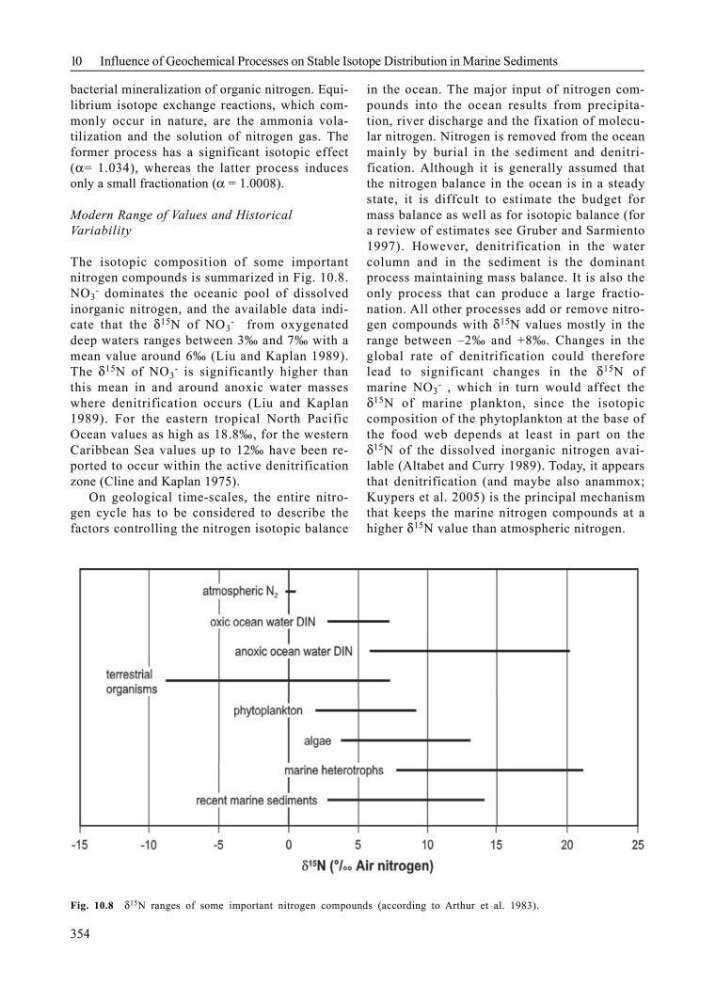
nitrogen compounds is summarized in Fig. 10.8.
NO 3
- dominates the oceanic pool of dissolved
inorganic nitrogen, and the available data indicate that the δ 15 N of NO 3
- from oxygenated
deep waters ranges between 3‰ and 7‰ with a
mean value around 6‰ (Liu and Kaplan 1989).
The δ 15 N of NO 3
- is significantly higher than
this mean in and around anoxic water masses
where denitrification occurs (Liu and Kaplan
1989). For the eastern tropical North Pacific
Ocean values as high as 18.8‰, for the western
Caribbean Sea values up to 12‰ have been reported to occur within the active denitrification
zone (Cline and Kaplan 1975).
On geological time-scales, the entire nitrogen cycle has to be considered to describe the
factors controlling the nitrogen isotopic balance
in the ocean. The major input of nitrogen compounds into the ocean results from precipitation, river discharge and the fixation of molecular nitrogen. Nitrogen is removed from the ocean
mainly by burial in the sediment and denitrification. Although it is generally assumed that
the nitrogen balance in the ocean is in a steady
state, it is diffcult to estimate the budget for
mass balance as well as for isotopic balance (for
a review of estimates see Gruber and Sarmiento
1997). However, denitrification in the water
column and in the sediment is the dominant
process maintaining mass balance. It is also the
only process that can produce a large fractionation. All other processes add or remove nitrogen compounds with δ 15 N values mostly in the
range between –2‰ and +8‰. Changes in the
global rate of denitrification could therefore
lead to significant changes in the δ 15 N of
marine NO 3
- , which in turn would affect the
δ 15 N of marine plankton, since the isotopic
composition of the phytoplankton at the base of
the food web depends at least in part on the
δ 15 N of the dissolved inorganic nitrogen available (Altabet and Curry 1989). Today, it appears
that denitrification (and maybe also anammox;
Kuypers et al. 2005) is the principal mechanism
that keeps the marine nitrogen compounds at a
higher δ 15 N value than atmospheric nitrogen.
Fig. 10.8 δ 15 N ranges of some important nitrogen compounds (according to Arthur et al. 1983).
354
bacterial mineralization of organic nitrogen. Equilibrium isotope exchange reactions, which commonly occur in nature, are the ammonia volatilization and the solution of nitrogen gas. The
former process has a significant isotopic effect
(α= 1.034), whereas the latter process induces
only a small fractionation (α = 1.0008).
Modern Range of Values and Historical
Variability
The isotopic composition of some important
nitrogen compounds is summarized in Fig. 10.8.
NO 3
- dominates the oceanic pool of dissolved
inorganic nitrogen, and the available data indicate that the δ 15 N of NO 3
- from oxygenated
deep waters ranges between 3‰ and 7‰ with a
mean value around 6‰ (Liu and Kaplan 1989).
The δ 15 N of NO 3
- is significantly higher than
this mean in and around anoxic water masses
where denitrification occurs (Liu and Kaplan
1989). For the eastern tropical North Pacific
Ocean values as high as 18.8‰, for the western
Caribbean Sea values up to 12‰ have been reported to occur within the active denitrification
zone (Cline and Kaplan 1975).
On geological time-scales, the entire nitrogen cycle has to be considered to describe the
factors controlling the nitrogen isotopic balance
in the ocean. The major input of nitrogen compounds into the ocean results from precipitation, river discharge and the fixation of molecular nitrogen. Nitrogen is removed from the ocean
mainly by burial in the sediment and denitrification. Although it is generally assumed that
the nitrogen balance in the ocean is in a steady
state, it is diffcult to estimate the budget for
mass balance as well as for isotopic balance (for
a review of estimates see Gruber and Sarmiento
1997). However, denitrification in the water
column and in the sediment is the dominant
process maintaining mass balance. It is also the
only process that can produce a large fractionation. All other processes add or remove nitrogen compounds with δ 15 N values mostly in the
range between –2‰ and +8‰. Changes in the
global rate of denitrification could therefore
lead to significant changes in the δ 15 N of
marine NO 3
- , which in turn would affect the
δ 15 N of marine plankton, since the isotopic
composition of the phytoplankton at the base of
the food web depends at least in part on the
δ 15 N of the dissolved inorganic nitrogen available (Altabet and Curry 1989). Today, it appears
that denitrification (and maybe also anammox;
Kuypers et al. 2005) is the principal mechanism
that keeps the marine nitrogen compounds at a
higher δ 15 N value than atmospheric nitrogen.
Fig. 10.8 δ 15 N ranges of some important nitrogen compounds (according to Arthur et al. 1983).