

349
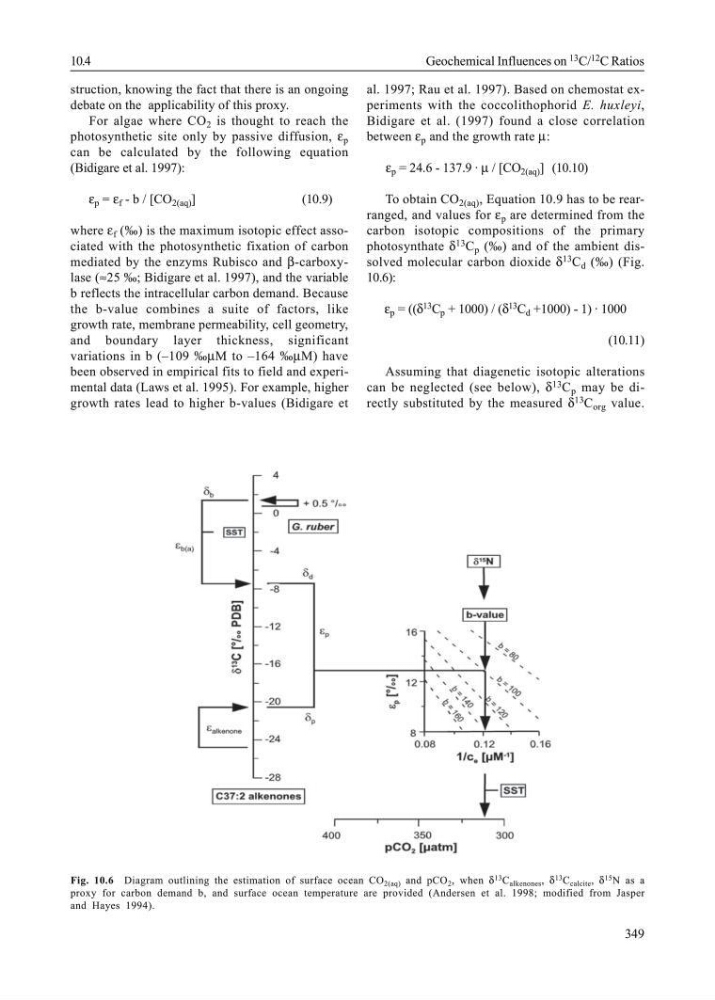
Fig. 10.6 Diagram outlining the estimation of surface ocean CO 2(aq) and pCO 2 , when δ 13 C alkenones , δ 13 C calcite , δ 15 N as a
proxy for carbon demand b, and surface ocean temperature are provided (Andersen et al. 1998; modified from Jasper
and Hayes 1994).
10.4
Geochemical Influences on 13 C/ 12 C Ratios
struction, knowing the fact that there is an ongoing
debate on the applicability of this proxy.
For algae where CO 2 is thought to reach the
photosynthetic site only by passive diffusion, ε p
can be calculated by the following equation
(Bidigare et al. 1997):
ε p = ε f - b / [CO 2(aq) ]
(10.9)
where ε f (‰) is the maximum isotopic effect associated with the photosynthetic fixation of carbon
mediated by the enzyms Rubisco and β-carboxylase (≈25 ‰; Bidigare et al. 1997), and the variable
b reflects the intracellular carbon demand. Because
the b-value combines a suite of factors, like
growth rate, membrane permeability, cell geometry,
and boundary layer thickness, significant
variations in b (–109 ‰µM to –164 ‰µM) have
been observed in empirical fits to field and experimental data (Laws et al. 1995). For example, higher
growth rates lead to higher b-values (Bidigare et
al. 1997; Rau et al. 1997). Based on chemostat experiments with the coccolithophorid E. huxleyi,
Bidigare et al. (1997) found a close correlation
between ε p and the growth rate µ:
ε p = 24.6 - 137.9 · µ / [CO 2(aq) ] (10.10)
To obtain CO 2(aq) , Equation 10.9 has to be rearranged, and values for ε p are determined from the
carbon isotopic compositions of the primary
photosynthate δ 13 C p (‰) and of the ambient dissolved molecular carbon dioxide δ 13 C d (‰) (Fig.
10.6):
ε p = ((δ 13 C p + 1000) / (δ 13 C d +1000) - 1) · 1000
(10.11)
Assuming that diagenetic isotopic alterations
can be neglected (see below), δ 13 C p may be directly substituted by the measured δ 13 C org value.
Fig. 10.6 Diagram outlining the estimation of surface ocean CO 2(aq) and pCO 2 , when δ 13 C alkenones , δ 13 C calcite , δ 15 N as a
proxy for carbon demand b, and surface ocean temperature are provided (Andersen et al. 1998; modified from Jasper
and Hayes 1994).
10.4
Geochemical Influences on 13 C/ 12 C Ratios
struction, knowing the fact that there is an ongoing
debate on the applicability of this proxy.
For algae where CO 2 is thought to reach the
photosynthetic site only by passive diffusion, ε p
can be calculated by the following equation
(Bidigare et al. 1997):
ε p = ε f - b / [CO 2(aq) ]
(10.9)
where ε f (‰) is the maximum isotopic effect associated with the photosynthetic fixation of carbon
mediated by the enzyms Rubisco and β-carboxylase (≈25 ‰; Bidigare et al. 1997), and the variable
b reflects the intracellular carbon demand. Because
the b-value combines a suite of factors, like
growth rate, membrane permeability, cell geometry,
and boundary layer thickness, significant
variations in b (–109 ‰µM to –164 ‰µM) have
been observed in empirical fits to field and experimental data (Laws et al. 1995). For example, higher
growth rates lead to higher b-values (Bidigare et
al. 1997; Rau et al. 1997). Based on chemostat experiments with the coccolithophorid E. huxleyi,
Bidigare et al. (1997) found a close correlation
between ε p and the growth rate µ:
ε p = 24.6 - 137.9 · µ / [CO 2(aq) ] (10.10)
To obtain CO 2(aq) , Equation 10.9 has to be rearranged, and values for ε p are determined from the
carbon isotopic compositions of the primary
photosynthate δ 13 C p (‰) and of the ambient dissolved molecular carbon dioxide δ 13 C d (‰) (Fig.
10.6):
ε p = ((δ 13 C p + 1000) / (δ 13 C d +1000) - 1) · 1000
(10.11)
Assuming that diagenetic isotopic alterations
can be neglected (see below), δ 13 C p may be directly substituted by the measured δ 13 C org value.