

10 Influence of Geochemical Processes on Stable Isotope Distribution in Marine Sediments
348
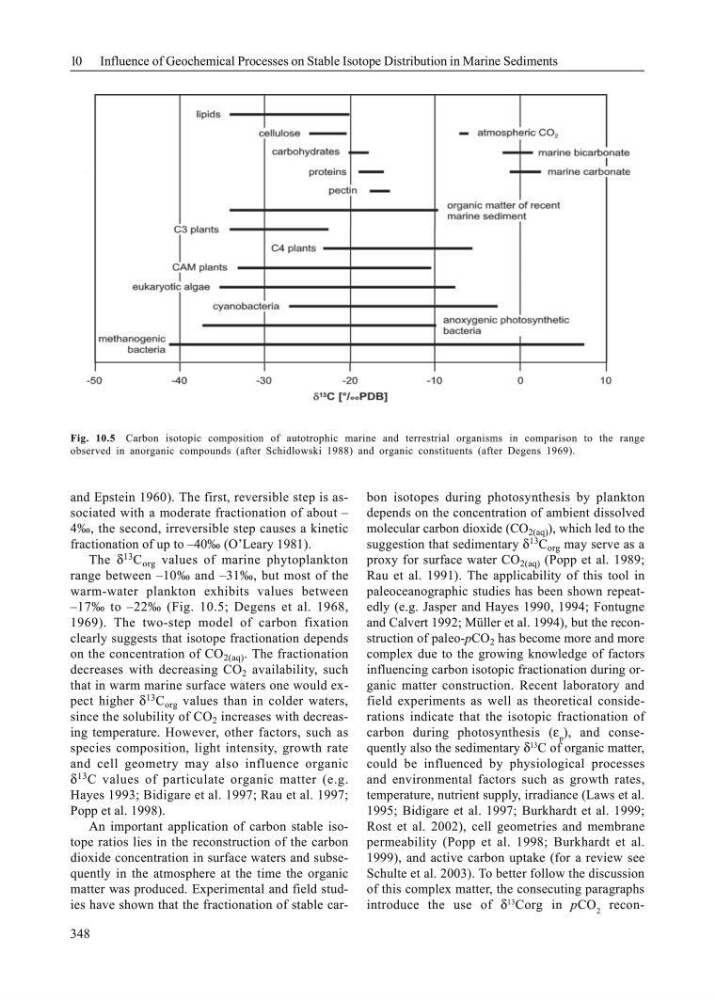
Fig. 10.5 Carbon isotopic composition of autotrophic marine and terrestrial organisms in comparison to the range
observed in anorganic compounds (after Schidlowski 1988) and organic constituents (after Degens 1969).
bon isotopes during photosynthesis by plankton
depends on the concentration of ambient dissolved
molecular carbon dioxide (CO 2(aq) ), which led to the
suggestion that sedimentary δ 13 C org may serve as a
proxy for surface water CO 2(aq) (Popp et al. 1989;
Rau et al. 1991). The applicability of this tool in
paleoceanographic studies has been shown repeatedly (e.g. Jasper and Hayes 1990, 1994; Fontugne
and Calvert 1992; Müller et al. 1994), but the reconstruction of paleo-pCO 2 has become more and more
complex due to the growing knowledge of factors
influencing carbon isotopic fractionation during organic matter construction. Recent laboratory and
field experiments as well as theoretical considerations indicate that the isotopic fractionation of
carbon during photosynthesis (ε p ), and consequently also the sedimentary δ
13
C of organic matter,
could be influenced by physiological processes
and environmental factors such as growth rates,
temperature, nutrient supply, irradiance (Laws et al.
1995; Bidigare et al. 1997; Burkhardt et al. 1999;
Rost et al. 2002), cell geometries and membrane
permeability (Popp et al. 1998; Burkhardt et al.
1999), and active carbon uptake (for a review see
Schulte et al. 2003). To better follow the discussion
of this complex matter, the consecuting paragraphs
introduce the use of δ
13
Corg in pCO 2 reconand Epstein 1960). The first, reversible step is associated with a moderate fractionation of about –
4‰, the second, irreversible step causes a kinetic
fractionation of up to –40‰ (O’Leary 1981).
The δ 13 C org values of marine phytoplankton
range between –10‰ and –31‰, but most of the
warm-water plankton exhibits values between
–17‰ to –22‰ (Fig. 10.5; Degens et al. 1968,
1969). The two-step model of carbon fixation
clearly suggests that isotope fractionation depends
on the concentration of CO 2(aq) . The fractionation
decreases with decreasing CO 2 availability, such
that in warm marine surface waters one would expect higher δ 13 C org values than in colder waters,
since the solubility of CO 2 increases with decreasing temperature. However, other factors, such as
species composition, light intensity, growth rate
and cell geometry may also influence organic
δ 13 C values of particulate organic matter (e.g.
Hayes 1993; Bidigare et al. 1997; Rau et al. 1997;
Popp et al. 1998).
An important application of carbon stable isotope ratios lies in the reconstruction of the carbon
dioxide concentration in surface waters and subsequently in the atmosphere at the time the organic
matter was produced. Experimental and field studies have shown that the fractionation of stable car-
348
Fig. 10.5 Carbon isotopic composition of autotrophic marine and terrestrial organisms in comparison to the range
observed in anorganic compounds (after Schidlowski 1988) and organic constituents (after Degens 1969).
bon isotopes during photosynthesis by plankton
depends on the concentration of ambient dissolved
molecular carbon dioxide (CO 2(aq) ), which led to the
suggestion that sedimentary δ 13 C org may serve as a
proxy for surface water CO 2(aq) (Popp et al. 1989;
Rau et al. 1991). The applicability of this tool in
paleoceanographic studies has been shown repeatedly (e.g. Jasper and Hayes 1990, 1994; Fontugne
and Calvert 1992; Müller et al. 1994), but the reconstruction of paleo-pCO 2 has become more and more
complex due to the growing knowledge of factors
influencing carbon isotopic fractionation during organic matter construction. Recent laboratory and
field experiments as well as theoretical considerations indicate that the isotopic fractionation of
carbon during photosynthesis (ε p ), and consequently also the sedimentary δ
13
C of organic matter,
could be influenced by physiological processes
and environmental factors such as growth rates,
temperature, nutrient supply, irradiance (Laws et al.
1995; Bidigare et al. 1997; Burkhardt et al. 1999;
Rost et al. 2002), cell geometries and membrane
permeability (Popp et al. 1998; Burkhardt et al.
1999), and active carbon uptake (for a review see
Schulte et al. 2003). To better follow the discussion
of this complex matter, the consecuting paragraphs
introduce the use of δ
13
Corg in pCO 2 reconand Epstein 1960). The first, reversible step is associated with a moderate fractionation of about –
4‰, the second, irreversible step causes a kinetic
fractionation of up to –40‰ (O’Leary 1981).
The δ 13 C org values of marine phytoplankton
range between –10‰ and –31‰, but most of the
warm-water plankton exhibits values between
–17‰ to –22‰ (Fig. 10.5; Degens et al. 1968,
1969). The two-step model of carbon fixation
clearly suggests that isotope fractionation depends
on the concentration of CO 2(aq) . The fractionation
decreases with decreasing CO 2 availability, such
that in warm marine surface waters one would expect higher δ 13 C org values than in colder waters,
since the solubility of CO 2 increases with decreasing temperature. However, other factors, such as
species composition, light intensity, growth rate
and cell geometry may also influence organic
δ 13 C values of particulate organic matter (e.g.
Hayes 1993; Bidigare et al. 1997; Rau et al. 1997;
Popp et al. 1998).
An important application of carbon stable isotope ratios lies in the reconstruction of the carbon
dioxide concentration in surface waters and subsequently in the atmosphere at the time the organic
matter was produced. Experimental and field studies have shown that the fractionation of stable car-