

9
Marine Carbonates: Their Formation and Destruction
326
ocean is already dissolved in the upper 1000 m of
the ocean. On the other hand, if calcite
dissolution above lysocline depths due to benthic
respiration of organic matter (e.g. Emerson and
Bender 1981; see also discussion and references
below) is much higher as previously thought, then
the fraction of pelagic carbonate production
which reaches the sea floor prior to benthic
respiration maybe in the order of 50 to 70 % and
not only about 20 % as given in Table 9.6 for the
more recent budget estimates. According to
Archer (1996b) 20-30 % of the carbonate flux to
the sea floor finally escapes dissolution. If this is
correct, it would require a much less total
carbonate production in the surface ocean (in the
order of the estimate of Milliman (1993); see Table
9.6), to maintain measured water column profiles of
alkalinity and total dissolved inorganic carbon, as
well as 11⋅10
12
mol yr
-1
of pelagic carbonate sedimentation. To solve the problem whether high
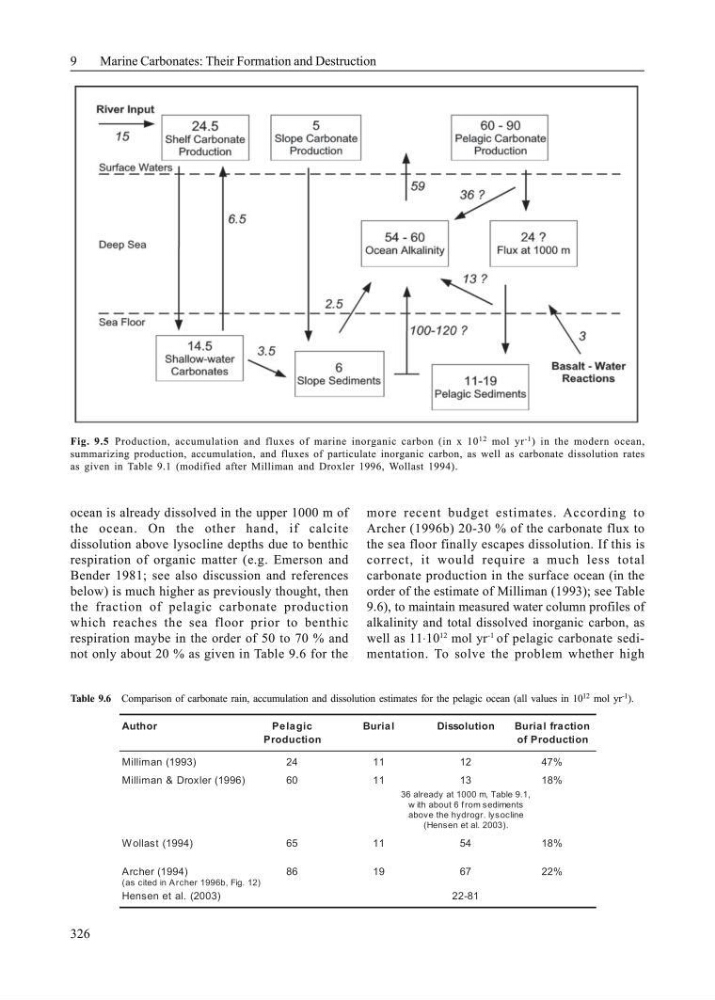
Fig. 9.5 Production, accumulation and fluxes of marine inorganic carbon (in x 10 12 mol yr -1 ) in the modern ocean,
summarizing production, accumulation, and fluxes of particulate inorganic carbon, as well as carbonate dissolution rates
as given in Table 9.1 (modified after Milliman and Droxler 1996, Wollast 1994).
Table 9.6 Comparison of carbonate rain, accumulation and dissolution estimates for the pelagic ocean (all values in 10 12 mol yr -1 ).
Author
Pelagic
Burial
Dissolution
Burial fraction
Production
of Production
Milliman (1993)
24
11
12
47%
Milliman & Droxler (1996)
60
11
13
18%
36 already at 1000 m, Table 9.1,
w ith about 6 f rom sediments
above the hydrogr. lysocline
(Hensen et al. 2003).
W ollast (1994)
65
11
54
18%
Archer (1994)
86
19
67
22%
(as cited in A rcher 1996b, Fig. 12)
Hensen et al. (2003)
22-81
Marine Carbonates: Their Formation and Destruction
326
ocean is already dissolved in the upper 1000 m of
the ocean. On the other hand, if calcite
dissolution above lysocline depths due to benthic
respiration of organic matter (e.g. Emerson and
Bender 1981; see also discussion and references
below) is much higher as previously thought, then
the fraction of pelagic carbonate production
which reaches the sea floor prior to benthic
respiration maybe in the order of 50 to 70 % and
not only about 20 % as given in Table 9.6 for the
more recent budget estimates. According to
Archer (1996b) 20-30 % of the carbonate flux to
the sea floor finally escapes dissolution. If this is
correct, it would require a much less total
carbonate production in the surface ocean (in the
order of the estimate of Milliman (1993); see Table
9.6), to maintain measured water column profiles of
alkalinity and total dissolved inorganic carbon, as
well as 11⋅10
12
mol yr
-1
of pelagic carbonate sedimentation. To solve the problem whether high
Fig. 9.5 Production, accumulation and fluxes of marine inorganic carbon (in x 10 12 mol yr -1 ) in the modern ocean,
summarizing production, accumulation, and fluxes of particulate inorganic carbon, as well as carbonate dissolution rates
as given in Table 9.1 (modified after Milliman and Droxler 1996, Wollast 1994).
Table 9.6 Comparison of carbonate rain, accumulation and dissolution estimates for the pelagic ocean (all values in 10 12 mol yr -1 ).
Author
Pelagic
Burial
Dissolution
Burial fraction
Production
of Production
Milliman (1993)
24
11
12
47%
Milliman & Droxler (1996)
60
11
13
18%
36 already at 1000 m, Table 9.1,
w ith about 6 f rom sediments
above the hydrogr. lysocline
(Hensen et al. 2003).
W ollast (1994)
65
11
54
18%
Archer (1994)
86
19
67
22%
(as cited in A rcher 1996b, Fig. 12)
Hensen et al. (2003)
22-81