

9
Marine Carbonates: Their Formation and Destruction
322
analytical evidence, obviously permanent by its
nature, due to the processes in the surface-near
ocean water and the fluxes across the interface
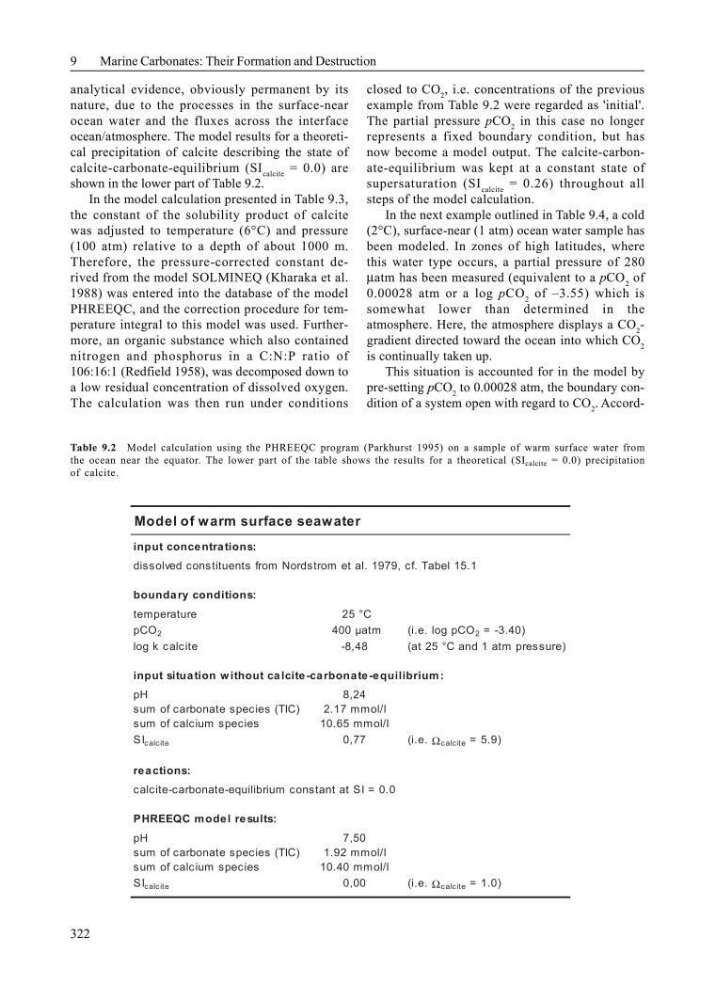
ocean/atmosphere. The model results for a theoretical precipitation of calcite describing the state of
calcite-carbonate-equilibrium (SI calcite = 0.0) are
shown in the lower part of Table 9.2.
In the model calculation presented in Table 9.3,
the constant of the solubility product of calcite
was adjusted to temperature (6°C) and pressure
(100 atm) relative to a depth of about 1000 m.
Therefore, the pressure-corrected constant derived from the model SOLMINEQ (Kharaka et al.
1988) was entered into the database of the model
PHREEQC, and the correction procedure for temperature integral to this model was used. Furthermore, an organic substance which also contained
nitrogen and phosphorus in a C:N:P ratio of
106:16:1 (Redfield 1958), was decomposed down to
a low residual concentration of dissolved oxygen.
The calculation was then run under conditions
closed to CO 2 , i.e. concentrations of the previous
example from Table 9.2 were regarded as 'initial'.
The partial pressure pCO 2 in this case no longer
represents a fixed boundary condition, but has
now become a model output. The calcite-carbonate-equilibrium was kept at a constant state of
supersaturation (SI calcite = 0.26) throughout all
steps of the model calculation.
In the next example outlined in Table 9.4, a cold
(2°C), surface-near (1 atm) ocean water sample has
been modeled. In zones of high latitudes, where
this water type occurs, a partial pressure of 280
µatm has been measured (equivalent to a pCO 2 of
0.00028 atm or a log pCO 2 of –3.55) which is
somewhat lower than determined in the
atmosphere. Here, the atmosphere displays a CO 2 -
gradient directed toward the ocean into which CO 2
is continually taken up.
This situation is accounted for in the model by
pre-setting pCO 2 to 0.00028 atm, the boundary condition of a system open with regard to CO 2 . AccordTable 9.2 Model calculation using the PHREEQC program (Parkhurst 1995) on a sample of warm surface water from
the ocean near the equator. The lower part of the table shows the results for a theoretical (SI calcite = 0.0) precipitation
of calcite.
Model of w arm surface seawater
input concentrations:
dissolved constituents from Nordstrom et al. 1979, cf. Tabel 15.1
bounda ry conditions:
temperature
25 °C
pCO 2
400 µatm
(i.e. log pCO 2 = -3.40)
log k calcite
-8,48
(at 25 °C and 1 atm pressure)
input situa tion w ithout ca lcite -ca rbona te -e quilibrium :
pH
8,24
sum of carbonate species (TIC)
2.17 mmol/l
sum of calcium species
10.65 mmol/l
SI calcite
0,77
(i.e. Ωcalcite = 5.9)
reactions:
calcite-carbonate-equilibrium constant at SI = 0.0
PHREEQC m ode l re sults:
pH
7,50
sum of carbonate species (TIC)
1.92 mmol/l
sum of calcium species
10.40 mmol/l
SI calcite
0,00
(i.e. Ωcalcite = 1.0)
Marine Carbonates: Their Formation and Destruction
322
analytical evidence, obviously permanent by its
nature, due to the processes in the surface-near
ocean water and the fluxes across the interface
ocean/atmosphere. The model results for a theoretical precipitation of calcite describing the state of
calcite-carbonate-equilibrium (SI calcite = 0.0) are
shown in the lower part of Table 9.2.
In the model calculation presented in Table 9.3,
the constant of the solubility product of calcite
was adjusted to temperature (6°C) and pressure
(100 atm) relative to a depth of about 1000 m.
Therefore, the pressure-corrected constant derived from the model SOLMINEQ (Kharaka et al.
1988) was entered into the database of the model
PHREEQC, and the correction procedure for temperature integral to this model was used. Furthermore, an organic substance which also contained
nitrogen and phosphorus in a C:N:P ratio of
106:16:1 (Redfield 1958), was decomposed down to
a low residual concentration of dissolved oxygen.
The calculation was then run under conditions
closed to CO 2 , i.e. concentrations of the previous
example from Table 9.2 were regarded as 'initial'.
The partial pressure pCO 2 in this case no longer
represents a fixed boundary condition, but has
now become a model output. The calcite-carbonate-equilibrium was kept at a constant state of
supersaturation (SI calcite = 0.26) throughout all
steps of the model calculation.
In the next example outlined in Table 9.4, a cold
(2°C), surface-near (1 atm) ocean water sample has
been modeled. In zones of high latitudes, where
this water type occurs, a partial pressure of 280
µatm has been measured (equivalent to a pCO 2 of
0.00028 atm or a log pCO 2 of –3.55) which is
somewhat lower than determined in the
atmosphere. Here, the atmosphere displays a CO 2 -
gradient directed toward the ocean into which CO 2
is continually taken up.
This situation is accounted for in the model by
pre-setting pCO 2 to 0.00028 atm, the boundary condition of a system open with regard to CO 2 . AccordTable 9.2 Model calculation using the PHREEQC program (Parkhurst 1995) on a sample of warm surface water from
the ocean near the equator. The lower part of the table shows the results for a theoretical (SI calcite = 0.0) precipitation
of calcite.
Model of w arm surface seawater
input concentrations:
dissolved constituents from Nordstrom et al. 1979, cf. Tabel 15.1
bounda ry conditions:
temperature
25 °C
pCO 2
400 µatm
(i.e. log pCO 2 = -3.40)
log k calcite
-8,48
(at 25 °C and 1 atm pressure)
input situa tion w ithout ca lcite -ca rbona te -e quilibrium :
pH
8,24
sum of carbonate species (TIC)
2.17 mmol/l
sum of calcium species
10.65 mmol/l
SI calcite
0,77
(i.e. Ωcalcite = 5.9)
reactions:
calcite-carbonate-equilibrium constant at SI = 0.0
PHREEQC m ode l re sults:
pH
7,50
sum of carbonate species (TIC)
1.92 mmol/l
sum of calcium species
10.40 mmol/l
SI calcite
0,00
(i.e. Ωcalcite = 1.0)