

8
Sulfur Cycling and Methane Oxidation
296
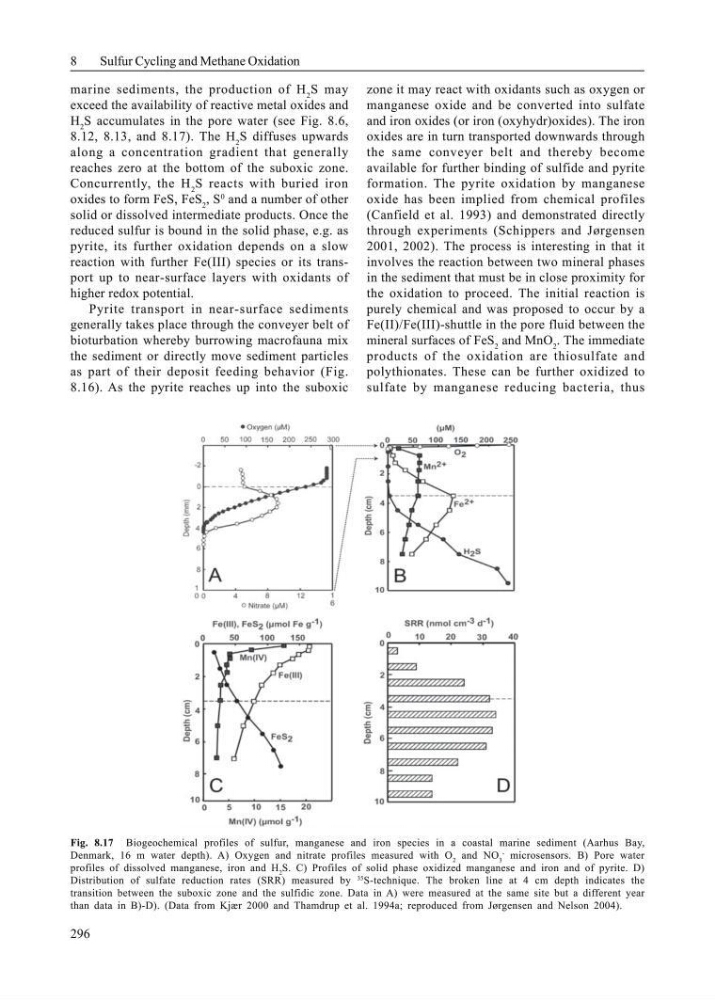
marine sediments, the production of H 2 S may
exceed the availability of reactive metal oxides and
H 2 S accumulates in the pore water (see Fig. 8.6,
8.12, 8.13, and 8.17). The H 2 S diffuses upwards
along a concentration gradient that generally
reaches zero at the bottom of the suboxic zone.
Concurrently, the H 2 S reacts with buried iron
oxides to form FeS, FeS 2 , S
0
and a number of other
solid or dissolved intermediate products. Once the
reduced sulfur is bound in the solid phase, e.g. as
pyrite, its further oxidation depends on a slow
reaction with further Fe(III) species or its transport up to near-surface layers with oxidants of
higher redox potential.
Pyrite transport in near-surface sediments
generally takes place through the conveyer belt of
bioturbation whereby burrowing macrofauna mix
the sediment or directly move sediment particles
as part of their deposit feeding behavior (Fig.
8.16). As the pyrite reaches up into the suboxic
zone it may react with oxidants such as oxygen or
manganese oxide and be converted into sulfate
and iron oxides (or iron (oxyhydr)oxides). The iron
oxides are in turn transported downwards through
the same conveyer belt and thereby become
available for further binding of sulfide and pyrite
formation. The pyrite oxidation by manganese
oxide has been implied from chemical profiles
(Canfield et al. 1993) and demonstrated directly
through experiments (Schippers and Jørgensen
2001, 2002). The process is interesting in that it
involves the reaction between two mineral phases
in the sediment that must be in close proximity for
the oxidation to proceed. The initial reaction is
purely chemical and was proposed to occur by a
Fe(II)/Fe(III)-shuttle in the pore fluid between the
mineral surfaces of FeS 2 and MnO 2 . The immediate
products of the oxidation are thiosulfate and
polythionates. These can be further oxidized to
sulfate by manganese reducing bacteria, thus
Fig. 8.17 Biogeochemical profiles of sulfur, manganese and iron species in a coastal marine sediment (Aarhus Bay,
Denmark, 16 m water depth). A) Oxygen and nitrate profiles measured with O 2 and NO 3
- microsensors. B) Pore water
profiles of dissolved manganese, iron and H 2 S. C) Profiles of solid phase oxidized manganese and iron and of pyrite. D)
Distribution of sulfate reduction rates (SRR) measured by
35 S-technique. The broken line at 4 cm depth indicates the
transition between the suboxic zone and the sulfidic zone. Data in A) were measured at the same site but a different year
than data in B)-D). (Data from Kjær 2000 and Thamdrup et al. 1994a; reproduced from Jørgensen and Nelson 2004).
Sulfur Cycling and Methane Oxidation
296
marine sediments, the production of H 2 S may
exceed the availability of reactive metal oxides and
H 2 S accumulates in the pore water (see Fig. 8.6,
8.12, 8.13, and 8.17). The H 2 S diffuses upwards
along a concentration gradient that generally
reaches zero at the bottom of the suboxic zone.
Concurrently, the H 2 S reacts with buried iron
oxides to form FeS, FeS 2 , S
0
and a number of other
solid or dissolved intermediate products. Once the
reduced sulfur is bound in the solid phase, e.g. as
pyrite, its further oxidation depends on a slow
reaction with further Fe(III) species or its transport up to near-surface layers with oxidants of
higher redox potential.
Pyrite transport in near-surface sediments
generally takes place through the conveyer belt of
bioturbation whereby burrowing macrofauna mix
the sediment or directly move sediment particles
as part of their deposit feeding behavior (Fig.
8.16). As the pyrite reaches up into the suboxic
zone it may react with oxidants such as oxygen or
manganese oxide and be converted into sulfate
and iron oxides (or iron (oxyhydr)oxides). The iron
oxides are in turn transported downwards through
the same conveyer belt and thereby become
available for further binding of sulfide and pyrite
formation. The pyrite oxidation by manganese
oxide has been implied from chemical profiles
(Canfield et al. 1993) and demonstrated directly
through experiments (Schippers and Jørgensen
2001, 2002). The process is interesting in that it
involves the reaction between two mineral phases
in the sediment that must be in close proximity for
the oxidation to proceed. The initial reaction is
purely chemical and was proposed to occur by a
Fe(II)/Fe(III)-shuttle in the pore fluid between the
mineral surfaces of FeS 2 and MnO 2 . The immediate
products of the oxidation are thiosulfate and
polythionates. These can be further oxidized to
sulfate by manganese reducing bacteria, thus
Fig. 8.17 Biogeochemical profiles of sulfur, manganese and iron species in a coastal marine sediment (Aarhus Bay,
Denmark, 16 m water depth). A) Oxygen and nitrate profiles measured with O 2 and NO 3
- microsensors. B) Pore water
profiles of dissolved manganese, iron and H 2 S. C) Profiles of solid phase oxidized manganese and iron and of pyrite. D)
Distribution of sulfate reduction rates (SRR) measured by
35 S-technique. The broken line at 4 cm depth indicates the
transition between the suboxic zone and the sulfidic zone. Data in A) were measured at the same site but a different year
than data in B)-D). (Data from Kjær 2000 and Thamdrup et al. 1994a; reproduced from Jørgensen and Nelson 2004).