

295
in detectable concentrations. The metal oxides
constitute an efficient sulfide barrier by oxidizing
and binding H 2 S that diffuses up from the sulfidic
sediment below. In this case, H 2 S oxidation by
oxygen is the exception and requires that the
metal oxide layer is penetrated by advective
transport, for example by bioirrigation by burrowing animals that pump oxic water for respiration directly down into the sulfidic sediment.
Another advective mechanism may be currentinduced advective pore water transport in porous
sandy sediments (Huettel et al. 1998), or oxygen
transport down into the root zone of sea grass
beds (Ballbjerg et al. 1998). Through such oxygen
penetration also pyrite may be oxidized with
oxygen, a process that has been extensively
studied (e.g. Lowson 1982; Luther 1987; Moses
and Herman 1991; Morse 1991). Pyrite oxidation
with O 2 is a rather fast process that may be purely
abiotic, catalyzed by an electron shuttle between
adsorbed Fe(II) and Fe(III) ions transferring
electrons from pyrite to O 2 . Sulfate is the end
product of the sulfur oxidation and iron oxides
often coat the surface of the oxidized pyrite
grains.
Most sulfide oxidation in marine sediments is
anoxic (i.e. takes place in the absence of oxygen)
and generally involves the precipitation of iron
sulfide and the subsequent oxidation of ironsulfur minerals back to sulfate. Evidence for
anoxic sulfide oxidation comes from studies of
pore water chemistry, solid phase distributions of
metal oxides and sulfides, mass balance calculations, and direct experiments. By the use of radiolabeled H 2 S added to anoxic sediment cores or
slurries, a rapid transfer of the label could be
observed into sulfur fractions defined as acid
volatile sulfide (mostly FeS), chromium reducible
sulfide (mostly FeS 2 ), elemental sulfur (S
0
), or
sulfate (Fossing and Jørgensen 1990). The
radiolabeled FeS and S
0
were readily oxidized to
sulfate in the anoxic sediment. Pyrite, in contrast,
is more stable and is oxidized only over longer
incubations. Yet, pyrite comprises the main sulfur
pool in marine sediments and undergoes slow
transport and oxidation of critical importance for
the sulfur cycle.
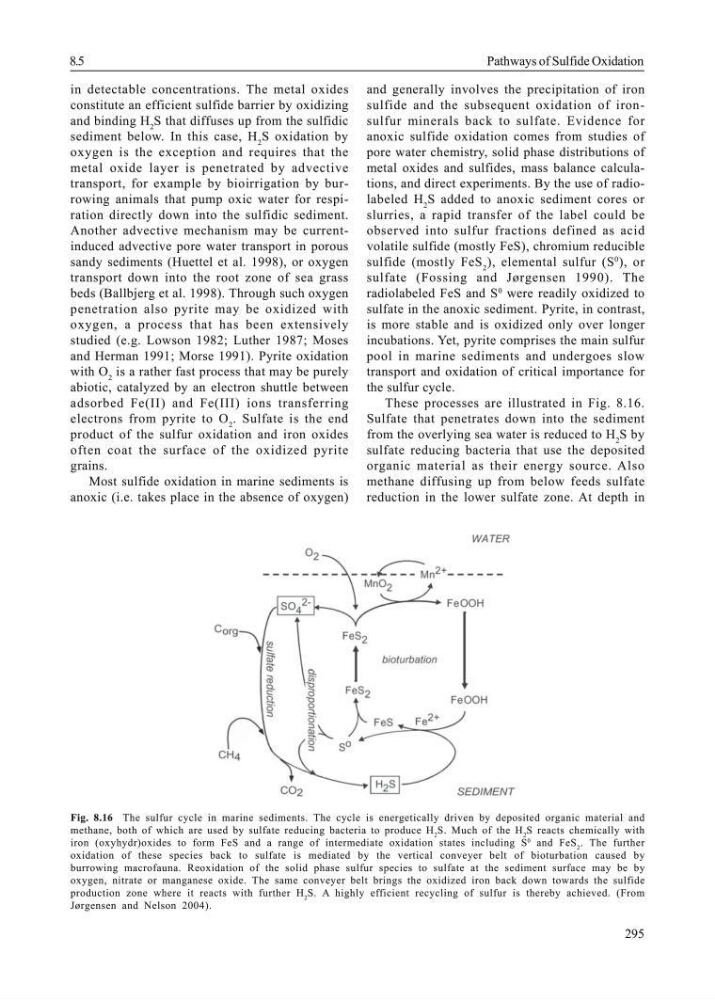
These processes are illustrated in Fig. 8.16.
Sulfate that penetrates down into the sediment
from the overlying sea water is reduced to H 2 S by
sulfate reducing bacteria that use the deposited
organic material as their energy source. Also
methane diffusing up from below feeds sulfate
reduction in the lower sulfate zone. At depth in
Fig. 8.16 The sulfur cycle in marine sediments. The cycle is energetically driven by deposited organic material and
methane, both of which are used by sulfate reducing bacteria to produce H 2 S. Much of the H 2 S reacts chemically with
iron (oxyhydr)oxides to form FeS and a range of intermediate oxidation states including S
0 and FeS 2 . The further
oxidation of these species back to sulfate is mediated by the vertical conveyer belt of bioturbation caused by
burrowing macrofauna. Reoxidation of the solid phase sulfur species to sulfate at the sediment surface may be by
oxygen, nitrate or manganese oxide. The same conveyer belt brings the oxidized iron back down towards the sulfide
production zone where it reacts with further H 2 S. A highly efficient recycling of sulfur is thereby achieved. (From
Jørgensen and Nelson 2004).
8.5
Pathways of Sulfide Oxidation
in detectable concentrations. The metal oxides
constitute an efficient sulfide barrier by oxidizing
and binding H 2 S that diffuses up from the sulfidic
sediment below. In this case, H 2 S oxidation by
oxygen is the exception and requires that the
metal oxide layer is penetrated by advective
transport, for example by bioirrigation by burrowing animals that pump oxic water for respiration directly down into the sulfidic sediment.
Another advective mechanism may be currentinduced advective pore water transport in porous
sandy sediments (Huettel et al. 1998), or oxygen
transport down into the root zone of sea grass
beds (Ballbjerg et al. 1998). Through such oxygen
penetration also pyrite may be oxidized with
oxygen, a process that has been extensively
studied (e.g. Lowson 1982; Luther 1987; Moses
and Herman 1991; Morse 1991). Pyrite oxidation
with O 2 is a rather fast process that may be purely
abiotic, catalyzed by an electron shuttle between
adsorbed Fe(II) and Fe(III) ions transferring
electrons from pyrite to O 2 . Sulfate is the end
product of the sulfur oxidation and iron oxides
often coat the surface of the oxidized pyrite
grains.
Most sulfide oxidation in marine sediments is
anoxic (i.e. takes place in the absence of oxygen)
and generally involves the precipitation of iron
sulfide and the subsequent oxidation of ironsulfur minerals back to sulfate. Evidence for
anoxic sulfide oxidation comes from studies of
pore water chemistry, solid phase distributions of
metal oxides and sulfides, mass balance calculations, and direct experiments. By the use of radiolabeled H 2 S added to anoxic sediment cores or
slurries, a rapid transfer of the label could be
observed into sulfur fractions defined as acid
volatile sulfide (mostly FeS), chromium reducible
sulfide (mostly FeS 2 ), elemental sulfur (S
0
), or
sulfate (Fossing and Jørgensen 1990). The
radiolabeled FeS and S
0
were readily oxidized to
sulfate in the anoxic sediment. Pyrite, in contrast,
is more stable and is oxidized only over longer
incubations. Yet, pyrite comprises the main sulfur
pool in marine sediments and undergoes slow
transport and oxidation of critical importance for
the sulfur cycle.
These processes are illustrated in Fig. 8.16.
Sulfate that penetrates down into the sediment
from the overlying sea water is reduced to H 2 S by
sulfate reducing bacteria that use the deposited
organic material as their energy source. Also
methane diffusing up from below feeds sulfate
reduction in the lower sulfate zone. At depth in
Fig. 8.16 The sulfur cycle in marine sediments. The cycle is energetically driven by deposited organic material and
methane, both of which are used by sulfate reducing bacteria to produce H 2 S. Much of the H 2 S reacts chemically with
iron (oxyhydr)oxides to form FeS and a range of intermediate oxidation states including S
0 and FeS 2 . The further
oxidation of these species back to sulfate is mediated by the vertical conveyer belt of bioturbation caused by
burrowing macrofauna. Reoxidation of the solid phase sulfur species to sulfate at the sediment surface may be by
oxygen, nitrate or manganese oxide. The same conveyer belt brings the oxidized iron back down towards the sulfide
production zone where it reacts with further H 2 S. A highly efficient recycling of sulfur is thereby achieved. (From
Jørgensen and Nelson 2004).
8.5
Pathways of Sulfide Oxidation